What is conversational AI? It is artificial intelligence that holds conversations in everyday language. It understands what someone means, even when they put it in their own words, and gives a fitting answer through chat, WhatsApp or voice. Where a traditional chatbot follows a fixed script, conversational AI responds to the question as it is actually asked.
Conversational AI: the meaning in brief
Conversational AI is the umbrella term for technology that lets computers hold a conversation with people that feels natural. The word conversational says it all: this is AI built to talk, not to calculate or create images.
In practice you come across it as a chat window on a website, as an assistant in WhatsApp or as a voice assistant on the phone. For businesses it is mainly about customer contact: answering questions, helping visitors along and capturing enquiries, at any time of day. If you want to see where that pays off in practice, read about AI in business.
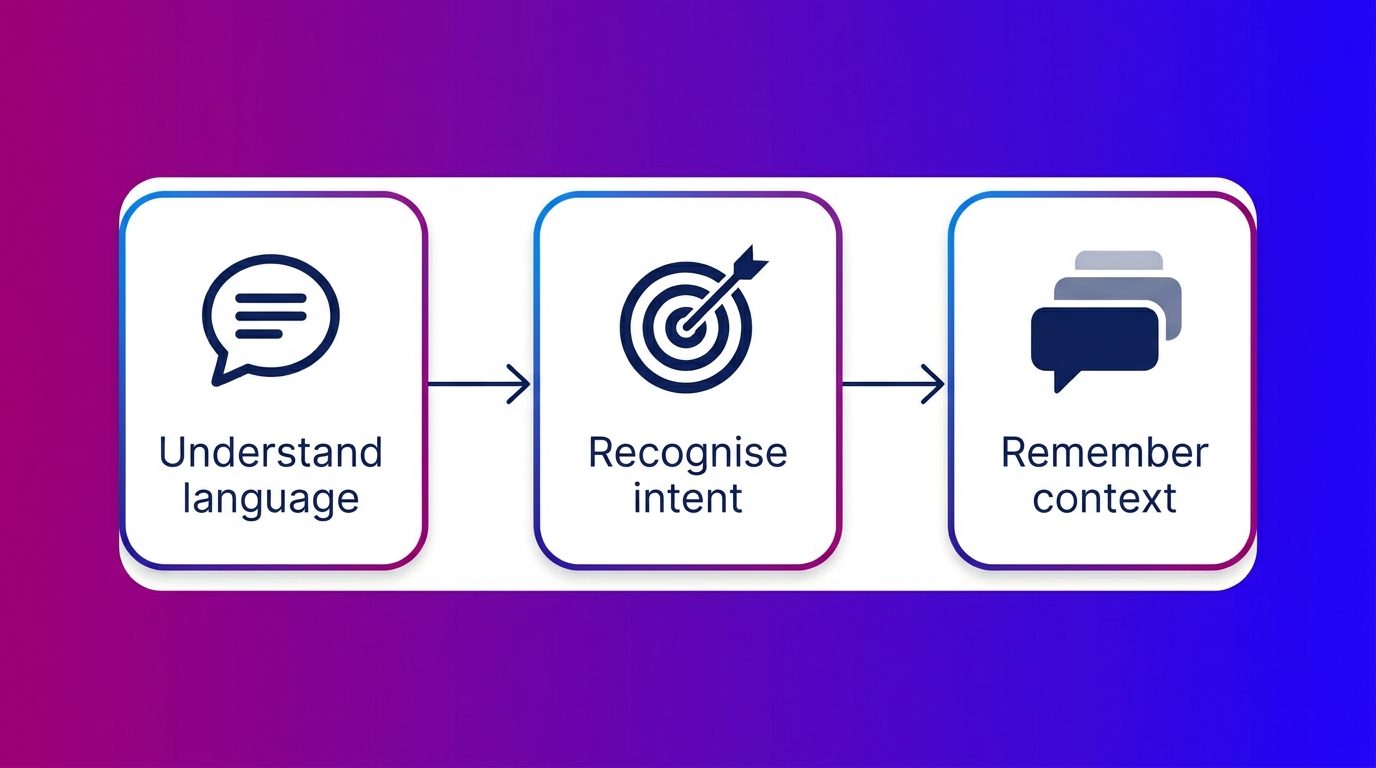
How conversational AI works, in three steps
Conversational AI works in three steps: it understands the language, recognises the intent and remembers the context of the conversation.
- Understanding language. The AI reads what someone writes or says, even with typos, informal language or half sentences. “Have you still got that one in grey?” is simply understood.
- Recognising intent. Every question has a goal behind it. Someone who asks whether a car is still available often wants to book a test drive. The AI recognises that and steers the conversation in that direction.
- Remembering context. A conversation consists of several messages. If someone first asks about a model and then says “and how much is it?”, the AI knows which car is meant.
The AI takes its answer from the information recorded for the business. How that works technically is explained in how conversational AI works.
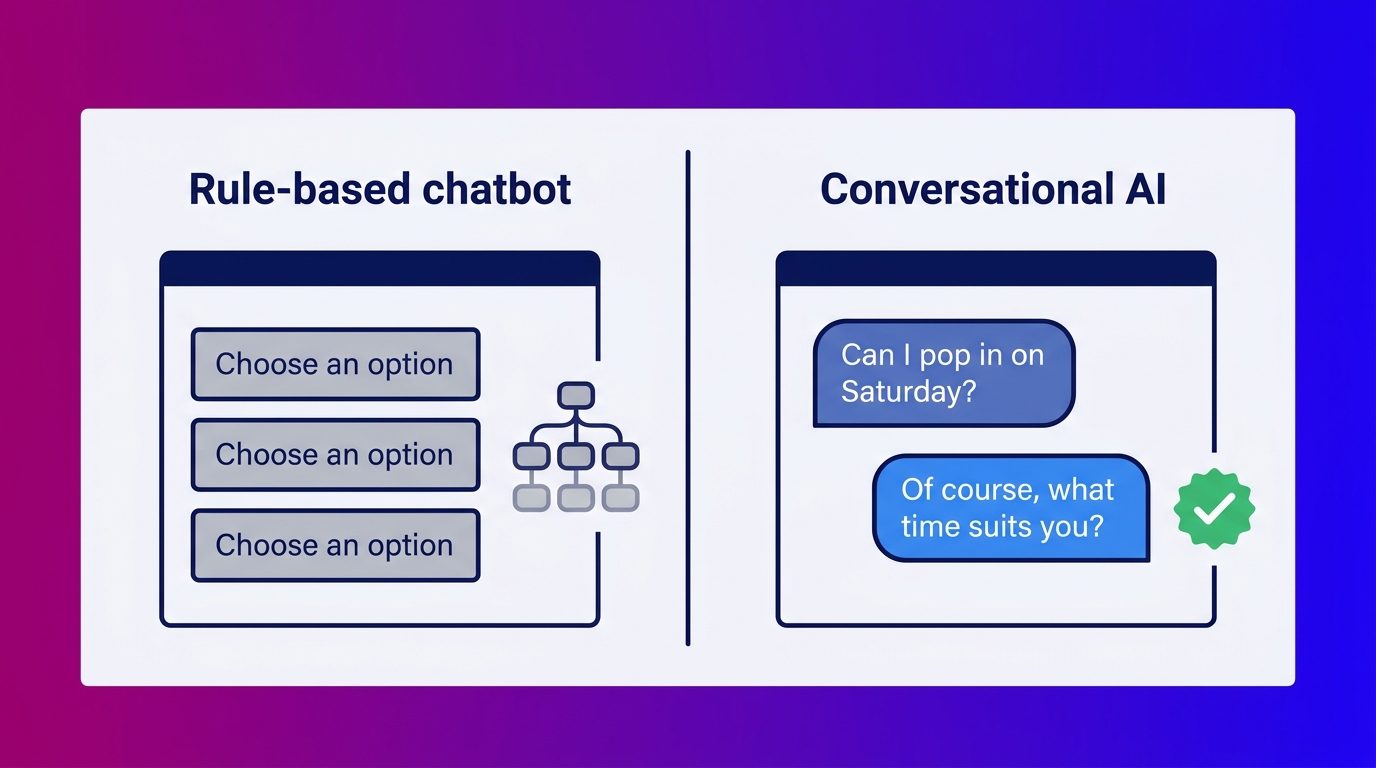
Conversational AI vs a chatbot
The difference between conversational AI and a traditional chatbot lies in understanding: a rule-based chatbot recognises words, conversational AI understands the question. A rule-based chatbot works with buttons, keywords and a decision tree drawn up in advance. If a visitor asks a question that does not fit that tree, the conversation gets stuck.
That is not an edge case. Visitors rarely phrase a question the way the script expects, and the questions that deviate from the standard are often exactly the ones that matter most to them.
In short, the two differ on four points:
- Input. A rule-based chatbot reacts to buttons and keywords; conversational AI reacts to questions in the visitor’s own words.
- Flexibility. A rule-based chatbot follows a fixed route; conversational AI follows the conversation.
- Memory. A rule-based chatbot treats each message separately; conversational AI remembers what was said earlier.
- When it gets stuck. A rule-based chatbot loops back to the menu; well-configured conversational AI says it does not know and hands over to a person.
A rule-based chatbot is not necessarily bad. For a few simple choices, such as “track your parcel” or “choose your branch”, it works fine. As soon as visitors ask real questions, conversational AI is the logical step. You can read more about chatbots in general in what a chatbot is.
What a conversational chatbot can do
A conversational chatbot, meaning a chatbot that runs on conversational AI, can do much more than give fixed answers. These are the main capabilities:
- Answering questions in everyday language, based on the business’s own information.
- Asking follow-up questions until it is clear what someone needs, for example for a quote or an appointment.
- Passing on complete enquiries to the sales team, with the full conversation attached. That turns a chat into a source of leads; see AI lead generation.
- Working in several languages, so a French- or German-speaking visitor is helped straight away too. Read more about the multilingual chatbot.
- Connecting to your systems, such as a CRM, calendar or inbox.
- Handing over to a person when a question is too complex or too sensitive.
The benefits of conversational AI
The biggest benefit of conversational AI is that customers get an answer straight away, at any time, without your team putting in extra hours.
- Always available. In the evening and at the weekend too, when many people are doing their research.
- Instant answers. No queue and no contact form that only gets a reply the next day.
- Scales with demand. Ten conversations at once take the AI as much effort as one.
- More time for your team. Repeat questions are handled, so staff can focus on conversations where their knowledge makes the difference.
- Consistent answers. Every customer gets the same, correct information.
Those benefits only apply if the AI is set up properly. An AI that runs on outdated or incomplete information gives the wrong answer quickly and consistently. How that plays out in customer service is covered in conversational AI for customer service.
Which bottleneck each benefit solves, and when it fails to materialise, is set out in the benefits of conversational AI.
Where conversational AI falls short
Conversational AI falls short on questions that fall outside the recorded knowledge and in conversations that call for empathy. These are the main limits:
- Made-up answers. Language models can give a convincing answer that is wrong. Good configuration makes sure the AI only answers on the basis of the business’s information and says honestly when it does not know something.
- Emotional or complex situations. A complaint, a sensitive question or a complicated bespoke request belongs with a person.
- Privacy. In a chat, customers share personal data. Under UK GDPR that data must be processed lawfully and transparently; the ICO’s guidance on AI and data protection explains what that means for AI systems.
- No route to a person. A chatbot that never admits it does not understand a question leaves the customer stuck.
Transparency is also becoming a legal requirement. Under Article 50 of the EU AI Act, people must be told when they are interacting with an AI system. If you serve customers in the EU, make sure that is clear in the chat window. Good practice goes further: always offer a route to human contact and stay in control of what the chatbot says.
All six disadvantages, with what you can do about each one, are listed in the limitations of conversational AI.
What we see in real conversations
At Bconnect, AI and our chat specialists hold conversations every day for car dealers, kitchen showrooms, window companies and other businesses where customers want to compare and ask questions first. We see the difference between a chatbot and conversational AI there every day.
A visitor rarely types the question that appears in a script. They ask “can I pop in on Saturday to look at the blue one?” or “do you take part-exchanges?”. Conversational AI understands a question like that, answers it and asks for what the salesperson needs: which model, which moment, which part-exchange car.
Just as important is what the AI does not do. If it does not know the answer, it does not make anything up. It announces that a colleague will take over and passes on the conversation with the full context, so the customer does not have to ask their question again. That way AI works where possible and a person helps where needed. If you want to have conversational AI set up for your website, that starts with the questions your customers actually ask.
Conversational AI: not a script, but a conversation
Conversational AI is AI that holds a conversation the way people do: in their own words, with an eye for intent and a memory for what has already been said. That helps customers faster than a rule-based chatbot. Its limits lie in made-up answers, sensitive conversations and privacy, and that is where a person belongs. Whoever combines the two well gets the most out of conversational AI.
Frequently asked questions about conversational AI
What is conversational AI in one sentence?
Conversational AI is artificial intelligence that can hold a conversation in everyday language: it understands what someone means, remembers the context and gives a fitting answer through chat, WhatsApp or voice.
What is the difference between conversational AI and a chatbot?
A traditional chatbot follows fixed rules and only recognises certain words or buttons. Conversational AI understands questions in the visitor’s own words, recognises the intent and remembers what was said earlier in the conversation. A chatbot that runs on conversational AI is also called a conversational chatbot.
Is conversational AI the same as ChatGPT?
No. ChatGPT is one application that runs on a large language model. Conversational AI is the broader umbrella term for technology that holds conversations. For businesses, that technology is set up around their own products, services and processes, so the answers are right for that organisation.
What are the benefits of conversational AI?
The main benefits are that customers always get an answer straight away, that busy periods do not create waiting times and that your team has time left for complex questions. On top of that, every customer gets the same, correct information, provided the AI is set up properly.
What are the disadvantages of conversational AI?
Conversational AI can give a wrong answer if information is missing or incorrect. It is less suited to emotional or complex conversations, and it processes personal data, which calls for care. That is why there should always be a route to a person.
Can conversational AI give wrong answers?
Yes. Language models can give a convincing but incorrect answer. You reduce that risk by having the AI answer only on the basis of your business’s information, by having it say when it does not know something and by reviewing conversations regularly.
Does conversational AI still need people?
Yes. Conversational AI handles many questions on its own, but in complex, sensitive or valuable conversations a person takes over. Customers should always be able to reach a member of staff. The best results come from a combination of AI and people.