The limitations of conversational AI are real, but almost all of them can be managed. Anyone who deploys AI expecting it to solve every question will be disappointed. Anyone who knows its limits can plan around them.
Below you will read the six main disadvantages, what goes wrong if you ignore them and what you can do about each one.
What are the limitations of conversational AI?
The limitations of conversational AI are: difficulty with complex and emotional conversations, the risk of incorrect answers, dependence on good knowledge, privacy risks, the duty to be transparent and the maintenance it requires. Conversational AI is AI that holds conversations in everyday language; what that involves exactly is explained in what is conversational AI.
Some of those disadvantages apply to any chatbot. You can read more about the specific drawbacks of chatbots with fixed answers and menus in the disadvantages of chatbots.
The six disadvantages at a glance
Each disadvantage below starts with what goes wrong and ends with what you do about it.
1. Complex and emotional conversations
Conversational AI is strong on clear, well-defined questions, but weak in conversations that call for empathy. A customer with damage to a car that has just been delivered, or a complaint about a window that was measured incorrectly, does not want a standard answer. Those conversations belong with a person, and the AI must recognise them and pass them on in time.
2. Answers that are wrong
A language model can give an answer that sounds convincing but is wrong. That is called hallucination. A wrong lead time or condition misleads a customer, and what your chatbot says, you say as a business. In the well-known Moffatt v. Air Canada case, a Canadian tribunal held the airline to the incorrect information its chatbot had given. The solution: have the AI answer only from your own knowledge base and have it bring in a person when it is not sure of the answer.
3. Dependent on good knowledge
Conversational AI is only as good as the information you give it. An outdated price list or a missing condition produces wrong or vague answers. The knowledge base must therefore be complete at the start and stay up to date afterwards.
4. Privacy and personal data
Personal data quickly comes up in a customer conversation: a name, a phone number, a registration number. That data falls under UK GDPR. Process no more than necessary and set out the arrangements with your supplier in a written contract; the ICO explains the roles of controllers and processors. The responsibility for the data stays with you.
5. Transparency: the visitor must know
A visitor must know they are talking to AI. Since 2 August 2026, Article 50 of the EU AI Act requires that, unless it is already obvious, for anyone serving customers in the EU. In practice this often goes wrong: many chat windows do not make clear whether a person or an AI is answering.
6. Management takes time
Conversational AI is never finished. Your range, prices and questions change, and without adjustment the quality slowly declines. Count that management as a fixed task. How to approach it is covered in training conversational AI.
What happens when there is no handover
The biggest disadvantage arises when there is no route to a person. Then every limitation of the AI immediately becomes a problem for the customer.
You recognise it straight away: a chatbot that does not admit it has not understood a question and keeps giving the same answer, so the customer ends up in a loop. That costs more trust than a website without a chat.
Good practice is clear: always offer human contact alongside a chatbot, stay in control of what the chatbot says and make clear that someone is talking to AI.
Where it goes wrong for clients in practice
At Bconnect we see that most problems with conversational AI do not come from the technology, but from the setup. Three situations keep coming back.
The first is expecting too much from AI alone. Businesses sometimes choose an AI-only solution because it seems cheaper, and then see that the number of leads is disappointing. AI handles frequently asked questions well, but a visitor considering a kitchen or a car wants advice and someone who asks the right follow-up questions.
The second is a knowledge base that lags behind. A new promotion, a changed lead time or a branch that opens later: if the knowledge base does not know about it, the AI gives an outdated answer.
The third is a handover that is not set up properly. With us, the AI makes nothing up: if it does not know, it announces that it is bringing in a colleague and the conversation goes, with the full context, to a chat specialist or to the client’s own team.
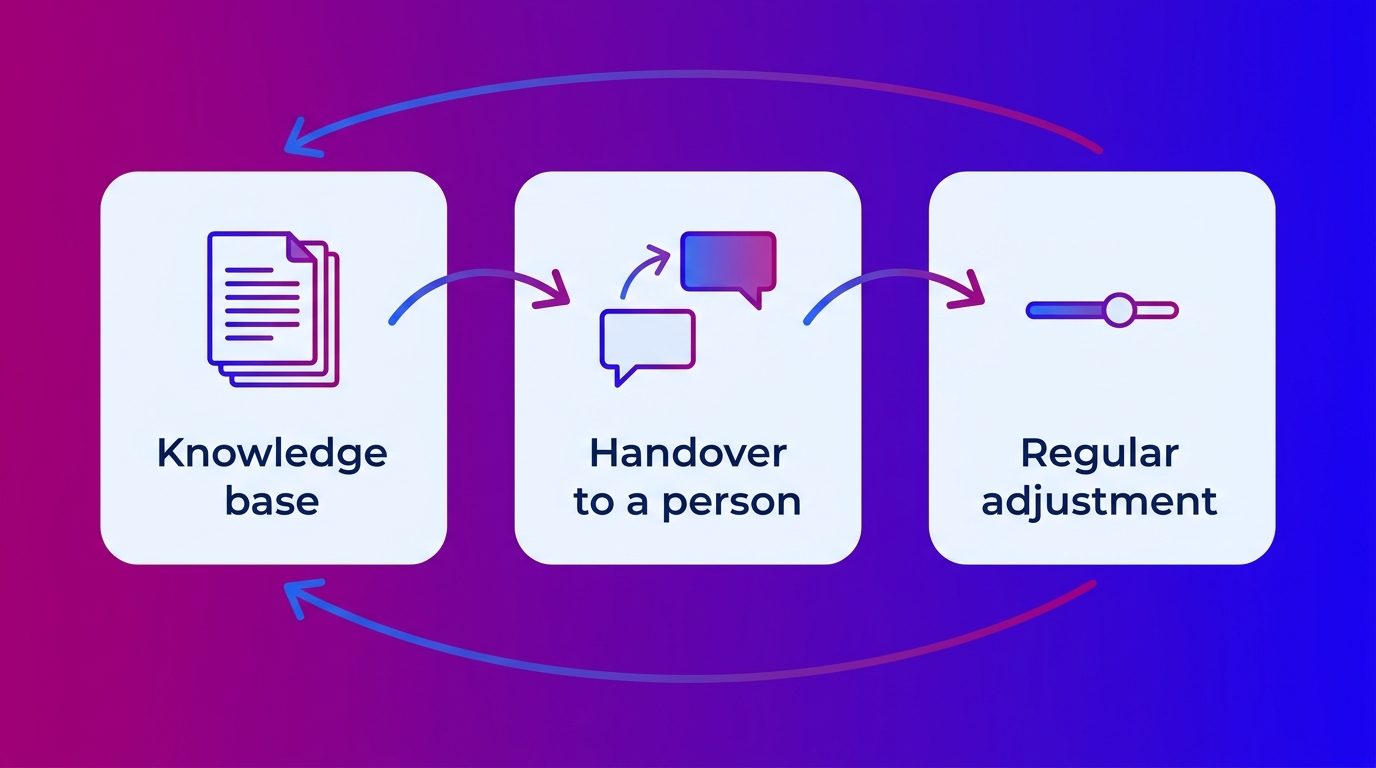
How to manage the disadvantages
You manage the disadvantages of conversational AI with three things: a good knowledge base, a handover to a person and regular adjustment. For each disadvantage, that looks like this:
- Complex and emotional conversations: set clear handover moments, so a person takes over in time.
- Answers that are wrong: let the AI answer only from your knowledge base and bring in a person when in doubt.
- Dependent on good knowledge: start with a complete knowledge base and update it with every change.
- Privacy: process no more data than needed and put a written contract in place with your supplier.
- Transparency: state clearly in the chat window that the visitor is talking to AI.
- Management: review conversations every week and add missing answers.
You choose the balance between AI and people for each situation. At Bconnect we work with three models: Operator Assisted AI, in which a chat specialist holds the conversation with AI support, AI First with handover to a person, and AI Only for predictable questions. A well-configured AI chatbot starts with that choice, not with the technology.
Knowing the limitations means you can plan for them
The limitations of conversational AI are no reason to avoid it, but they are a reason to set it up well. Make sure you have a knowledge base that is correct, a route to a person and someone who keeps adjusting. Then the disadvantages do not outweigh the benefits of conversational AI.
Frequently asked questions about the limitations of conversational AI
What are the limitations of conversational AI?
The main limitations are difficulty with complex and emotional conversations, the risk of incorrect answers, dependence on a good knowledge base, privacy risks, the duty to be transparent and the maintenance it requires. With good configuration, almost all of them can be managed.
Can conversational AI make mistakes?
Yes. A language model can give an answer that sounds convincing but is wrong. You reduce that risk by having the AI answer only from your own knowledge base and bring in a member of staff when in doubt.
Is conversational AI GDPR compliant?
That depends on the setup and the supplier. Process no more personal data than necessary, put a written processing contract in place and check where your supplier processes the data. The responsibility for the data stays with you.
Do I have to tell visitors they are talking to AI?
If you serve customers in the EU, yes. Since 2 August 2026, the EU AI Act requires you to tell users they are interacting with an AI system, unless that is already obvious. Ideally, keep that notice visible throughout the conversation.
Can conversational AI deal with emotions?
To a limited extent. AI can recognise that a customer is angry or disappointed, but real empathy and making an exception remain human work. So have a member of staff take over those conversations.
What happens if the AI does not know the answer?
With a well-configured AI, it announces that it is bringing in a member of staff and the conversation goes to a person with the full context. Without that handover the customer is left stuck, and in practice that is the biggest disadvantage.
Do the benefits outweigh the disadvantages?
For most businesses with many recurring questions or a lot of website traffic, yes, provided the AI is set up properly. The difference lies in an up-to-date knowledge base, a handover to a person and regular adjustment after go-live.