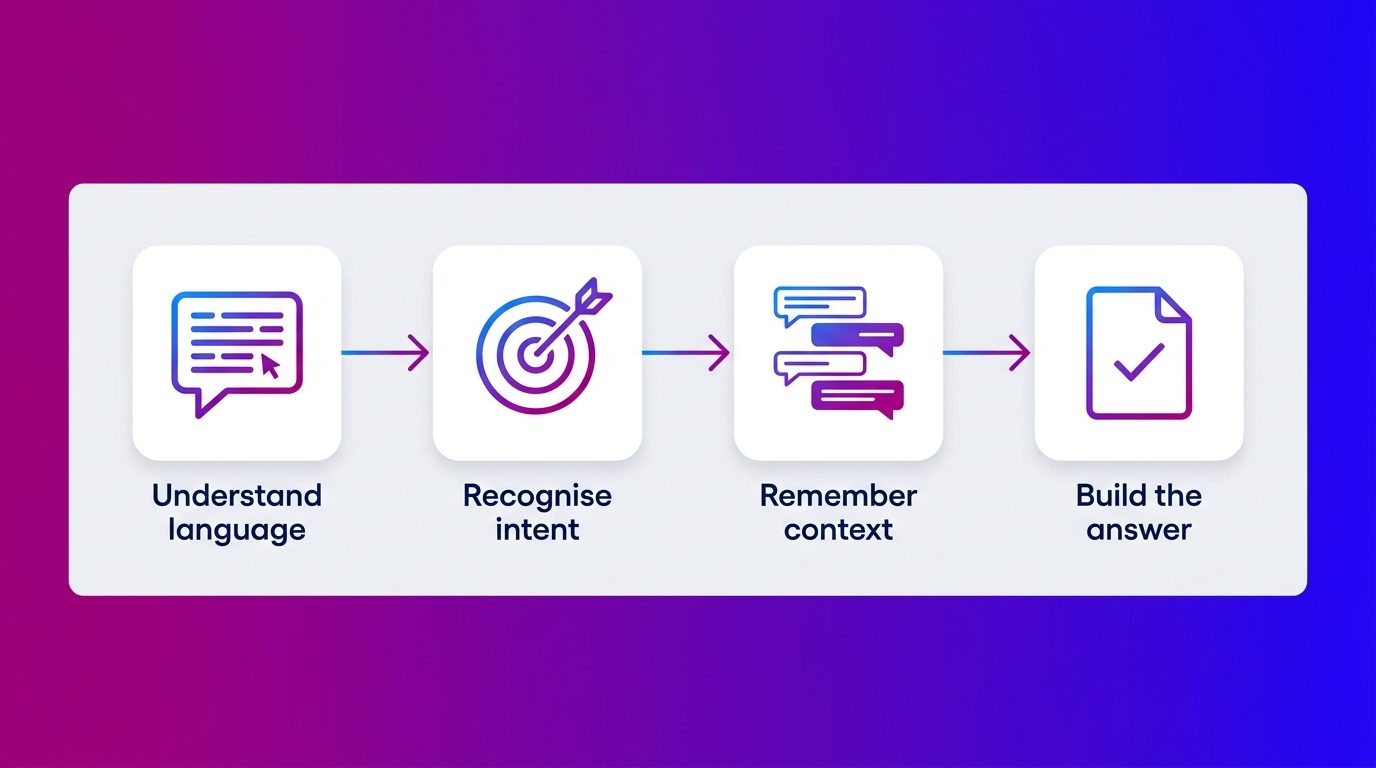
How does conversational AI work? In four steps: it understands the visitor’s language, recognises what they want, remembers what has already been said and takes the answer from the business’s knowledge base. That happens in a few seconds, in everyday language, through chat or WhatsApp. Once you understand how those steps work, you also see where it goes well and where it goes wrong.
How conversational AI works in four steps
Every conversation with conversational AI goes through the same four steps, again with every message.
- Understanding language. The AI reads the message, even if it is full of typos, abbreviations or informal language. “Have u still got that 1 in grey?” is simply understood.
- Recognising intent. The AI works out what the visitor wants to achieve. A question about availability is often the start of a test drive or a quote.
- Remembering context. The AI keeps track of what was said earlier in the conversation. If someone then asks “and how much is it?”, the AI knows which product is meant.
- Building the answer. The AI looks up the right answer in the business’s information and phrases it in everyday language.
What conversational AI is and how it differs from a rule-based chatbot is explained in what is conversational AI.
The role of the language model and the knowledge base
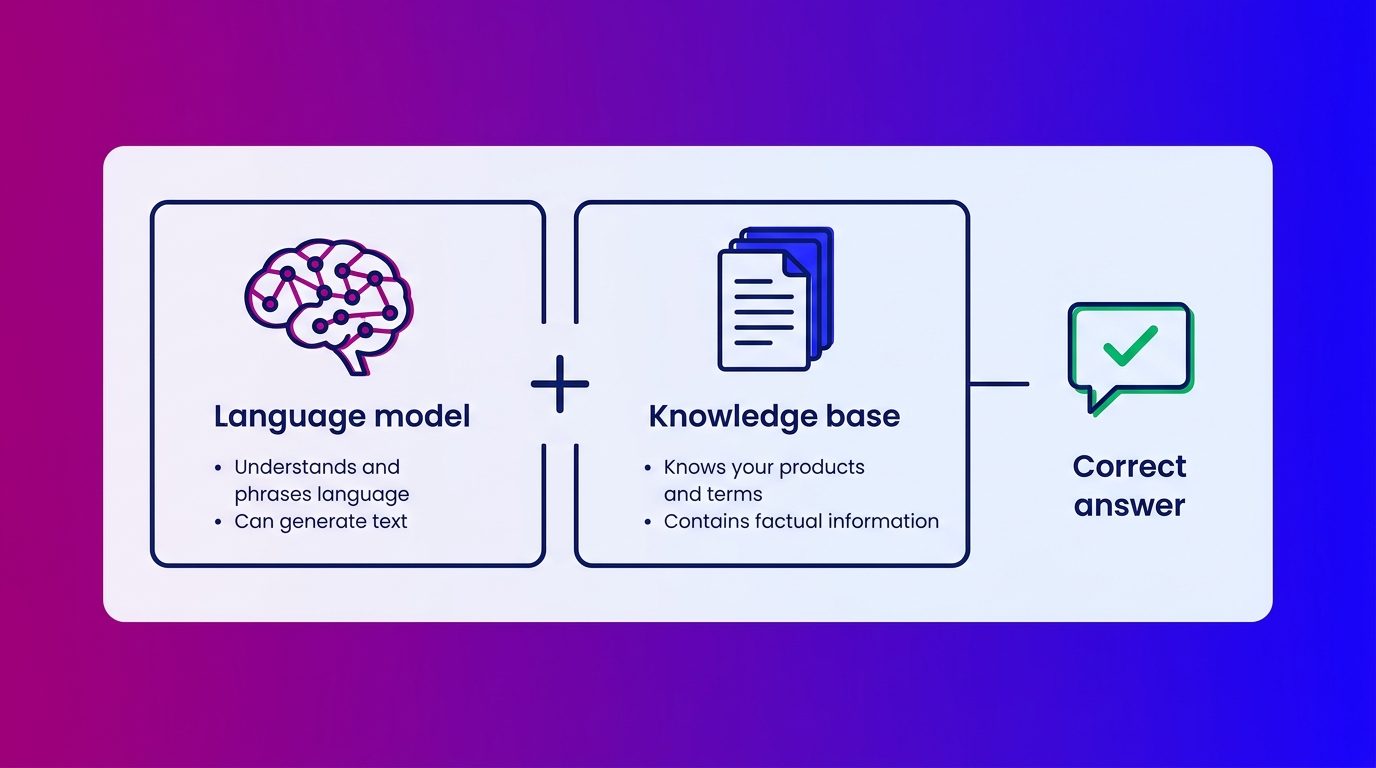
Conversational AI consists of two parts that work together: a language model that understands and phrases language, and a knowledge base that determines what the AI knows.
The language model has been trained on enormous amounts of text. That allows it to understand language and form natural sentences. But the language model knows nothing about your business: not which cars are in stock, not what your lead time is and not when your showroom is open.
That business knowledge comes from the knowledge base: the questions customers ask, the answers your team gives, product information, terms and ways of working. The AI uses the language model to understand the question and phrase the answer, but the content comes from the knowledge base. That is why the quality of the knowledge base largely determines how well the AI answers.
Why conversational AI must not make things up
A language model always gives an answer, even when it does not know the answer. That is the biggest pitfall of conversational AI: a convincing answer that is wrong.
A well-configured AI is therefore set up to answer only on the basis of the knowledge base. If the answer is not in it, it says so honestly and brings in a member of staff. That is less spectacular than an AI that has an answer for everything, but it prevents a customer from being given the wrong price, lead time or condition.
The rest of the conversation has limits too. The AI makes no promises the business cannot keep, does not draw up quotes and does not negotiate. That stays with the sales team.
When a person takes over
A person takes over the conversation as soon as the question falls outside the knowledge base, the conversation becomes sensitive or the customer asks for it. You agree in advance when that happens.
What matters is how the handover works. The AI announces that a colleague will take over and passes on the whole conversation. That way the customer does not have to ask their question again and the colleague can carry on straight away. Outside office hours the AI records the question, so the team can pick it up the next day. How to arrange that handover in customer service is covered in conversational AI for customer service.
How we build the knowledge base together
At Bconnect we see that the knowledge base makes the difference between an AI that helps customers and an AI that drives them away. That is why we build it together with the client, instead of expecting the client to supply everything themselves.
We gather the information from practice: frequently asked questions, product information, terms and the way the team helps customers. For a car dealer that means questions such as “how much horsepower does this car have?” or “is this covered by the warranty?”; for a window company, “can this be made to measure?”. We then agree when the AI asks follow-up questions, what it needs to ask for a good enquiry and when a chat specialist or the client’s own team takes over.
After go-live the AI does not stand still. We look at which questions go well and where the AI gets stuck, and add to the knowledge base. That way the AI gets better every week. If you want an AI chatbot that actually delivers leads, it starts with that knowledge base. Which applications deliver the most for businesses is covered in AI in business.
How it works determines what you choose
Conversational AI understands language, recognises intent, remembers context and answers from the knowledge base. The language model takes care of the language, the knowledge base of the content and people of everything beyond that. If you want to use conversational AI, do not just look at the model; look above all at the knowledge base and the handover to a person.
Frequently asked questions about how conversational AI works
How does conversational AI work in brief?
Conversational AI understands a visitor’s language, recognises what they want, remembers what was said earlier in the conversation and takes the answer from the business’s knowledge base. It then phrases that answer in everyday language.
What is the difference between the language model and the knowledge base?
The language model understands and phrases language, but knows nothing about your business. The knowledge base contains the business’s information, such as products, terms and frequently asked questions. The AI uses both together.
Can conversational AI make up answers?
A language model can give a convincing answer that is wrong. A well-configured AI therefore answers only on the basis of the knowledge base and brings in a member of staff if the answer is not in it.
Does conversational AI learn from conversations?
The AI improves because the knowledge base is added to on the basis of real conversations. By looking at where the AI gets stuck, you fill in missing answers and improve the setup.
When does a person take over the conversation?
When the question falls outside the knowledge base, the conversation becomes sensitive or the customer asks for it. The AI announces the handover and passes the whole conversation to the member of staff.
Does conversational AI also work through WhatsApp?
Yes. Conversational AI works through the chat on your website, through WhatsApp and through other messaging channels. It works the same everywhere: the AI understands the question and answers from the knowledge base.
How long does it take to set up conversational AI?
That depends on the amount of information and the connections to your systems. Most of the time goes into building a good knowledge base and agreeing the handover to your team.