A chatbot is software that holds conversations with people automatically, usually through a chat window on a website or in a messaging app such as WhatsApp. You ask a question in plain language and the chatbot answers straight away, points you in the right direction or sets a next step in motion. The word is a contraction of “chat” and “robot”.
That one name covers very different systems, though. A menu of fixed buttons is a chatbot, and an AI system that understands free text is a chatbot too. For a business, that difference is everything. It determines what the chatbot can do, what it costs and where it gets stuck.
What exactly is a chatbot?
A chatbot is a computer program that mimics a human conversation to answer questions and guide users through a process. It does so through text, sometimes through speech, at the moment the question is asked.
In practice, what a chatbot does comes down to three tasks:
- Giving answers to questions that keep coming back, such as opening hours, delivery times or warranty conditions.
- Pointing people on to the right page, the right form or the right member of staff.
- Collecting details, such as a name, a phone number or the wish behind a question, so that someone else can follow up.
The idea is older than the internet. ELIZA, the program Joseph Weizenbaum presented at MIT in 1966, already held conversations based on a script of rules. As the Open University describes, users stayed deeply engaged even when they knew how the program worked. That effect still applies: a chatbot often seems smarter than it is.
Which types of chatbot are there?
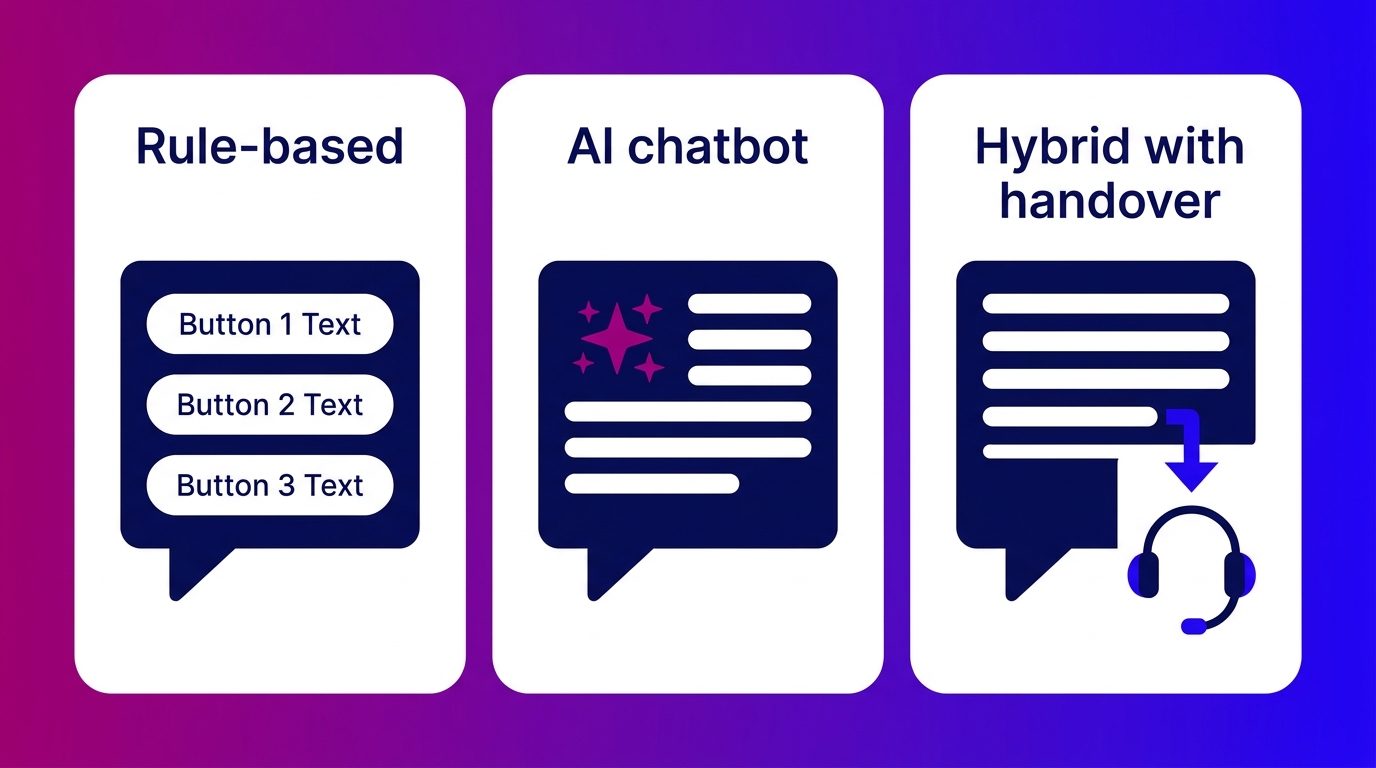
There are three types of chatbot: rule-based chatbots, AI chatbots and hybrid chatbots in which a person can take over the conversation. The difference lies in how they process a question and what happens when they do not know the answer.
Rule-based chatbot
A rule-based chatbot follows a decision tree drawn up in advance. The visitor chooses from buttons or types a keyword, and the bot gives the answer that belongs to that choice. A click bot is the best-known form: buttons only, no free text. Predictable and cheap, but a question that is not in the menu hits a dead end.
AI chatbot
An AI chatbot understands free text. It recognises what someone means, even with a typo, colloquial language or a question spread over three messages. That makes the conversation feel natural. The risk is that it gives a wrong answer with great confidence when its knowledge source falls short.
Hybrid chatbot
A hybrid chatbot combines automatic answers with a person who takes over. The chatbot handles what it knows for sure and passes the rest to a member of staff, with the conversation attached. For a visitor with a complaint or a complex question, that handover is the difference between help and frustration.
What is the difference between a chatbot and ChatGPT?
ChatGPT is a chatbot, but a general one: it knows a lot about almost everything and nothing about your business. A chatbot on a company website works the other way round. It knows little about the world, but everything about your offering, your terms and your way of working.
You see that difference in three points:
- Knowledge. ChatGPT draws on a broad language model. A business chatbot draws on the information the business itself supplies and checks.
- Boundaries. A business chatbot only talks about agreed topics and hands over when a question falls outside them.
- Follow-up. A business chatbot is connected to systems such as a CRM or diary, so a conversation ends in an appointment or a lead.
Many AI chatbots for businesses do run on the same kind of language models as ChatGPT. The difference lies in the set-up around them.
What do businesses use a chatbot for?
Businesses mainly use a chatbot to answer questions immediately, help visitors choose and capture sales opportunities before the visitor leaves. AI is now mainstream in UK business: according to the Office for National Statistics, around 3 in 10 UK businesses reported using at least one type of AI technology in September 2026, rising to 51% for businesses with 250 or more employees.
Using a chatbot in practice comes down to automating recurring work. Chatbot automation mostly concerns these tasks:
- Handling customer questions, such as the status of an order or a delivery time, including outside opening hours.
- Qualifying visitors by asking about budget, timing or preferred specification before sales calls.
- Booking appointments, such as a test drive, a showroom visit or a measuring appointment.
- Pointing people on to the right page or branch.
Which task delivers the most differs per business. The benefits of chatbots are greatest where many of the same questions come in. There are also disadvantages of chatbots, especially with questions that call for bespoke advice or empathy. Applications per sector are shown in the chatbot examples.
What is an AI chatbot?
An AI chatbot is a chatbot that uses artificial intelligence to recognise the meaning of a question and formulate an answer itself, instead of running through a fixed script. It works with a language model and with the knowledge you give it.
Two things make an AI chatbot useful or risky. First, the knowledge source: the better and more current the information, the better the answers. Second, the agreement on when it stops. An AI chatbot that does not know when to hand over starts guessing. What happens technically is covered in how do chatbots work.
There is a legal ground rule too. If you serve customers in the EU, the AI Act requires that people are informed they are interacting with an AI system: the European Commission explains that chatbots must make this clear from the start of the conversation, unless it is already obvious. A chatbot that pretends to be a member of staff is therefore not an option.
How do you get started with a chatbot?
Start with the questions that come in now, not with the software. Collect the questions your team answers again every week and which of those could be handled without a person. That becomes your chatbot’s first task.
Then three choices follow:
- Which type suits your questions: a fixed menu, an AI chatbot or a hybrid set-up with a person on hand.
- Who builds and manages it: your own team or an external party. The trade-offs are in building a chatbot yourself or outsourcing it.
- Where the result ends up: in your CRM, your diary or your salespeople’s inbox.
Do not underestimate the management. A chatbot is not finished at go-live. Products, prices and terms change, and every change has to land in the chatbot too. If you would rather not do that work yourself, you can have a chatbot built and managed.
How we use chatbots at car dealers and in home and living
At Bconnect we see that a chatbot only delivers once it is fixed in advance what it handles itself and when a person takes over. That boundary determines how the conversation feels for the visitor.
We therefore work with three models. With Operator Assisted AI our chat specialists hold the conversation and AI supports them. With AI First + Human Handoff the AI holds the conversation and a specialist or your own team takes over where needed. With AI Only the AI handles everything independently, day and night.
An example from automotive: a visitor asks in the evening whether they can take a test drive on Saturday. The AI answers their questions about the car, asks for a preferred day and passes the request with the whole conversation to the right branch. If they are unsure about part-exchange or finance, the AI announces a handover and a specialist takes over, with the full conversation attached. In home and living it works the same way: the AI answers questions about sizes and delivery times, and a visitor who wants a showroom or measuring appointment goes through to the sales team with their wishes.
The same conversations run with us via website chat, WhatsApp, email and SMS, for websites from 5,000 visitors a month.
A chatbot is only as good as the agreements around it
A chatbot is software that holds conversations, but the value lies in the choices around it: which questions it gets, which knowledge it uses and when it brings in a person. For a handful of fixed questions a simple menu bot is enough. As soon as visitors ask free questions or consider a purchase, you need an AI chatbot with a clear handover to a person. All the topics around this theme are in the overview of chatbots.
Frequently asked questions about chatbots
What does a chatbot do?
A chatbot answers visitors’ questions automatically, points them to the right page or member of staff and collects details for follow-up. On a business website it is usually about questions on products, delivery times, appointments and terms.
What is the difference between a chatbot and ChatGPT?
ChatGPT is a general chatbot with broad knowledge on many subjects. A chatbot on a business website is set up on the offering and way of working of one business, only talks about agreed topics and is connected to systems such as a CRM or diary.
Is ChatGPT a chatbot?
Yes. ChatGPT is an AI chatbot: you hold a conversation with it in plain language and it formulates answers itself with a language model. It is just not a chatbot that has been set up for one business.
What are examples of chatbots?
Examples are a menu bot that gives opening hours and returns conditions, an AI chatbot that answers questions about products and a chatbot that books a test drive or showroom appointment. Voice assistants on a phone work on the same principle.
What are the disadvantages of chatbots?
A chatbot gets stuck on questions outside its knowledge, and an AI chatbot can give a wrong answer with confidence. Without a good handover to a person, a visitor then gets frustrated. A chatbot also needs ongoing maintenance.
How do you build a chatbot yourself?
You first collect the questions that come in often, then choose a type of chatbot and a platform, fill in the knowledge and test the conversations. After that, someone has to keep the chatbot up to date. That management is the bulk of the work in practice.
What does the word chatbot mean?
Chatbot is a contraction of “chat” and “robot”. The word stands for software that holds conversations with people, usually through text in a chat window or a messaging app.