The benefits of conversational AI do not lie in the technology, but in the bottlenecks it solves. Questions that come in during the evening while nobody is watching. Peaks your team cannot handle. Visitors who drop off because they wait too long for an answer.
Below you will read, for each benefit, which bottleneck it solves, how that works and when the benefit fails to materialise. That way you can quickly see which conversational AI benefits apply to your business.
What conversational AI delivers
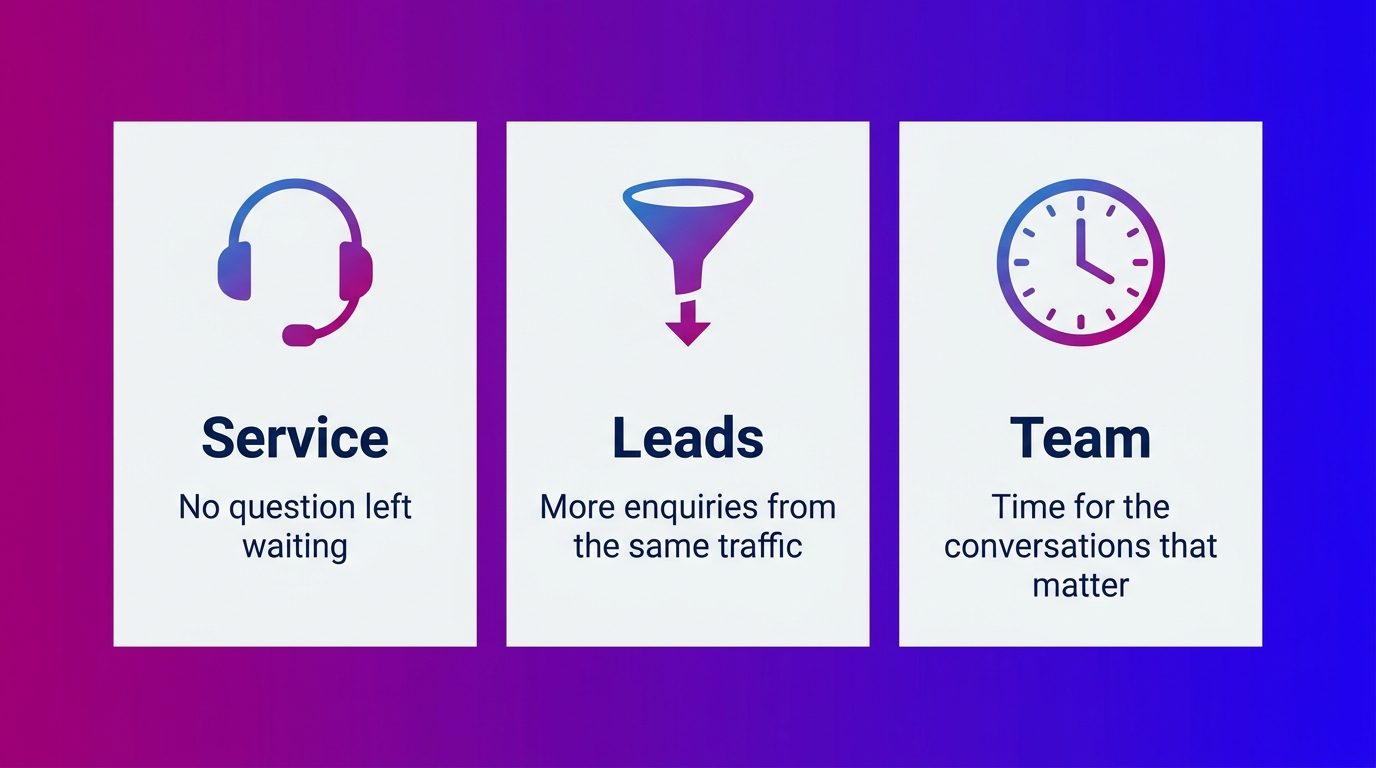
Conversational AI delivers three kinds of gain: better service, more leads from the same traffic and time for your team. It is AI that holds conversations in everyday language, through the chat on your website or through WhatsApp, and recognises the question behind the question. What exactly that is, you can read in what is conversational AI.
Whether a benefit applies to you depends on your situation. That is why each benefit below comes with the mechanism behind it.
Benefits for your customer service
For service, the biggest benefit is that a question no longer sits waiting. The AI answers straight away, at any time, in the visitor’s language.
Available outside office hours
Many questions come in during the evening and at the weekend, exactly when your team is not there. An AI chatbot that is available outside office hours picks up those questions and answers them straight away. The visitor does not have to wait until Monday morning.
Instant answers, no queue
Anyone who asks a question on a website wants a quick answer. For simple questions, speed and clarity are what customers value most in a chat. That way there is no queue for questions about opening hours, lead times or the status of an enquiry.
Consistent answers
The AI takes every answer from the same knowledge base. Two visitors with the same question get the same answer, regardless of the time or who is on duty. That only works if the knowledge base is correct and up to date.
Several languages
If you serve customers abroad, you also get questions in other languages. Conversational AI switches to the visitor’s language, without a separate team for each language.
How to divide the tasks in customer service between AI and your own people is covered in conversational AI for customer service.
Benefits for lead generation
For sales, the benefit is that you get more enquiries from the traffic you already have. Conversational AI does not wait until a visitor fills in a form, but starts the conversation at the moment of interest.
A visitor on the page of an SUV asks whether they can part-exchange their current car. The AI recognises that as a buying signal, asks for the registration number, the preferred specification and when they want to drive, and passes the complete enquiry to the salesperson. They call back with everything they need.
It works the same way at a kitchen showroom. A question about the lead time of a kitchen island becomes a showroom appointment, because the AI asks about wishes and budget. How that process runs from visitor to enquiry is covered in AI lead generation.
Benefits for your team
For your team, the benefit is time. Routine questions take up a large share of customer contact, and those are exactly the ones the AI can handle.
That means the AI does not replace your people, but shifts their work. Staff have time left for the conversations that call for judgement: a complaint, an exception, a customer who is unsure about a big purchase.
Peaks also become easier to handle. Around a promotion or a new collection, the number of questions shoots up. You cannot double a team in an afternoon, but the AI handles the basic questions while your people hold the conversations that make the difference.
Which benefits we see first with clients
The first benefit Bconnect’s clients notice is almost always availability. Questions that used to wait until the next working day now get an answer straight away. Especially in the evening and at the weekend, when visitors are calmly browsing for a car or a new kitchen.
The second benefit follows from that: more enquiries from the same traffic. That is not down to the AI alone, but to the combination: the AI is available around the clock and our chat specialists take over, from early morning until late in the evening, the conversations where advice makes the difference.
What we also see: the benefit for the team comes later. In the first weeks, time goes into adding to the knowledge base. After that, the manual work noticeably decreases.
When the benefits fail to materialise
The benefits of conversational AI are not automatic. They fail to materialise if the basics are not in order, and that happens more often than providers show.
- A thin knowledge base. The AI can only answer what it knows. If information is missing, the question still sits waiting.
- No handover to a person. A visitor who gets stuck with no way out drops off. Then the AI costs you customers instead of winning them.
- Too little traffic. With few visitors there is simply too little to gain. Outsourcing works for us from a few thousand website visitors a month.
- No adjustment after go-live. An AI that is not updated stays stuck at its day-one level.
If you want to know the other side well, read the limitations of conversational AI.
Benefits that match your bottleneck
Conversational AI delivers the most where there is a clear bottleneck: questions that sit waiting, visitors who drop off or a team drowning in routine. So start with the bottleneck, not with the technology. Which other applications there are is covered in AI in business.
Frequently asked questions about the benefits of conversational AI
What are the benefits of conversational AI?
The main benefits are availability outside office hours, instant answers without a queue, consistent answers, multilingual contact, more leads from existing website traffic and time for your team. Which benefits weigh most depends on your bottleneck: service, leads or workload.
What are the benefits of AI in customer service?
In customer service, AI answers frequently asked questions straight away and at any time, in the evening and at the weekend too. That leaves your team time for complaints and exceptions. Complex or sensitive questions go to a member of staff with the full context.
Does conversational AI deliver more leads?
Yes, if the AI is set up for leads. It recognises buying intent, asks about wishes, timing and budget, and passes a complete enquiry to your sales team. That gets you more enquiries from the same traffic, without extra advertising budget.
Does conversational AI replace staff?
No. The AI takes over routine questions, so staff have time for conversations that call for judgement and advice. For lead generation, a combination of AI and trained people works best in practice.
Is conversational AI suitable for smaller businesses too?
That depends mainly on your traffic and your questions. With few visitors there is little to gain. Outsourcing to Bconnect works from a few thousand website visitors a month. Below that, a simpler solution may be enough.
How quickly do you notice the benefits?
You notice availability straight after go-live, because questions get an answer immediately. More leads and a lower workload usually follow after a few weeks, once the knowledge base has been added to on the basis of real conversations.
What are the disadvantages of conversational AI?
The main disadvantages are difficulty with complex or emotional conversations, the risk of incorrect answers with a poor knowledge base, privacy and the maintenance it requires. With good configuration and a handover to a person, those disadvantages are easy to manage.