AI in business is not about the technology, but about work that can be done faster, better or more cheaply. AI helps businesses mainly on three fronts: faster and more personal customer contact, automating repetitive work and better decisions from data. Most of the gain lies where customer contact and revenue meet: the questions visitors ask before they buy.
What AI in business actually does
AI is software that performs tasks that normally require human insight, such as understanding a question, phrasing an answer or recognising a pattern in data. For a business, that means part of the work people do now can be done faster and at any hour of the day.
Use is growing quickly, and marketing and sales are among the purposes businesses mention most. That matches what we see in practice. AI delivers the most where many of the same questions come in and where a quick answer makes the difference between an enquiry and a visitor who clicks away. That applies to large companies, but just as much to AI for small business: a small team gains the most from not having to answer the same question twenty times a day.
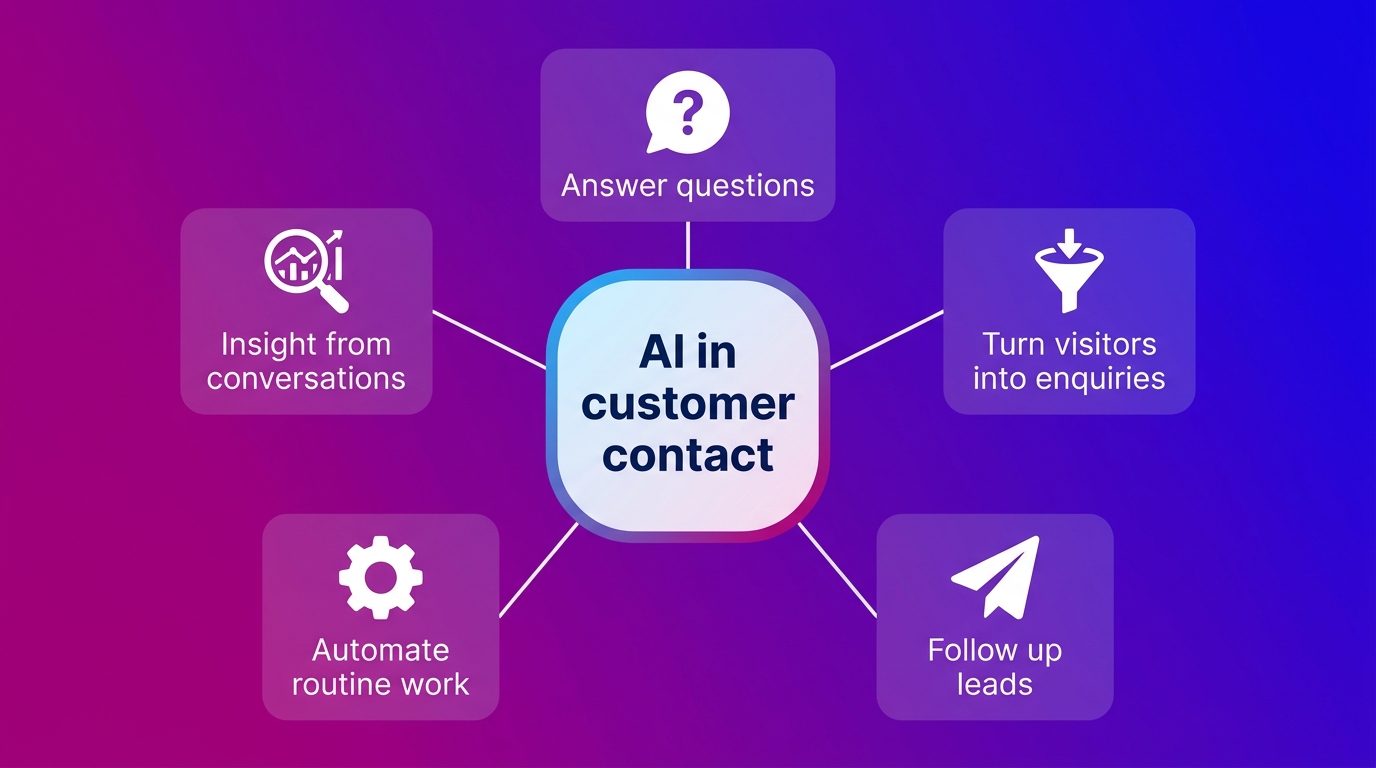
Five AI applications for businesses
These are the five applications of AI that deliver something straight away for most businesses. They all start with customer contact, because that is where the questions, the enquiries and the data come together.
1. Answering frequently asked questions straight away
AI looks up the answer to a question in your own business’s information and answers it straight away. Think of opening hours, lead times, stock, price indications or what is included with a product or service. A well-configured AI chatbot for your customer contact does that on your website and through WhatsApp, in the evening and at the weekend too.
The difference with a fixed FAQ page: the visitor does not have to search themselves. They ask their question in their own words and get an answer that fits their situation.
2. Turning visitors into enquiries
AI recognises when there is buying intent behind a question and then asks follow-up questions. Someone who asks whether a model is still available often wants a test drive or a quote. The AI asks the questions your sales team needs and passes the enquiry on complete. How that works is covered in the article on AI lead generation.
3. Following up leads and customers
After the first contact, a lead cools down quickly if nobody responds. AI can follow up an enquiry straight away through WhatsApp or email, ask for missing information and send reminders or appointment confirmations. Your salespeople then call with a more complete picture.
4. Automating routine work
A lot of work repeats itself every day: status questions, standard emails, copying details into the CRM. AI takes over that kind of predictable work. Exceptions and bespoke work stay with your team, with the context of what has already been discussed.
5. Gaining insight from conversations
Every conversation with a customer is data. AI can analyse large numbers of conversations and show which questions keep coming back, where visitors drop off and which information is missing from your website. That insight makes your website, your offering and your service more focused.
Many of these applications come together in customer service: answering questions, passing on statuses and taking over routine work. What that looks like in practice and where a person must take over is covered in the article on AI customer service.
Examples of AI in business: what we see in practice
At Bconnect, AI and our chat specialists hold conversations every day for car dealers, kitchen showrooms, window companies and other businesses. The same pattern shows up again and again: most questions are predictable, and that is exactly where AI delivers fastest.
At a car dealer, it is about questions such as “is this used car still available?”, “is this covered by the warranty?” or “what is the range?”. The AI looks up the answer in the dealer’s information, answers the question and then asks whether the visitor would like to book a test drive. The enquiry goes to the right branch with the whole conversation.
At a kitchen showroom or window company, it is about questions such as “can this be made to measure?” or “can I visit the showroom without an appointment?”. Those questions often come in during the evening, when people are planning at home. An immediate answer stops them carrying on with a competitor the next day.
What we also see: AI only works well on a strong knowledge base. That is why we build it together with the business, with customers’ real questions as the foundation. If the AI does not know an answer, it makes nothing up. It announces that a colleague will take over and passes on the conversation with the full context.
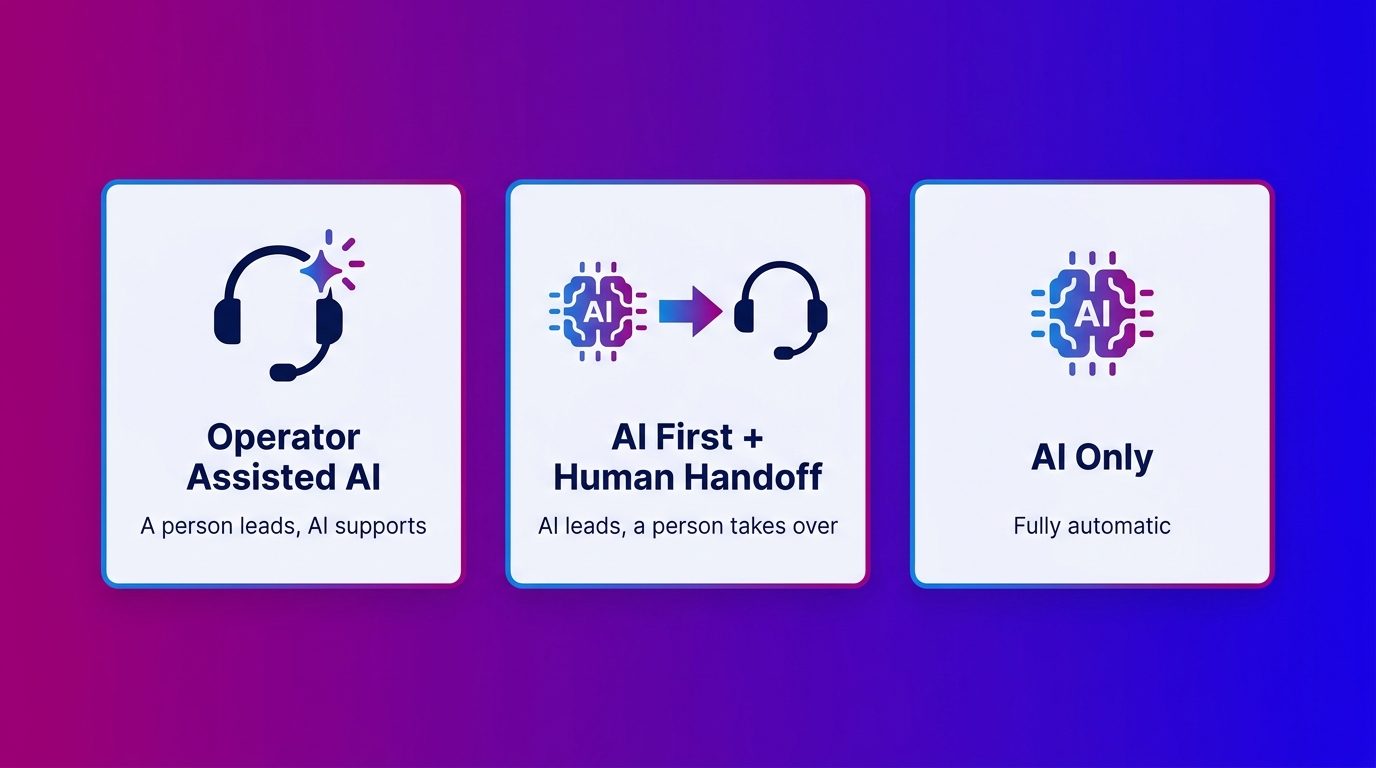
Which AI solution suits your business?
The best AI solution for your business is the mix of AI and people that suits your questions and your goal. There is no best tool in general. The choice depends on how predictable your questions are and how much a conversation is worth.
We work with three models:
- Operator Assisted AI: a chat specialist holds the conversation and is supported by AI in real time. Suits advice, bespoke work and valuable sales opportunities, and is often the starting point.
- AI First + Human Handoff: the AI holds the conversation and a person takes over where needed, with the full context. Suits high volumes with a regular exception.
- AI Only: the AI handles everything itself, day and night. Suits predictable questions and fixed processes, such as status questions and appointment confirmations.
An honest note: AI handles frequently asked questions well, but to really get more enquiries from your website you often still need people who ask follow-up questions and steer the conversation towards an appointment. For follow-up after the first contact, AI workflows for follow-up and customer contact are often the logical next step. You can always switch model later.
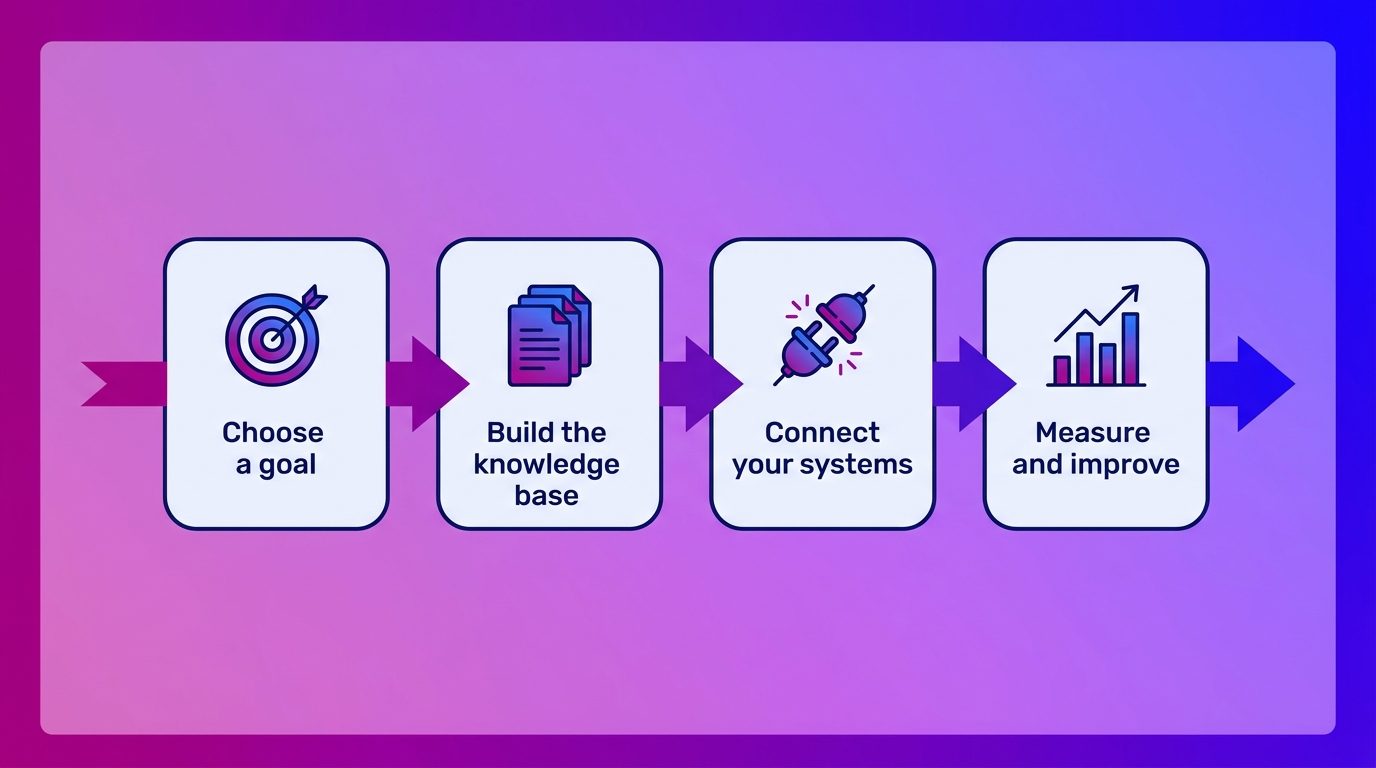
Using AI in your business: how to start
Start with one concrete goal and one application, not with the technology. Lack of experience is one of the main reasons businesses that consider AI do not get started. Starting small removes that barrier.
- Choose a goal. Where is the most value leaking away right now? For example, questions that go unanswered in the evening, or leads that are followed up too late.
- Build the knowledge base. Collect the questions customers really ask and the answers your team gives. That is the foundation the AI works on.
- Connect your systems. Have enquiries land directly in your CRM, calendar or inbox, so nobody has to retype details.
- Measure and improve. After a few weeks, look at which questions go well and where the AI gets stuck. Only expand once the first application works.
What such a project looks like step by step is covered in implementing conversational AI.
Where AI is not the solution
AI is strong on predictable questions and fixed processes, but not on everything. Complex, sensitive or emotional conversations belong with a person. An AI that does not know when to hand over is more likely to cost you customers than win them.
The rules have changed too. Since 2 August 2026, Article 50 of the EU AI Act requires it to be clear when someone is talking to AI, which applies if you serve customers in the EU. In customer service, a customer must know they are not speaking to a real member of staff.
AI also processes personal data. So choose a partner that works in line with UK GDPR, is clear about where data is processed and uses data only for its intended purpose; the ICO’s guidance on AI and data protection explains what that means. If you want to know how AI works on the service side, read about conversational AI for customer service.
AI as a means, not an end
AI in business delivers the most when you use it in a targeted way: on the questions that come back every day, the enquiries you are missing now and the follow-up that gets left undone. Start with one goal, measure what it delivers and use people where they make the difference. If you first want to understand what conversational AI is, that is a good place to start.
Frequently asked questions about AI in business
What can AI do for my business?
AI helps businesses mainly on three fronts: faster and more personal customer contact, automating repetitive work and better decisions from data. In concrete terms, that means answering questions straight away, turning visitors into enquiries, following up leads, taking over routine work and gaining insight from customer conversations.
Which AI is best for businesses?
There is no best AI for every business. The right choice depends on how predictable your questions are and how much a conversation is worth. For predictable questions, fully automated AI works well. For advice and valuable sales opportunities, a combination of AI and people works better.
How can I implement AI in my business?
Start with one concrete goal, such as questions that go unanswered outside office hours. Build a knowledge base with the questions customers really ask, connect the AI to your CRM or calendar and measure what it delivers after a few weeks. Only expand once the first application works.
What are examples of AI in business?
A car dealer has AI answer questions about stock and warranty and gather the details of test-drive requests. A kitchen showroom answers questions about bespoke work and showroom visits in the evening. Other examples are automatic lead follow-up, appointment confirmations and analysing customer conversations.
Is AI also useful for small businesses?
Yes. A small team often gains the most, because AI takes over the repeat questions that would otherwise eat into everyone’s day. Start with one application, such as answering frequently asked questions on your website, and expand once it works.
Does AI replace my staff?
No. AI mainly takes over routine work and the first contact, so your team has time for the conversations that really matter. For complex or sensitive questions, a person takes over. AI takes pressure off your team and gives your salespeople better enquiries.
Do I have to tell customers they are talking to AI?
If you serve customers in the EU, yes. Since 2 August 2026, the EU AI Act requires that people know when they are talking to AI rather than a member of staff. A short notice at the start of the conversation is the simplest solution.