When you start comparing conversational AI platforms, you see the same promises everywhere: clever language understanding, quick to go live, integrations with everything. The real differences rarely appear on the feature list. They lie in who sets up the platform, what happens when the AI does not know an answer and who keeps improving it after go-live.
So you will not find a ranking of brands here. Instead you get an overview of the types of solution, the criteria for comparing them side by side and a way to work out the real costs.
What is a conversational AI platform?
A conversational AI platform is software that lets you hold automated conversations with website visitors and customers, in everyday language and through channels such as website chat, WhatsApp and Messenger. It understands open questions, looks up the answer in a knowledge base and can hand a conversation over to a person.
How that technology works exactly is explained in what is conversational AI. For a choice, something else matters more: what is arranged around the software.
The terms platform and conversational AI software are used interchangeably. By software, providers usually mean the product itself; by platform, the environment in which you build and manage conversations and connect them to your other systems. For your comparison, that distinction makes little difference.
Which parts the software itself consists of and what each part must be able to do is covered in conversational AI software.
Three types of solution side by side
Broadly, you choose from three types of solution: building it yourself on an AI platform, buying off-the-shelf software or working with a partner who sets up and manages the platform. They differ mainly in how much work is left with you.
- Build it yourself on an AI platform. Most control, but you carry everything: setup, testing, maintenance and the quality of every conversation.
- Off-the-shelf software. Faster to go live, but the work around it stays with you: filling the knowledge base, refining answers and maintaining integrations.
- A partner who sets up and manages it. The partner does that work and keeps improving the AI; you mainly agree goals and follow up enquiries.
Building it yourself gives the most control, but for most businesses it turns into an underestimated project. Off-the-shelf software gets you live faster: the tool is there, but the work around it remains yours.
With the third route, a partner does that work. Bconnect is an example: we deliver conversational AI as a managed service, build the knowledge base together with you and keep adjusting the AI. That is not the best choice for everyone, but it is a logical one if you do not want to carry the management yourself.
Alongside these three routes there is one more question that appears on no feature list: does the visitor only talk to AI, or can a person step in? We come back to that further down.
Start with your goal: leads or service
First decide whether the platform should mainly deliver leads or mainly handle service questions. That goal determines how much weight each criterion carries.
For leads, the AI works before the conversion. It recognises buying intent, asks follow-up questions and passes a complete enquiry to your sales team. For service, it works after or around the purchase: frequently asked questions, status questions and appointments.
A car dealer who wants more test-drive requests weighs follow-up questions and a connection to their DMS more heavily than an extensive service bot. A kitchen showroom looks mainly at how well the AI handles bespoke questions and books a showroom appointment. Which other applications there are is covered in AI in business.
Also map out your own situation. How much traffic do you have, through which channels do questions come in, do you have your own team and in which system should a lead land? Only then start comparing.
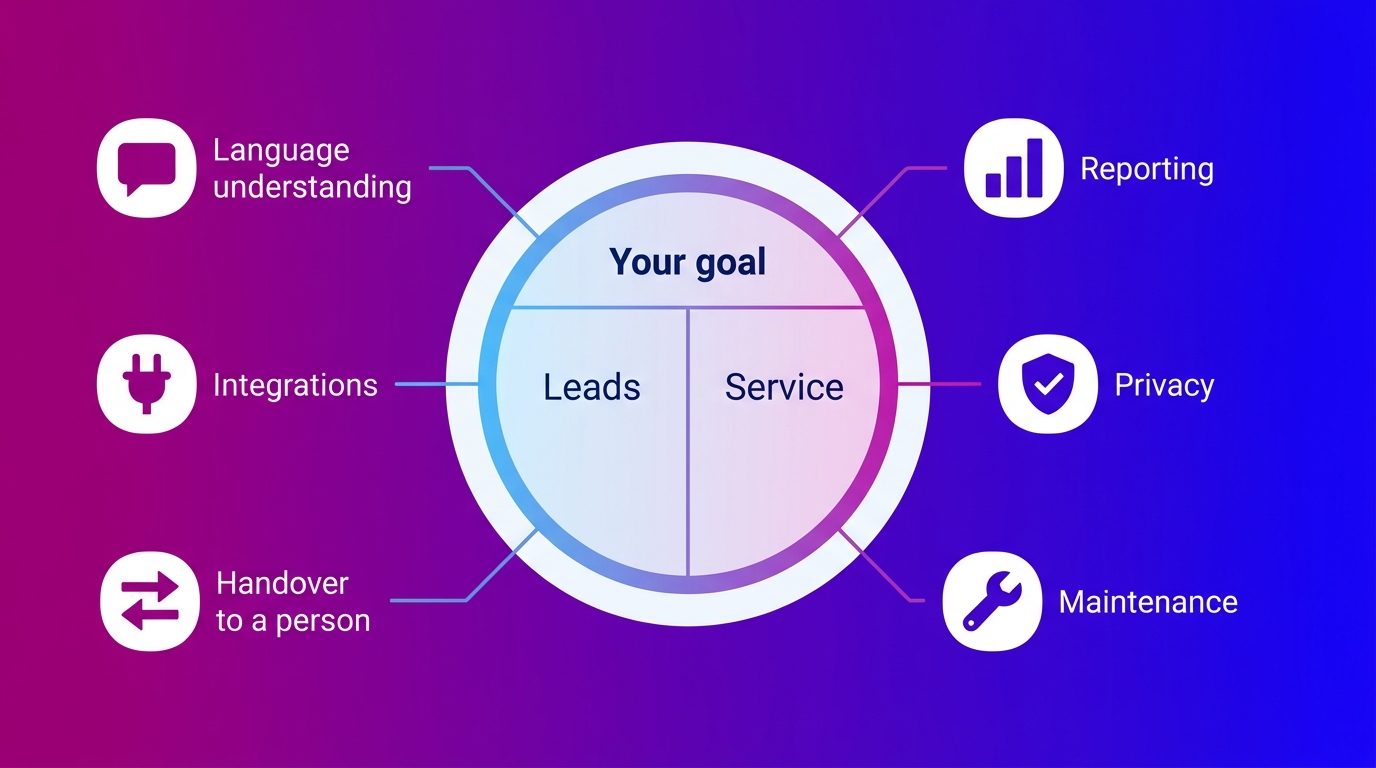
Comparing conversational AI platforms on six criteria
Compare platforms side by side on six criteria: language understanding, integrations, handover to a person, reporting, privacy and maintenance. Go through them with your own goal in mind.
Language understanding and multilingual support
Do not test with neat demo questions, but with messy reality: half sentences, typos and two questions in one message. A good platform recognises the intent, even when the question is phrased differently than expected.
If you serve customers in several countries, you will also get questions in other languages. Check whether the platform handles several languages without a separate system for each. Where that goes wrong is covered in multilingual chatbot.
Integrations and channels
A lead that ends up in a stray email is only half the job. Ask whether the platform connects to your CRM, DMS or calendar, and which integrations are standard and which are custom.
Also look at the channels. Do website chat, WhatsApp and Messenger come together in one inbox, or will you be managing three separate environments? An integration is not always needed to get started, by the way: leads can initially come in by email.
Handover to a person
This criterion is forgotten most often and is perhaps the most important. Many chat windows do not show beforehand whether you can reach a member of staff, and many chatbots do not clearly indicate when they have not understood a question.
So test exactly the moment when the AI does not know. Does it announce the handover? Does the member of staff get the whole conversation, so the visitor does not have to tell their story again? And who takes over the conversation outside office hours?
Reporting and optimisation
Almost every platform has a dashboard. The real question is whether you can see where conversations get stuck and which pages deliver enquiries, and whether someone then adjusts scripts and answers. Which figures count for that is covered in chatbot metrics.
Privacy and transparency
A platform processes conversations and often personal data. If another party does that for you, they act as your processor and you need a written contract that meets UK GDPR; the ICO explains the roles of controllers and processors. So ask about the data processing agreement and where the data is stored.
The visitor must also know they are talking to AI. Since 2 August 2026, the transparency obligation in Article 50 of the EU AI Act applies to anyone serving customers in the EU. Good practice adds that organisations should always offer human contact alongside a chatbot and stay in control of what the chatbot says.
Maintenance and support
A conversational AI is never finished. Range, prices and questions change, and without adjustment the quality slowly declines. Ask who does that work, how quickly a change goes live and who helps you when something goes wrong. How a project runs from setup to go-live is covered in implementing conversational AI.
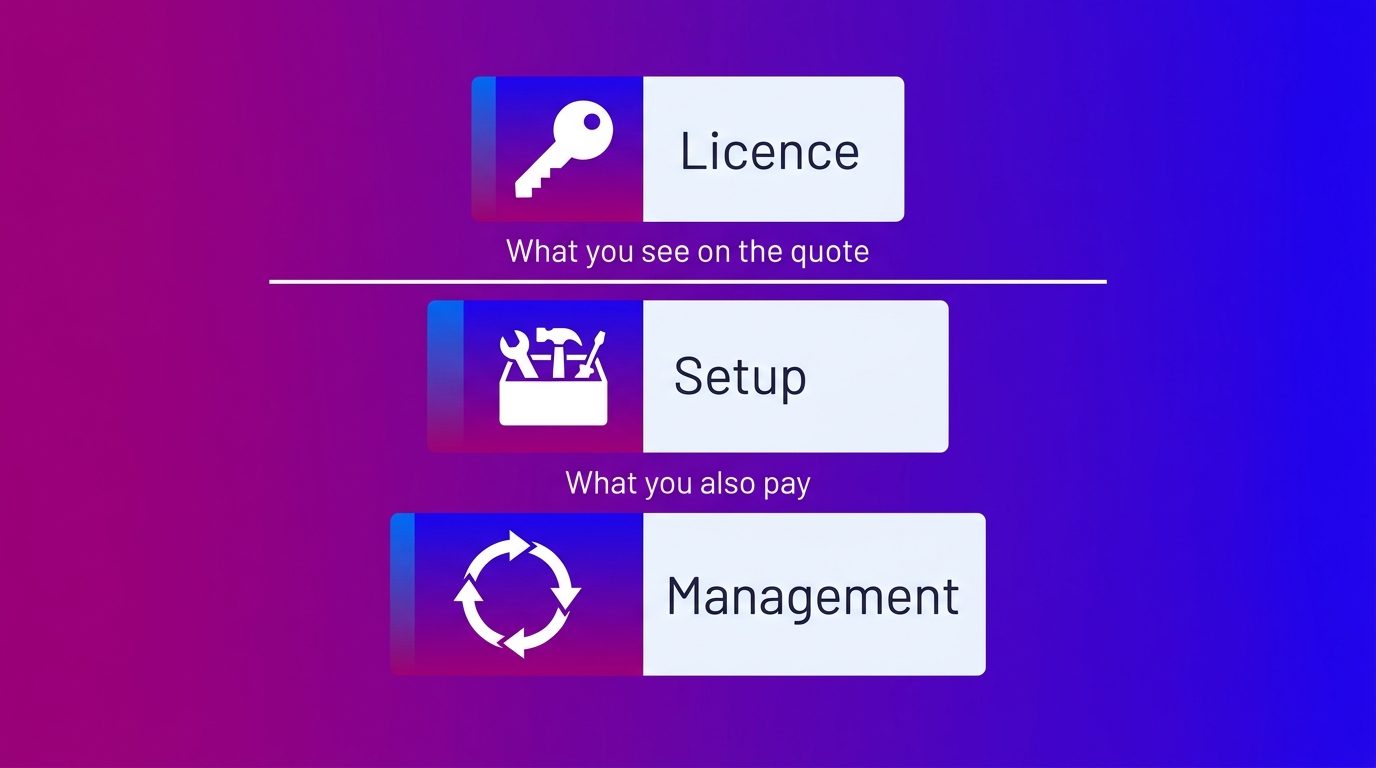
What a conversational AI platform really costs
The monthly price on the quote is rarely the real price. Count three cost items: the licence, the setup and the management.
The licence is what you pay for access, per user, per conversation or per result. The setup is building the knowledge base, setting up integrations and testing with real questions. The management is the ongoing adjustment after go-live, plus staffing the handover to a person.
With building it yourself and with off-the-shelf software, setup and management are often not in the price, but in your own team’s hours. Count those hours. A cheap licence with a lot of your own work can turn out more expensive than a solution in which that work is included.
A checklist to score platforms yourself
Put your shortlist side by side and score each platform on each question with good, fair or weak. You decide the weighting yourself, based on your goal. A low score on a criterion that does not matter to you is no problem.
- Language understanding: does it handle messy, real questions and other languages?
- Integrations: does a lead land directly in your CRM, DMS or calendar?
- Channels: do website chat, WhatsApp and Messenger come together in one inbox?
- Handover: is the handover announced and does the whole conversation go with it?
- Reporting: can you see where conversations get stuck and what they deliver?
- Privacy and transparency: is there a data processing agreement and is it clear that visitors are talking to AI?
- Maintenance: who adjusts the AI after go-live, and how quickly?
- Costs: what do licence, setup and management cost together, including your own hours?
Five mistakes we keep seeing when businesses choose:
- Choosing on licence price. Setup and management eat up the difference later.
- Falling for features. What you never use, you still pay for.
- Only testing the demo. A demo shows what goes well, not what happens when the AI does not know.
- Forgetting maintenance. The work only starts after go-live.
- No goal in advance. Without a goal, every feature seems useful.
Why AI alone often disappoints for lead generation
An AI-only solution handles frequently asked questions well, but rarely gets the most out of your website traffic. We see that at Bconnect in practice: businesses sometimes choose AI only because it seems cheaper and faster, and some come back later because the number of leads is disappointing.
The reason lies in the conversation itself. A visitor considering a new kitchen or wanting to part-exchange their car wants advice. Someone has to ask about bespoke requirements, timing and budget, and steer the conversation towards a showroom appointment or a quote. People are still better at that than AI.
That is why we work with three models. With Operator Assisted AI, a chat specialist holds the conversation, supported by AI; for more leads that is often the starting point. With AI First with handover, the AI holds the conversation and a person takes over where needed. AI Only suits predictable questions such as status updates and appointment confirmations. You can always switch later.
Our advice when comparing: do not only ask what the AI can do, but also who takes over the conversation when there is a sales opportunity. With us, that is a trained chat specialist who picks up the conversation with the full context.
From shortlist to choice
The best conversational AI platform is not the one with the most features, but the one that fits your goal and that you can make work in practice. Start with leads or service, choose the route that fits how much work you want to do yourself, and weigh the six criteria.
Then do not test the demo, but the moment when the AI does not know. And work out the full costs, including your own team’s hours. That will not make the choice easier, but it will make it easier to justify.
Frequently asked questions about conversational AI platforms
What is a conversational AI platform?
A conversational AI platform is software that lets you hold automated conversations with website visitors and customers, in everyday language and through channels such as website chat, WhatsApp and Messenger. It understands open questions, looks up answers in a knowledge base and hands the conversation over to a person when needed.
What is the difference between conversational AI software and a platform?
In practice the terms are used interchangeably. By software, providers usually mean the product itself; by platform, the environment in which you build and manage conversations and connect them to other systems. For your choice, who sets up and manages the solution matters more.
Which conversational AI platform is the best?
There is no platform that is best for everyone. The best platform fits your goal, leads or service, and how much work you want to do yourself. Compare on language understanding, integrations, handover to a person, reporting, privacy and maintenance, and work out the full costs.
What does a conversational AI platform cost?
The costs consist of three items: the licence, the setup and the management. The licence is charged per user, per conversation or per result. With a lot of software, setup and management are not in the price but in your own team’s hours. Count those hours when comparing providers.
Can a conversational AI platform connect to my CRM?
Usually yes, through a standard integration, an API or webhooks, so leads land directly in your CRM. Ask which integrations are standard and which are custom. An integration is not always needed to get started: leads can initially come in by email.
What happens if the AI cannot answer a question?
With a well-configured platform, the AI makes nothing up. It announces that it is handing over the conversation and a member of staff takes over, with the full conversation attached. Always test this moment yourself, because this is where platforms differ most.
Do I have to tell visitors they are talking to AI?
If you serve customers in the EU, yes. Since 2 August 2026, the EU AI Act requires you to tell users they are interacting with an AI system, unless that is already obvious. So choose a platform in which you can make that visible, ideally throughout the conversation.