Conversational AI software consists of more than a clever language model. Behind every good conversation there is a knowledge base, conversation rules, channels, a handover to a person, integrations and reporting. If one of those parts is missing, your visitor notices straight away.
Below you will read which parts conversational AI software consists of, what each part must be able to do and what is legally expected of the software.
What is conversational AI software?
Conversational AI software is software that lets you hold automated conversations with website visitors and customers, in everyday language and through channels such as website chat, WhatsApp and Messenger. The software understands open questions, looks up the answer in a knowledge base and hands the conversation over to a person when needed.
The terms software and platform are used interchangeably. This article looks at what is inside the software. How to compare different providers and types of solution side by side is covered in comparing conversational AI platforms.
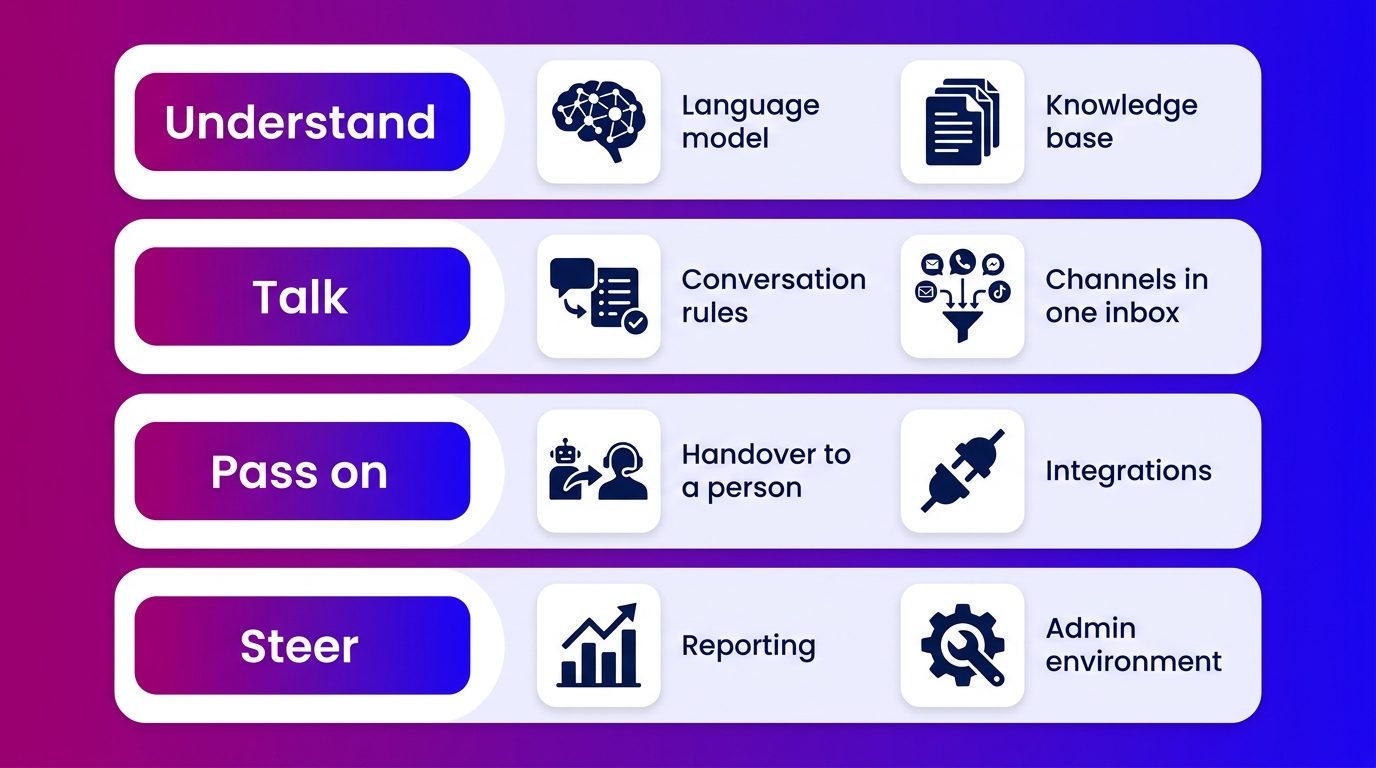
The eight parts of conversational AI software
Conversational AI software consists of eight parts: a language model, a knowledge base, conversation rules, channels with one inbox, a handover to a person, integrations, reporting and an admin environment. For each part you will read what it must be able to do.
1. Language model
The language model understands the question and phrases the answer. It must also handle messy questions: half sentences, typos, two questions at once. If you serve customers in several countries, it must handle other languages too. How that works is covered in multilingual chatbot.
2. Knowledge base
The knowledge base is the source of every answer: your products, prices, lead times and terms. Good software has the AI answer only from that source and not make things up freely. Also important is how easily you can update the knowledge base when your range changes.
3. Conversation rules and instructions
Conversation rules determine the tone, what the AI does and does not promise and which questions it asks. For leads, that also means asking for the information your sales team needs, such as part-exchange, timing or budget.
4. Channels and one inbox
Visitors ask questions through the chat on your website, WhatsApp, Messenger or email. Good software brings all those channels together in one inbox, so you do not have to look in three systems and the customer history stays in one place.
5. Handover to a person
If the AI does not know the answer, it must say so and hand the conversation over to a member of staff, with the whole conversation attached. This is the part that is most often missing or poorly implemented in practice.
6. Integrations
A lead belongs in your CRM, an appointment in your calendar and, for car dealers, an enquiry in the DMS. Software connects through standard integrations, an API or webhooks. Ask which integrations are standard and which require custom work.
7. Reporting
Reporting shows how many conversations there are, how many leads they deliver, where the AI brings in a person and where visitors drop off. Which figures weigh most is covered in chatbot metrics.
8. Admin environment
In the admin environment you read back conversations, give feedback on answers and update the knowledge base. The more user-friendly that environment, the more often the adjustment actually happens.
What the software must do legally and in practice
Alongside the features, there are requirements every conversational AI software must meet. They concern transparency, human contact and privacy.
Showing that it is AI. Since 2 August 2026, Article 50 of the EU AI Act requires that users know they are talking to an AI system, unless that is already obvious. That applies if you serve customers in the EU. The software must be able to show that notice, ideally throughout the conversation.
Enabling human contact. Good practice is to always offer human contact alongside a chatbot.
Saving conversations. A customer should be able to read back what was agreed. That is far from always the case: many chatbots do not let you save the conversation.
Privacy. The software processes personal data. Ask about the data processing agreement and where the data is stored; the ICO explains the roles of controllers and processors under UK GDPR.
Managing the software yourself or buying it as a service
All the parts above must not only be in the software, but also be set up and maintained. You can do that yourself or have it done.
If you buy only the software, you fill the knowledge base yourself, write the conversation rules, set up the integrations and adjust after go-live. That gives control, but takes time. If you choose conversational AI software with management included, a partner does that work and keeps adjusting the AI. How to weigh up those routes is covered in implementing conversational AI.
What that looks like on our platform
At Bconnect we work with our own chat and messaging platform, which we set up and manage for each client. All channels come together in one inbox as standard: website chat, WhatsApp, Messenger, SMS and email.
We build the knowledge base together with the client. In the support system, clients can find chats, give feedback and update frequently asked questions. After every conversation the transcript goes straight to the specified email address, and a lead goes with the conversation attached to the CRM, by email or to the support system. You can find the available connections on our integrations page.
In the dashboards, clients see in real time how many conversations were held, how many qualified leads they delivered, where a handover took place and which pages convert best. If the AI does not know, a chat specialist or the client’s own team takes over the conversation, with the full context.
Look at the whole, not at one feature
Good conversational AI software is more than a clever language model. It is the whole that counts: a knowledge base that is correct, channels in one inbox, a handover to a person, integrations with your systems and reporting you can steer by. And someone who keeps it up to date.
Frequently asked questions about conversational AI software
What is conversational AI software?
Conversational AI software is software that lets you hold automated conversations with website visitors and customers, in everyday language and through channels such as website chat, WhatsApp and Messenger. It understands open questions, looks up the answer in a knowledge base and hands the conversation over to a person when needed.
Which features does conversational AI software need?
The main parts are a language model, a knowledge base, conversation rules, channels in one inbox, a handover to a person, integrations with your systems, reporting and an admin environment. The software must also be able to show that it is AI and let conversations be saved.
What is the difference between conversational AI software and a chatbot?
A simple chatbot often works with fixed answers or menus and gets stuck when a question is phrased differently. Conversational AI software understands free language, recognises the intent behind a question and can hand a conversation over to a person.
Can conversational AI software connect to my CRM?
Usually yes, through a standard integration, an API or webhooks, so leads land directly in your CRM. Ask which integrations are standard and which require custom work. Without an integration, leads can initially come in by email.
Can I manage conversational AI software myself?
Yes, if you have someone who keeps the knowledge base up to date, reads back conversations and adjusts the AI. If you do not have time for that, you can choose software where a partner takes care of the management.
What must conversational AI software comply with on privacy and AI?
The software processes personal data and falls under UK GDPR, so you need a data processing agreement and should know where the data is processed. If you serve customers in the EU, the software must also be able to show that the visitor is talking to AI.