Chatbot metrics show whether your conversational AI really helps customers and what it delivers. The most important are how many questions the AI resolves on its own, how often it hands over, how satisfied customers are, how quickly it responds and how many enquiries it generates. If you track those figures, you can see where the AI works well and where you need to adjust.
Why you need to measure conversational AI
An AI you do not measure slowly gets worse. Your range changes, customers ask new questions and the knowledge base goes out of date. Without figures, you only notice when customers complain or enquiries dry up.
Measuring has two goals. The first is improvement: seeing which questions the AI handles well and where it gets stuck, so you can add to the knowledge base. The second is accountability: showing what the AI delivers in time, availability and enquiries. So start with the goal you set at the beginning and choose the metrics that go with it.
What conversational AI does exactly and how it differs from an ordinary chatbot is explained in the meaning of conversational AI.
The six most important chatbot metrics
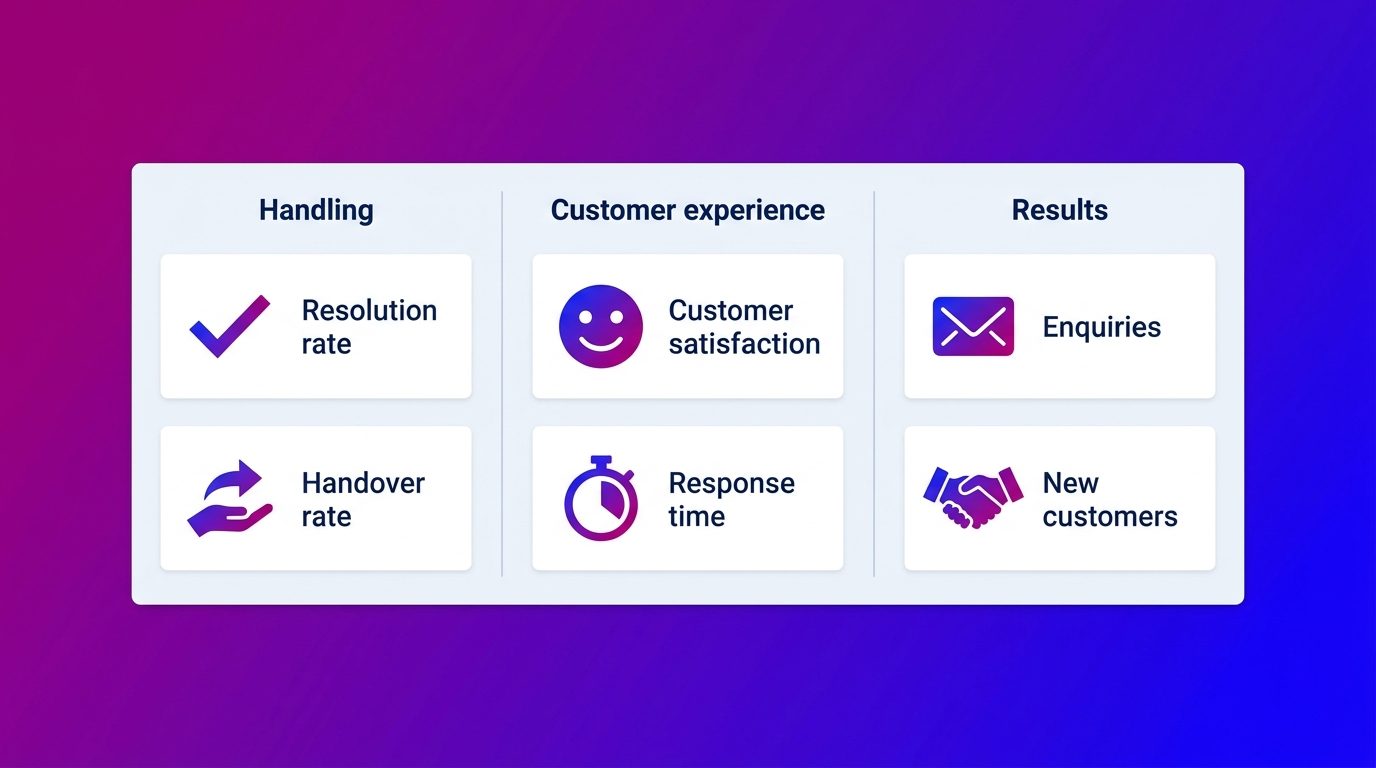
Together, these six metrics give a good picture of how your AI is performing:
- Resolution rate. The share of conversations the AI resolves without a person. It shows how complete your knowledge base is.
- Handover rate. How often the AI passes a conversation to a member of staff, and on which questions. It shows where knowledge is missing or where a person is rightly needed.
- Customer satisfaction. How customers rate the conversation. It shows whether the AI actually helps, not just whether it closes conversations.
- Response time. How quickly a visitor gets a first answer. It shows whether nobody is left waiting, including outside office hours.
- Number of enquiries. How many conversations lead to an enquiry, such as a quote, test drive or appointment. It shows the commercial result.
- Enquiries that become customers. How many of those enquiries turn into a sale. It shows what the AI really delivers, together with your sales team’s follow-up.
Never look at a single metric in isolation. A high resolution rate looks good, but not if customer satisfaction is falling. In that case the AI is closing conversations it should have handed over.
How to measure the metrics and adjust
Measuring starts with a baseline. Record where things stood before go-live: how many enquiries you received, how quickly your team responded and how many repeat questions came in. Without a baseline, you cannot show later what the AI has changed.
After that, look at the conversations themselves every week, not just at the figures. Which questions lead to a handover? Where does a customer drop off? Which question keeps coming back without a good answer? Add to the knowledge base based on what you see and check a week later whether the figure has improved. How to set that up at the start is covered in implementing conversational AI.
How to improve the AI based on those figures is covered in training conversational AI.
Common measurement mistakes
The most common mistake is measuring only what is easy to measure. The number of conversations says little if you do not know how many of them led to an enquiry. Other mistakes we often see:
- No baseline, so you cannot compare.
- Looking only at the AI and not at what happens to the enquiry afterwards.
- Seeing handovers as failures, when a good handover on a complex question is exactly what is supposed to happen.
- Collecting figures without doing anything with them.
What we measure in our reports
At Bconnect our reports look at both service and results. On the service side: how many questions the AI handles on its own, how often a chat specialist or the client’s team takes over and on which questions that happens. On the results side: how many conversations lead to an enquiry and how complete those enquiries are.
The most important part is what happens next. An enquiry only delivers something if the sales team acts on it quickly. That is why we also look at follow-up together with the client: how quickly the customer is called and how many enquiries become customers. That turns measurable return from AI in customer contact into a conversation about results rather than loose figures. How to get more enquiries from your website is covered in AI lead generation. Which applications deliver the most for businesses is covered in AI in business.
Measuring to improve
Chatbot metrics are not a report card, but a steering wheel. Choose the metrics that fit your goal, record a baseline and look every week at the conversations behind the figures. That way chatbot analytics show you where the AI works well, where it can do better and what it delivers for your customers and your team.
Frequently asked questions about chatbot metrics
What are the most important metrics for conversational AI?
The most important are how many questions the AI resolves on its own, how often it hands over, customer satisfaction, response time, the number of enquiries and how many enquiries become customers.
What is a good resolution rate?
That depends on your sector and the kind of questions. More important than a fixed percentage is that the figure rises while customer satisfaction stays the same or improves.
Is a handover to a member of staff a bad thing?
No. For a complex or sensitive question, a good handover is exactly what is intended. It only becomes a problem if the AI hands over simple questions it could have answered itself.
How often should I review the metrics?
In the first months, look at the figures and the conversations behind them every week. Once the AI is running stably, once a month is often enough.
What is a baseline?
A baseline records where things stood before go-live, for example the number of enquiries and your team’s response time. It lets you show later what the AI has changed.
How do I measure customer satisfaction?
Ask for a short rating at the end of a conversation. Also look at conversations in which a customer drops off or asks for a member of staff.
How do I measure what conversational AI delivers?
Track how many conversations lead to an enquiry and how many enquiries become customers. Compare that with the baseline from before go-live.