Live chat produces a lead when a conversation ends with contact details and a clear next step. A visitor asks about a car, a kitchen or new windows; whoever answers well and asks follow-up questions ends up with a test drive, a quote request or a survey appointment. That happens with the traffic already coming to your website, without extra advertising budget.
This article is about leads from conversations on your own website. You are not buying leads: you are getting more enquiries from the visitors who are already there.
Why a chat conversation produces a strong lead
A chat conversation produces a strong lead because the contact happens at the moment someone is interested. The visitor is on your site, looking at a product and has a question. That is exactly the moment when a contact form often gets left unfinished.
A lead from the chat also comes with context. The transcript shows what someone was looking for, what they asked and what they already knew. A salesperson who calls them back does not start from scratch. If you want to know how live chat works as a channel, that is covered in a separate article.
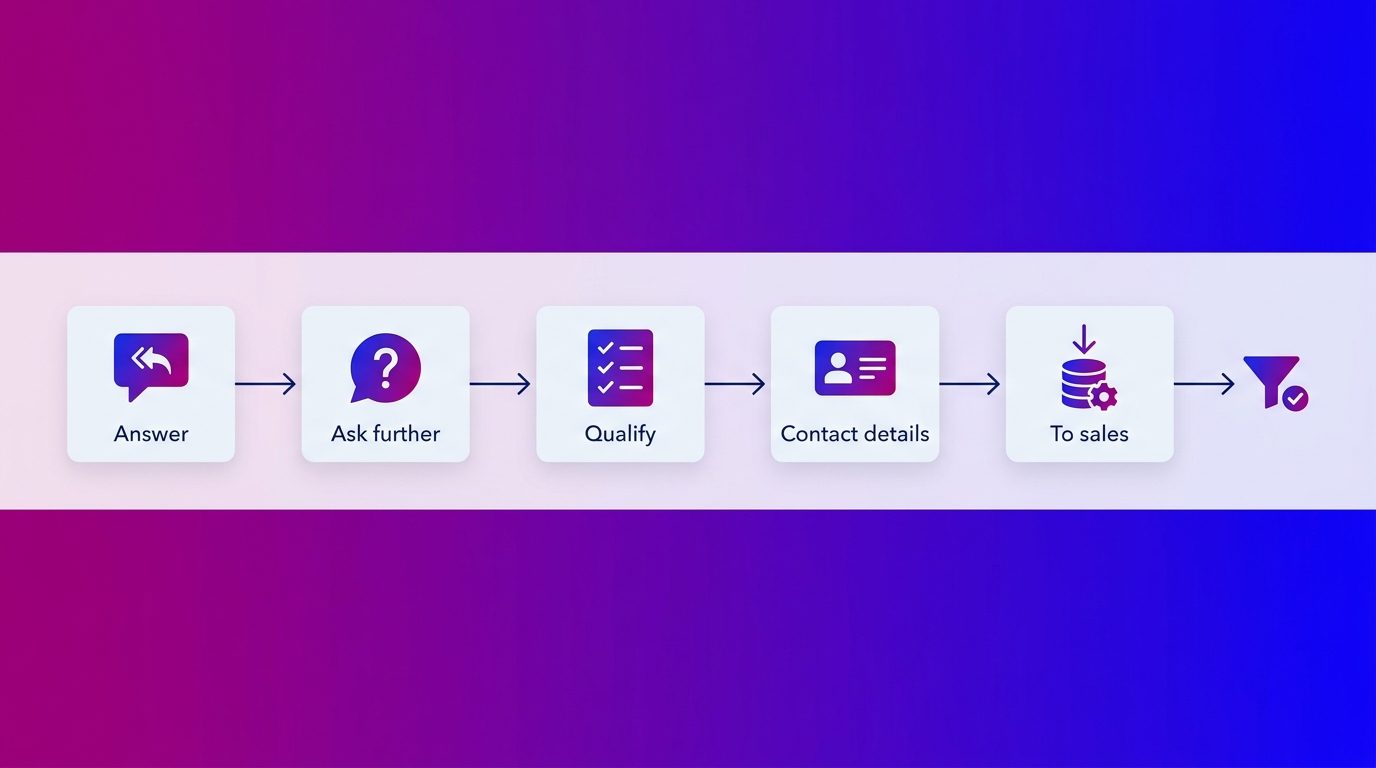
From question to lead in five steps
A chat conversation becomes a lead in five steps: answering, asking follow-up questions, qualifying, asking for contact details and passing the lead to sales.
- Answer straight away. The visitor gets an immediate answer to their question, based on a knowledge base with information about your offering. Anyone who has to wait first drops out.
- Find the question behind the question. “How much horsepower does this car have?” sounds like a technical question, but there is often buying intent behind it. A good chat recognises that and steers the conversation in that direction.
- Qualify by asking follow-up questions. A few targeted questions make it clear whether and when someone wants to buy. Which questions those are is covered below.
- Ask for contact details. Name, email address and phone number, at a natural moment in the conversation and not as the first question.
- Pass it on with the transcript. The lead goes to the sales team, in the CRM, by email or in the support system, with the whole conversation attached.
After that, the division of tasks is clear. The chat generates and qualifies; the salesperson follows up and closes the deal.
Which questions qualify a lead
A lead is qualified when you know who it is, what they want and when. Which questions belong to that depends on your sector and on what your sales team needs to follow up.
In automotive, it often comes down to:
- the model or trim someone is looking for;
- whether they have a car to part-exchange;
- when they want to drive or buy;
- the nearest branch.
In home and living, it often comes down to:
- the product and the measurements, for example a bespoke kitchen or made-to-measure windows;
- the budget or the preferred price range;
- the timing of the renovation;
- a showroom appointment, design consultation or survey appointment.
Agree these lead criteria in advance with your sales team. At a minimum, you need a name, email address and phone number. The rest is up to you: the more the salesperson knows, the more targeted their follow-up can be.
Following up quickly after the chat
A lead from the chat is worth the most in the hours straight after the conversation. After that, interest fades and the visitor carries on looking elsewhere. Research published in Harvard Business Review showed back in 2011 that most companies do not respond quickly enough to online leads.
The transcript helps the salesperson start off on the right foot. They know which model or product someone was looking for, which questions have already been answered and what is still open. That way, the follow-up call picks up where the chat left off.
AI, people or both for leads
AI catches buying questions day and night, but for more leads you also need people who ask follow-up questions. An AI Sales Agent approaches visitors, answers questions and collects contact details. These AI-powered chats work well for predictable questions and outside office hours.
With a product customers hesitate over, the visitor wants someone who thinks along with them. A chat specialist asks about the part-exchange, the measurements or the timing, and steers the conversation towards an appointment. Be open about who is answering too: under Article 50 of the EU AI Act, people must be told when they are interacting with an AI system.
That is why a combination usually works best: AI picks up the standard questions, and a person takes over where the conversation becomes valuable. If you do not want to staff that yourself, choose lead generation with a staffed chat or outsource live chat to professionals.
How an external chat team gets more leads out of your website is covered in the article on live chat lead generation. This article focuses on the chat function itself: the steps, the qualifying questions and the follow-up.
What lead conversations deliver in practice
Lead conversations deliver the most where the customer journey is long and the order value is high. At Bconnect, we hold those conversations mainly for car dealers and home and living businesses, and that is where we see what a well-configured chat does.
The difference lies in the way of working. Our chat specialists work with the client’s lead criteria, ask follow-up questions until there is a concrete next step and pass the lead on with the transcript. The client knows their product and closes the deal. We make sure more and better enquiries come in.
How to see whether your chat produces leads
You see whether your chat produces leads by tracking what share of conversations becomes a lead and which pages those leads come from. That shows you which pages work and where visitors drop out.
Also look at what happens to the leads: how many become an appointment, a quote or a sale? Which figures you need for that is covered in the article on live chat metrics. Want to get more visitors into a conversation first? Then increasing conversions with live chat is the next step.
A lead starts with a good conversation
Live chat produces leads when the conversation goes further than the answer. If you ask follow-up questions, qualify against fixed criteria and pass the lead on with the transcript, you get more enquiries from the traffic you already have. How quickly you follow up then decides how many of those leads become customers.
Questions fréquentes
How do you generate leads with live chat?
You answer the visitor’s question straight away, look for the buying intent behind it, ask a few qualifying questions and ask for contact details at a natural moment. Then you pass the lead to your sales team with the transcript.
What is the difference between a chat conversation and a lead?
A chat conversation is any contact through the chat, including a short question about opening hours. A lead is a conversation that ends with contact details and a clear intention to buy or book, so your sales team can follow up.
Which details do you ask for in the chat to complete a lead?
At a minimum, a name, email address and phone number. Depending on your sector, you also ask about the product or model, a part-exchange, measurements, budget or timing. Agree those criteria in advance with your sales team.
Can an AI chatbot qualify leads by itself?
Yes, an AI chatbot can ask standard qualifying questions and collect contact details. For products customers hesitate over or want advice on, a chat specialist who asks follow-up questions usually produces more and better leads.
How does a lead from the chat get into my CRM?
Through an integration between the chat software and your CRM, or through a webhook or Zapier. Without an integration, the lead arrives by email or in the support system, with the transcript attached.
Does lead generation through chat work outside office hours?
Yes, if the chat is staffed then. AI can answer and collect details day and night. With chat specialists, it depends on the staffing; at Bconnect, they are available seven days a week from early in the morning until late in the evening.
Do you buy leads from Bconnect?
No. Bconnect does not sell leads. The leads come from conversations with visitors on your own website, which we answer, qualify and pass on to your sales team.