Live chat for business works when visitors have questions before they buy, when there is enough traffic to the website and when someone answers quickly. If one of those three is missing, a chat delivers less than you hope. That does not mean chat is not for you, but that a different form fits better.
With four questions you can test for yourself whether live chat suits your organisation, and which form.
Four questions that decide whether live chat suits you
Live chat suits you if you answer mostly yes to these four questions.
- Do enough visitors come to your website? A chat lives on conversations. With little traffic it stays quiet, and then a staffed chat is hard to make pay.
- Do your visitors have questions before they buy? The longer someone researches and the higher the order value, the more questions there are. Think of a car, a kitchen or new windows.
- Can someone answer quickly, also in the evening and at the weekend? A chat that does not respond backfires. Many people do their research precisely outside office hours.
- Does someone follow up the enquiries? A chat produces enquiries. They only have value if your sales team picks them up quickly.
If you answer yes to the first two questions, live chat makes sense in principle. The last two mainly determine which form you choose.
Which businesses get the most from live chat
Live chat delivers the most for businesses where customers compare, ask questions and want advice before they buy. These are often B2C businesses with a high order value, but also B2B businesses with an advisory process.
At car dealers and dealer groups, live chat for car dealers is all about test drives, quotes and showroom appointments. Visitors ask about versions, stock and part-exchange, and those questions are the start of a purchase.
For kitchen showrooms, window companies and bathroom specialists, chat for kitchen showrooms and other showrooms works the same way. Questions about bespoke work, materials and lead time lead to a quote, a design consultation or a survey appointment.
Beyond that, the approach also works in markets with a long research phase, such as boats and water sports, motorbikes, swimming pools and outdoor living, clinics with intake appointments and opticians or hearing care.
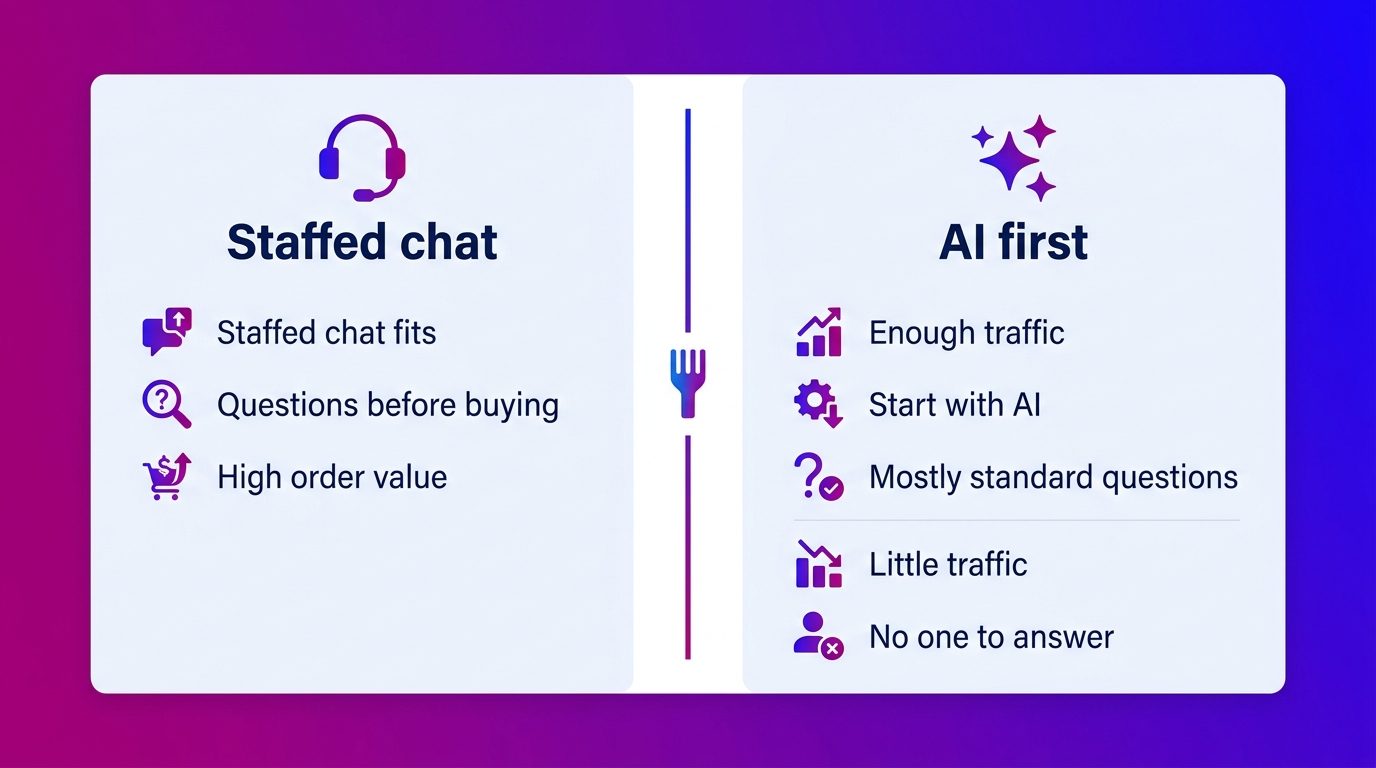
When staffed chat delivers less, and AI fits
Staffed live chat delivers less with little traffic, with only standard questions and when nobody has time to answer. In those situations, AI is often a better start.
- Little traffic. With few visitors there are too few conversations to schedule people. AI needs no staffing and is available day and night.
- Only standard questions. A webshop with questions about delivery times, returns and order status gains little from follow-up questions. An AI chatbot for standard questions fits better there than a staffed chat.
- No time to answer. If you put up a chat without anyone to respond, you are better off starting with AI than with a button that goes unanswered.
AI is not a solution for everything. A chatbot has to solve a concrete problem for your visitors: Nielsen Norman Group found that users do not go out of their way to find out what a chatbot can do for them. AI also needs a full knowledge base. And good practice is to always offer human contact alongside a chatbot.
Do it yourself, AI or have it staffed
Which form fits depends mainly on who can conduct the conversations. There are three routes:
- Do it yourself. Your team answers the chat during office hours. You choose software and keep everything in your own hands.
- AI. An AI chatbot handles standard questions, day and night, and hands over to a person when needed.
- Have it staffed. A provider supplies software, AI and chat specialists in one, also in the evening and at the weekend.
A chat function for business websites often combines those routes: AI for the standard questions, people for advice and enquiries. If you want to hand over the staffing completely, choose outsourced live chat.
If you choose software yourself, first read about the features of live chat software. How to compare providers is in the article on choosing the best live chat software.
Do chat specialists really know your sector?
The question that comes up most often in our consultations is whether an external chat team knows the sector well enough. At Bconnect we answer that question with the way we work.
- Specialisation. We focus on automotive and home and living, with experience in customer contact through chat since 2010.
- Training per sector. Our chat specialists are trained on the client’s sector, on lead generation and on helping visitors, with weekly coaching.
- A knowledge base we build together. We gather the product and process information from the client and turn it into answers, scripts and qualification questions.
- Searching the client’s website. That way chat specialists also answer questions about specific models, stock or versions.
- Making nothing up. Whatever a chat specialist or the AI does not know goes to the client’s team with the full context.
When businesses come to us, there is often a clear trigger. More advertising budget is coming, but conversion is lagging. The in-house team can no longer staff the chat, especially in the evening and at the weekend. A new branch or a new website is coming. Or leads are followed up too slowly, and that shows in revenue.
How to start without much risk
Start small: put the chat first on the pages where most buying questions arise, measure for a few weeks and then scale up. For a car dealer those are, for example, the model pages; for a kitchen showroom, the pages with designs and prices.
After those first weeks, look at the number of conversations, the share that becomes an enquiry and what happens to those enquiries. What else you can expect is covered in the article on the benefits of live chat. The technology is usually the smallest part: see how to add live chat to your website.
Live chat fits where customers want to ask something first
Live chat is not a standard part of every website, but a channel for businesses where customers have questions before they buy. With enough traffic, someone who answers quickly and a team that follows up, a staffed chat produces more enquiries. If that is missing, AI for the standard questions is often a better first step.
Frequently asked questions about live chat for business
Is live chat suitable for every business?
No, not every form suits every business. Staffed live chat works best for businesses where customers have questions before they buy and where there is enough traffic. With little traffic or only standard questions, an AI chatbot often fits better.
From how many website visitors does live chat make sense?
That depends on the form. An AI chatbot can make sense even with little traffic. A staffed chat needs more conversations to pay off. At Bconnect, outsourcing works from a few thousand website visitors a month.
Is live chat also suitable for B2B?
Yes, if your customers want advice before they make a decision, for example with bespoke work or a longer sales process. The chat then helps to answer questions and schedule appointments with the right contact.
Does live chat work for a small business without its own customer service?
Yes, provided someone answers the chat. That can be AI for standard questions, an external partner that staffs the chat, or a combination. A chat that nobody answers is better left switched off.
Can live chat work outside office hours?
Yes. AI can answer day and night. A staffed chat is available as long as chat specialists are on the rota. Outside those hours, show clearly when the chat will be staffed again.
Does live chat suit a webshop?
For a webshop with lots of standard questions about delivery times or returns, an AI chatbot usually fits better. For a webshop with products customers want advice on, such as bespoke furniture or big purchases, a staffed chat can produce more enquiries.
How quickly can you see whether live chat works?
Usually within a few weeks. Look at the number of conversations, the share that becomes an enquiry and what your sales team does with those enquiries. Start on the pages with the most buying questions and then scale up.