On most websites the chat function sits there as a service channel. Visitors ask a question, get an answer, and that is the end of it. But that same chat window can be a lead channel. The difference is not in the technology but in what happens in the conversation: is the question only answered, or is the visitor also qualified?
That is where outsourcing plays a role. An outsourced chat team is not trained merely to answer politely, but to recognise buying signals, ask follow-up questions and record contact details at the right moment. That makes turning chat conversations into leads fundamentally different from a chat window that is only there for support. Qualifying is a skill, not a coincidence. It is the difference between a visitor who gets an answer and clicks off, and a visitor who reaches your sales team as a qualified lead.
Whether live chat lead generation actually delivers depends on a handful of choices: on which pages you use chat, how the conversation is held, how quickly someone responds and what happens to the lead after the conversation. Together those choices determine the result, and that is what this article is about.
The difference between chat as a support channel and chat as a lead engine
A support conversation is finished as soon as the question is answered. A lead conversation starts there. The question “what does this car cost?” is rarely only a question about price. Behind it is an intention: someone is researching, comparing, considering an appointment. Anyone who only names the price leaves that intention lying there.
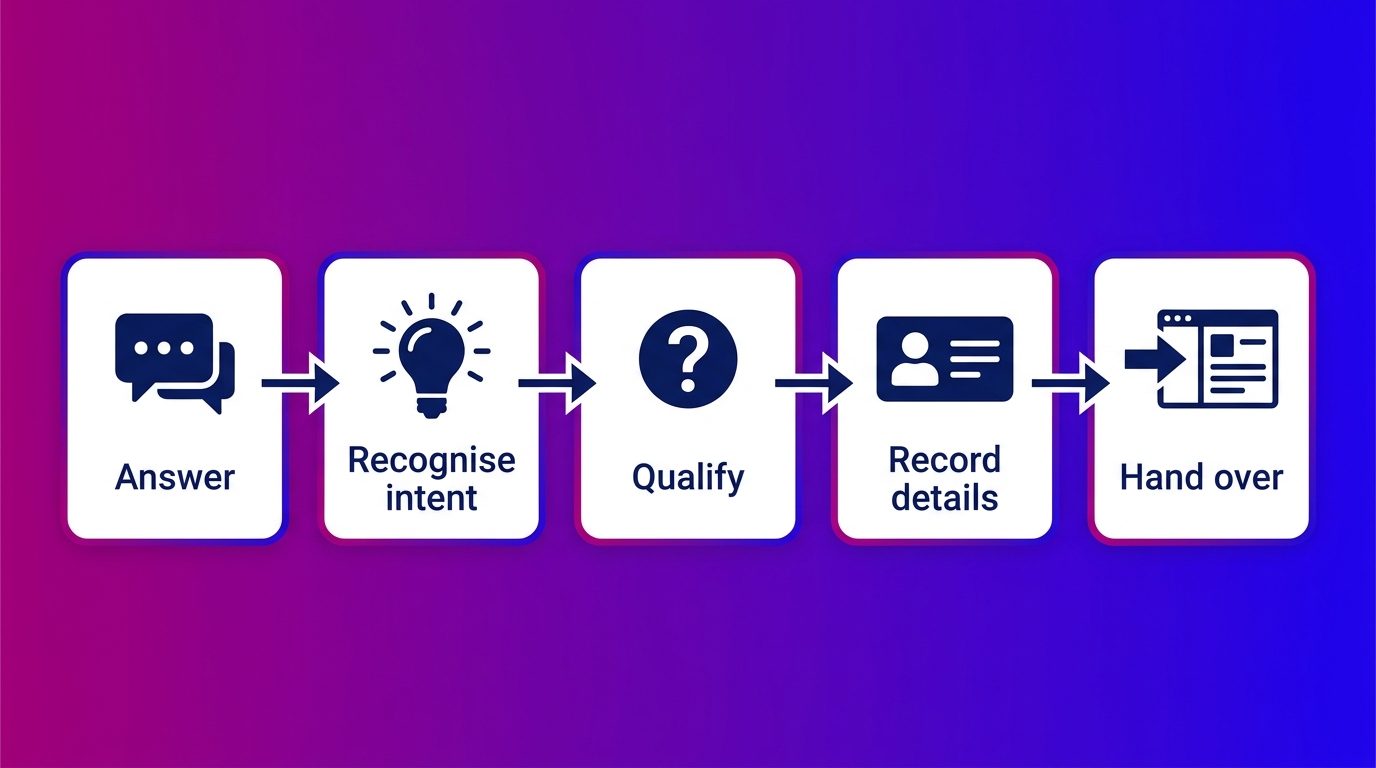
The model Bconnect uses makes that distinction explicit. A conversation goes through a number of steps: the question is answered, the question behind the question is recognised, follow-up questions qualify the visitor, contact details are requested and the lead is passed to the client. An operator trained on this model hears in “is this used car still available?” not just a stock question but a buying signal, and acts on it.
That comes with a clear division of tasks. Bconnect is responsible for generating and qualifying the lead. Follow-up, calling back, booking the appointment and closing the deal stay with your own team. That split is deliberate: the first contact and the qualification require trained conversation skills, while you know your own product and customer best. Outsourcing therefore does not mean handing over your sales, but having the top of the funnel caught by people who do that all day. Whether that works better than chatting in-house or outsourcing depends on your own capacity.
Where on your website chat produces leads (and where it does not)
Not every page is a good place for lead-generating chat. On a general homepage or a blog article the intention is often still vague. On pages with high buying intent it is different. There sits someone who is concretely comparing or deciding, and exactly there a well-timed chat removes doubt at the moment it counts.
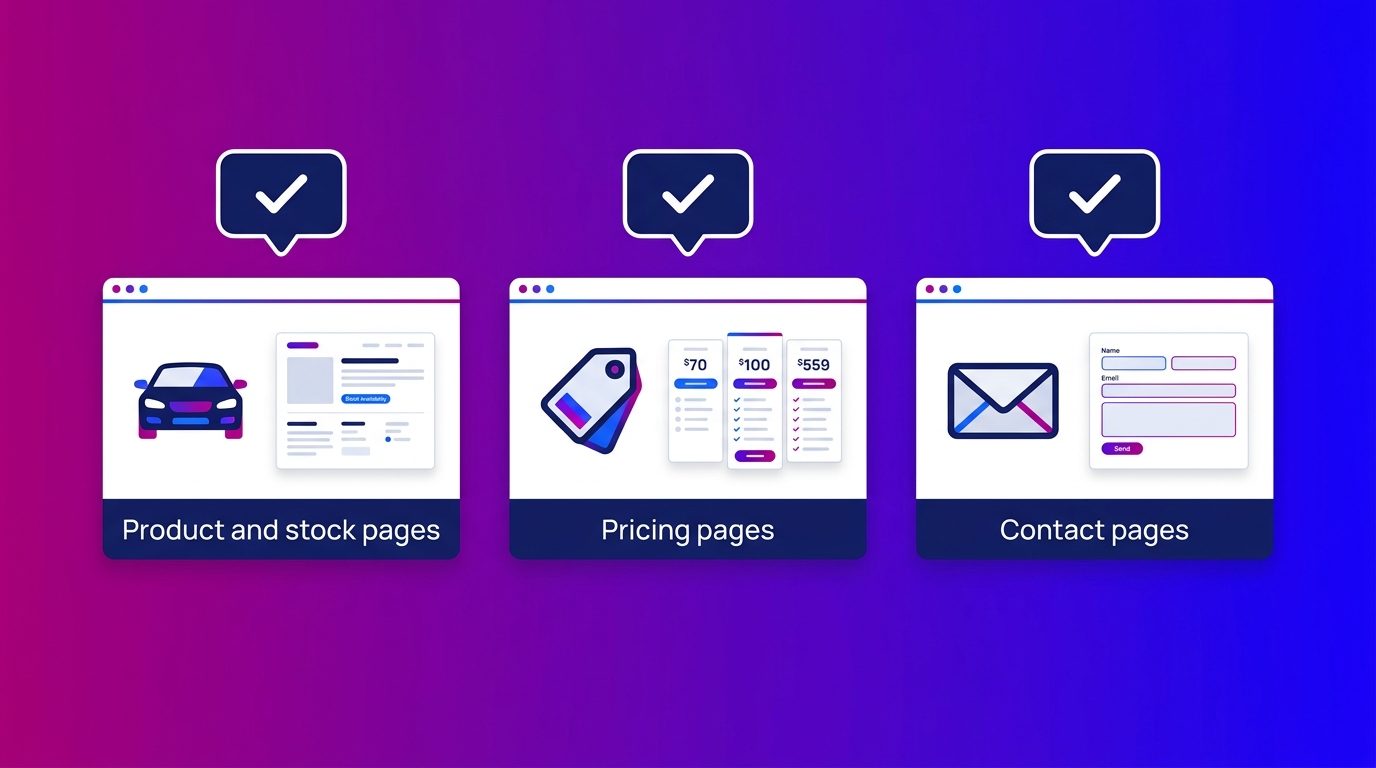
In practice these are the pages that deliver the most:
- Product and stock pages, where someone is looking at a specific offer
- Pricing pages, where the visitor makes the final assessment
- Contact pages, where the intention to get in touch is already explicit
You see this clearly in automotive. A visitor who lingers on a used car page or clicks back and forth between several models is giving a behavioural signal. The same applies to a leasing page, where the choice between personal and business leasing is often the point where someone gets stuck. A proactive chat message at that moment, “not sure whether personal or business leasing suits you?”, responds to a concrete question instead of popping up at random. For lead generation in the automotive sector this is one of the strongest moments to let a test drive or used car enquiry arise.
Starting the conversation proactively without being pushy
Proactive chat does not mean ambushing everyone with a pop-up as soon as they arrive. That backfires: it interrupts someone who is still researching and feels like selling before there is a conversation. Effective proactive chat works on behaviour. Only when someone gives a signal, lingers on a specification page or returns repeatedly to the same offer, is there a logical opening to start the conversation.
The second principle is that you start by helping, not pushing. A good conversation opens with advice or a relevant question, not with “shall I book an appointment for you?”. By first taking the visitor’s question seriously and meeting them where they are in their search, you build the trust needed before someone is willing to leave their details. The appointment or enquiry then comes into view by itself, at the moment the conversation is ready for it.
That order, value first, then questions, is exactly where a trained team makes the difference compared with a standard chat script that pushes for conversion too quickly. It is the core of live chat lead generation: generating leads through a conversation instead of through a form.
From question to qualified lead: qualifying and recording details
Qualifying is the heart of lead generation through chat. It is the difference between a name with an email address and a lead your sales team can act on immediately. Qualifying means asking for exactly the information needed to assess the lead. What that is differs per business and per sector: think of timing, budget, preferred specification, location or a possible part-exchange.
An example from automotive: with a used car enquiry, the difference between “I am interested” and a usable lead is often the question of whether someone wants to part-exchange, when they are ready to switch and whether they would like a test drive. An operator who asks those questions deliberately delivers a lead the salesperson no longer has to untangle.
Asking for contact details is a separate skill. Ask too early and you scare people off; ask too late and the lead walks away. The wording operators use for this has been built up over years of operational experience and is reassuring in nature: it invites rather than demands. Whether a conversation ultimately goes through as a lead depends on the lead criteria you agree together up front. That prevents half-hearted interest landing with sales as a lead and keeps the quality high. What counts as a lead, and how to recognise a qualified one, is covered in what is a lead.
Passing leads to your CRM or sales team
A qualified lead is only valuable if it reaches the right place quickly. That is why leads from the chat are passed to the system your sales team works in. That can be through an integration with your CRM or dealer management system, so a lead lands directly in the right pipeline. Integrations run via API, webhooks or an intermediate layer such as Zapier. Which systems can be connected is set out on the integrations page.
An integration is useful, but not required to start. If you do not have one yet, leads are delivered by email to the address you specify, and they can always be found in the central system as well. So you can begin without first having to change your whole technical landscape, and set up the integration later when it pays off.
What happens next is up to you. Bconnect generates and qualifies the lead; your team calls, books the appointment and closes the deal. The faster that follow-up happens, the greater the chance the lead is still warm. A lead called back within an hour feels very different from one that only surfaces three days later. How to organise that is covered in lead follow-up.
How response time determines your chat conversion
In chat, speed is not an extra but the core. A visitor who asks a question during the research phase is fleeting: if the answer does not come, they are gone and probably already on a competitor’s website. Research published by Harvard Business Review in 2011 found that companies which tried to contact a lead within an hour were nearly seven times as likely to qualify it as companies that waited an hour longer. In chat the window is even shorter. At Bconnect, operators pick up conversations within seconds on average, and an AI Sales Agent responds within a few seconds and is available 24/7. That way you no longer miss a question outside office hours or during busy peaks.
Conversion optimisation does not stop at speed. It is an ongoing process in which scripts, proactive triggers and lead criteria are adjusted based on what works in practice. Which opening question converts best on a leasing page, at which moment a trigger comes too early or too late, which qualifying questions lead to usable leads: that only becomes clear from the chat data. That is also where most of the opportunities for website lead generation lie. At Bconnect a dedicated account manager keeps an eye on this and makes periodic adjustments. So the set-up becomes better matched to your visitors over time, instead of remaining a static setting.
Chat only becomes a lead engine with the right set-up
A chat function does not produce leads by itself. It becomes a lead engine when the parts connect: chat on the pages where buying intent is high, a trained team that qualifies instead of only answering, a response time that does not let the visitor drop out, a clean handover to your CRM or sales team, and continuous optimisation based on what the data shows. If one of those links is missing, chat stays stuck at the level of support.
Outsourcing is interesting because you do not have to build those links yourself. You place the qualifying and the availability with a party that works on it every day, and keep control of the follow-up and the deal yourself. If you want to read more broadly first, start with what live chat outsourcing is. If you want to see how it works to have outsourced chat that qualifies leads, read our page on outsourcing.
Frequently asked questions about live chat lead generation
What is the difference between live chat for support and for lead generation?
With support, the aim is to answer a question and close the conversation. With lead generation, the question becomes the starting point: the operator recognises the intention behind the question, asks follow-up questions to qualify the visitor and records contact details. The difference is not in the technology but in how the conversation is held and whether the visitor is qualified.
Which pages are most suitable for lead-generating chat?
Pages with high buying intent deliver the most: product and stock pages, pricing pages and the contact page. There the visitor is concretely comparing or deciding, so a well-timed chat can remove doubt at that moment. Proactive triggers work best when they are linked to behaviour, such as lingering on a specification page or returning repeatedly to the same offer.
How does a lead from the chat reach my CRM or my sales team?
Leads are passed on through an integration with your CRM or dealer management system, so they land directly in the right pipeline. Integrations run via API, webhooks or an intermediate layer such as Zapier. An integration is not required to start: without one, leads are delivered by email and can always be found in the central system.
How much website traffic do I need before outsourced chat pays off?
There is no fixed threshold. Outsourcing pays off when enough conversations come in every day to generate leads from them structurally. With more traffic, the number of promising conversations grows and the investment becomes worthwhile sooner. What it delivers exactly is linked to what live chat outsourcing costs and the number of leads that come out of it.
How do I prevent weak leads reaching my sales team?
Agree together up front which information makes a lead usable for your sales team, for example timing, budget, preferred specification or a part-exchange. Only conversations that meet those criteria are passed on as leads, so sales does not receive half-hearted interest.
Can AI qualify leads in the chat as well?
Yes. An AI Sales Agent can engage visitors, answer the first questions and do an initial qualification outside office hours, and hand the conversation to a chat specialist or your own team when nuance or advice is needed.