What is live chat? It is real-time contact through a chat window on a website: a visitor types a question and gets an answer straight away. That answer comes from a person, from AI or from both. You will also see it written as livechat; it means the same thing.
For a business, live chat is all about the moment. The visitor is on your site, looking at a car or a kitchen, and is unsure. Whoever answers then holds a conversation that would otherwise never have happened.
How does live chat work?
Live chat works with a small script on your website that shows a chat window. Every message from the visitor arrives in an inbox, where a person or AI answers it. The live chat software behind it handles the window, the inbox and the connections to your other systems.
For the visitor
The visitor sees a chat button or gets an invitation, for example when they stay on the same product page for a long time. They type their question, with no phone queue and no form they wait days on. If the chat is not always staffed, they should be able to see that: Nielsen Norman Group recommends showing the chat’s opening hours.
For the business
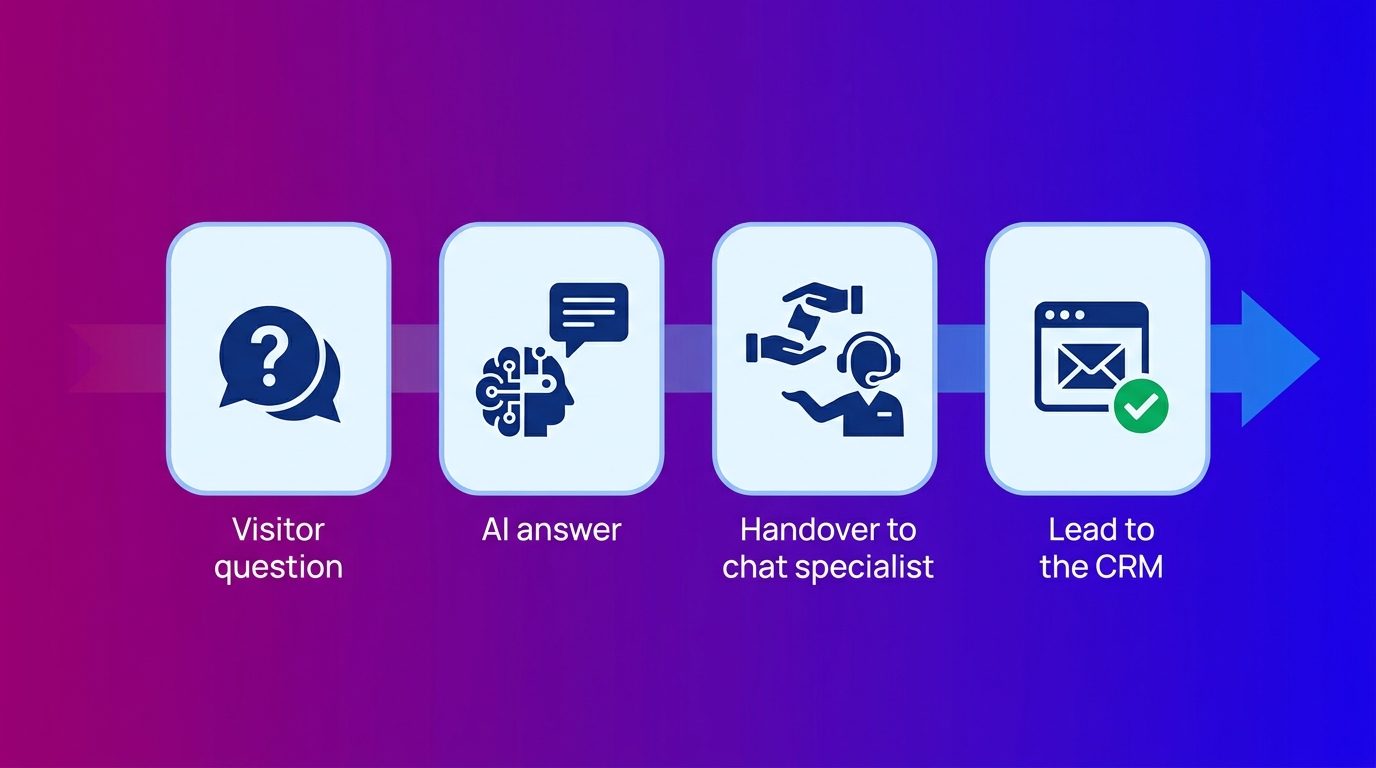
Behind the scenes, a conversation runs in four steps:
- Start. The visitor clicks the chat, or a configured trigger shows an invitation.
- Answer. A chat specialist or AI answers the question based on a knowledge base about your offering.
- Follow-up questions. A good chat looks for the question behind the question: does someone want a test drive, a quote or a showroom appointment?
- Recording. The conversation and contact details go with the full transcript to your CRM, your inbox or your support system.
Different forms of live chat
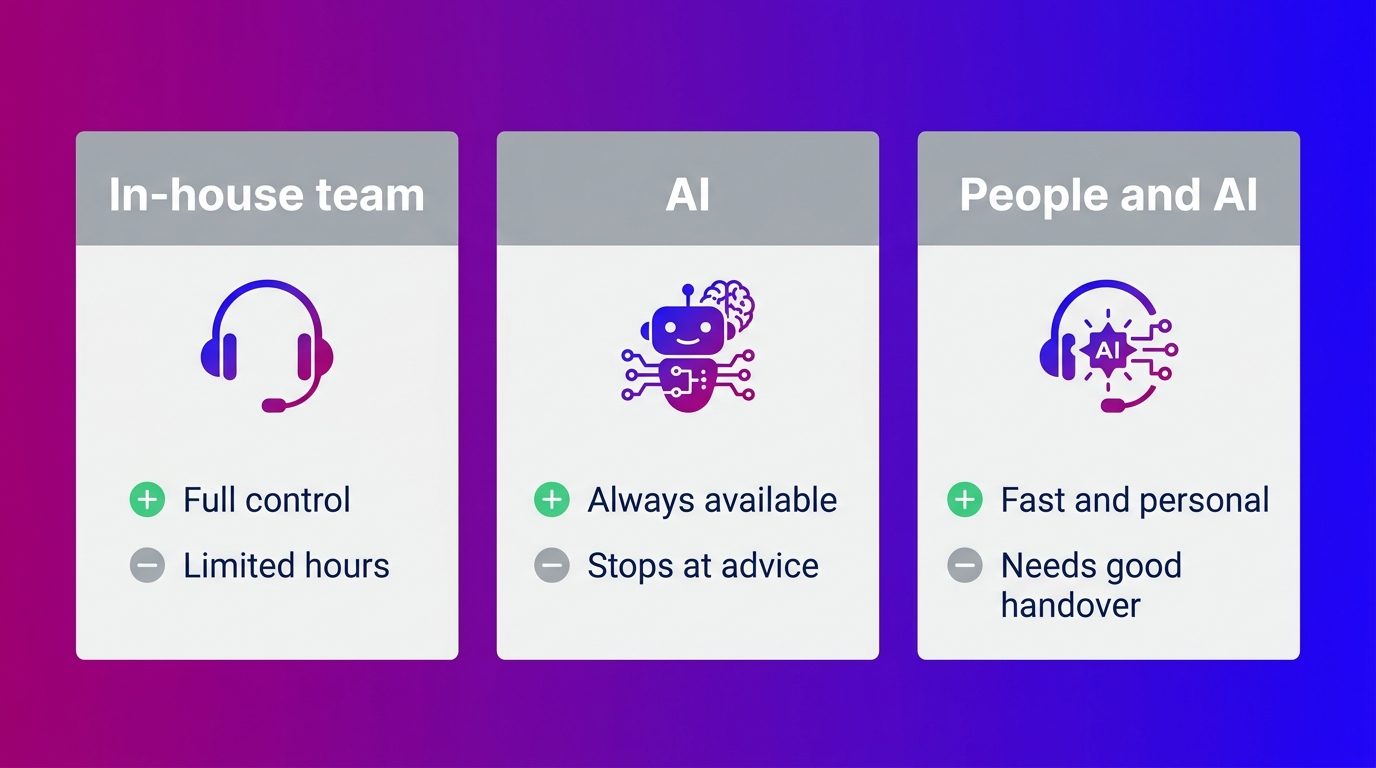
Live chat differs mainly in who answers: your own team, AI or a combination. On top of that, you choose whether to organise it yourself or outsource it.
- Your own team. Staff answer the chat alongside their other work. You keep everything in your own hands, but the chat is only as well staffed as your rota.
- AI. An AI chatbot answers predictable questions day and night, such as opening hours, lead times or the status of an appointment. It is fast, but stops where a question calls for advice or bespoke work.
- People and AI together. AI picks up the first questions or helps the person during the conversation. A chat specialist takes over as soon as the conversation becomes valuable or complicated.
Alongside who answers, there is the question of who organises it. With managed live chat, an external partner staffs the chat on your behalf, with its own chat specialists, training and scheduling. That solves the biggest problem of an in-house team: evenings and weekends.
Which form suits you depends on your questions. If you mainly get standard questions, AI can handle a lot. If you sell something customers hesitate over and compare, such as a car, a kitchen or windows, you need people who ask follow-up questions. If you are looking for live chat on your website in which AI and people work together, a mix is usually the best starting point.
The impact of AI on live chat: more than automation
AI makes live chat faster and easier to reach, but it does not change what a good conversation is: a correct answer and a logical next step.
In the chat, AI does four things:
- Reading along and suggesting. During a conversation, AI suggests answers and follow-up questions to the chat specialist, based on the knowledge base and what the visitor has already said.
- Recognising what someone wants. AI sees whether it is a service question, a buying question or a complaint, and routes the conversation to the right person.
- Targeted invitations. If someone stays on a specification page for a long time, the chat shows an invitation that fits that page.
- Summarising. Afterwards, AI puts the gist of the conversation into the CRM as a summary.
Where AI stops
A good AI makes nothing up. If it does not know the answer, it hands the conversation over to a person, announced and with the full context. For the visitor, that should feel like one conversation: according to NN/g, one chat window is one interaction for the user, even if someone else takes over behind the scenes.
Being open about that is also becoming a legal requirement. Under Article 50 of the EU AI Act, people must be told when they are not talking to a real person, which applies if you serve customers in the EU. Good practice adds that organisations should offer human contact alongside a chatbot. The choice between chatbot and live chat is therefore less black and white than it seems: in good live chat, they work together.
Live chat alongside phone, email and WhatsApp
Live chat is the fastest channel as long as the visitor is on your website. Phone, email and WhatsApp are stronger at other moments:
- Live chat: instant answers while the visitor is browsing your site, ideal for the question just before an enquiry.
- Phone: strong for urgent or complex matters, but only during opening hours and with a higher threshold.
- Email: suits longer questions and documents, but the visitor waits for the answer.
- WhatsApp: ideal for follow-up after the website visit, because the conversation stays on the customer’s phone.
The difference lies in timing. A contact form waits until the visitor makes an enquiry themselves. Live chat catches the question that comes before it: “is this car still available?” or “can this window be made to measure?”.
In practice the channels overlap. A conversation starts in the chat and continues through WhatsApp or email. That is why at Bconnect we bring all channels together in one inbox as standard.
When does live chat deliver the most?
Live chat delivers the most when the chat is there at the moment of doubt, and when someone asks follow-up questions instead of just answering.
- Available when your visitors are looking. Contact is lost precisely in the evening and at the weekend if the chat is closed then.
- Inviting with context. A generic “Can I help you?” works less well than an invitation that fits the page. In 2026 NN/g found that users do not go out of their way to find out what a chatbot can do for them, and recommends specific opening messages in the right place.
- Asking towards a next step. A conversation that stops at the answer produces a satisfied visitor. A conversation that asks about a test drive or a survey appointment produces a lead.
All the benefits of live chat, from availability to more enquiries, are set out in a separate article.
Whether live chat suits your organisation, you can test with four questions in the article on live chat for business.
Why a chat conversation often does not produce a customer
A chat conversation does not produce a customer if nobody answers, if the answer stops at the question, or if AI gets stuck without a handover. At Bconnect we keep seeing those three patterns in conversations for car dealers and home and living businesses.
The chat is open, but nobody is there
A chat button that gives no answer in the evening backfires. The visitor asks their question, waits and leaves. That is why our chat specialists are available seven days a week from early morning until late in the evening, and AI answers outside those hours.
Answering is not enough
“How much horsepower does this car have?” is a question with buying intent behind it. Anyone who only gives the horsepower misses the opportunity. Our chat specialists ask follow-up questions: would you like a test drive, do you have a part-exchange, when do you want to drive? Only then does a conversation become a lead, which goes to the sales team with the transcript.
AI with no way out
AI handles frequently asked questions well. To really get more enquiries from your website, you also need people who qualify and steer the conversation towards an appointment or quote. With us, a chat specialist takes over where the AI stops, announced and with the full context.
What do you need to get started with live chat?
To get started with live chat you need three things: software, someone who answers and the knowledge to answer well.
- Software. A chat window, an inbox and connections to your CRM or calendar.
- Staffing. Your own team, AI, an external partner or a mix.
- Knowledge. A knowledge base with answers about your offering, plus agreements on what a good lead is and when a conversation goes to your own team.
The technical part, adding live chat to your website, is usually the smallest piece of work: a script in the code or through Google Tag Manager. The knowledge base and the agreements take more time, and determine whether the chat delivers anything.
What determines the price of live chat is mainly the form you choose. Software you staff yourself costs a licence and your team’s hours. With a staffed or outsourced chat, the balance between AI and people, the number of conversations, the channels and the integrations all count.
Live chat is about the conversation, not the window
A chat window is quickly on your site. The difference lies in what happens in that window: who answers, how quickly, and whether the conversation goes anywhere. AI makes the chat faster and always available; people turn it into an appointment or quote. On the overview page with everything about live chat you will find the next steps, from choosing software to measuring what it delivers.
Frequently asked questions about live chat
What is the difference between live chat and a chatbot?
Live chat is the channel: a chat window on your website in which visitors ask questions in real time. A chatbot is one way of staffing that channel, with software that answers automatically. With live chat a person can also answer, or a person and AI together.
What does live chatting mean?
Live chatting is exchanging messages in real time through a chat window, with both sides responding straight away. In business, it is a conversation between a website visitor and a company, held by a member of staff, by AI or by both.
How does live chat work for a website visitor?
The visitor clicks the chat button or responds to an invitation and types their question. They get an answer without phoning or emailing, while they carry on browsing the website. Afterwards they can often receive the conversation by email.
What happens if the AI in the chat does not know the answer?
A well-configured AI does not make up an answer, but hands the conversation over to a member of staff. That handover is announced and the member of staff sees the whole conversation, so the visitor does not have to ask their question again.
Is live chat available 24 hours a day?
That depends on who staffs the chat. AI can answer day and night. With people, the chat is available as long as someone is on the rota. If the chat is closed outside those hours, show clearly when it will be open again.
Can you combine live chat with WhatsApp and other channels?
Yes. Chat software can bring live chat, WhatsApp, Facebook Messenger, SMS and email together in one inbox. That way a conversation that starts in the chat can continue through WhatsApp without losing the context.
What does live chat cost?
The costs depend on the form. With software you staff yourself, you pay a licence and your own team’s hours. With a staffed or outsourced chat, the balance between AI and people, the number of conversations, the channels and the integrations determine the price.
Is live chat suitable for every business?
Live chat works best when visitors have questions before they buy, for products with a long research phase such as cars, kitchens or windows. For a webshop with simple products and few questions it delivers less. At Bconnect, outsourcing works from a few thousand website visitors a month.