Conversational AI training does not stop on the day the AI goes live. At that point it knows the questions you had anticipated, but visitors always ask questions nobody thought of. That is exactly where the real training begins.
Below you will read what you train, how you learn from real conversations, which adjustments you make and how often you do it.
What conversational AI training involves
Conversational AI training means continually updating the knowledge, instructions and handover rules the AI uses to answer, based on real conversations. So you do not train the language model itself, but everything around it. How the language model and the knowledge base work together is explained in how does conversational AI work.
This article is about the work after go-live. The initial setup, from collecting questions to the first test, is covered step by step in how to train a chatbot.
What you train: knowledge, instructions and intents
You train three things: what the AI knows, how it answers and which intent it recognises behind a question.
Knowledge
The knowledge base is the source of every answer: products, prices, lead times, terms, opening hours. If something changes in your range, it must change here too. An AI with an outdated knowledge base gives outdated answers, however good the language model is.
Instructions
Instructions determine how the AI talks and what it does not talk about. Which tone suits your brand, what does it never promise and when does it bring in a member of staff? You adjust those agreements as soon as you see that an answer is too assertive, too vague or too long.
Intents
An intent is the purpose behind a question. “How much is this kitchen?”, “Will this fit my budget?” and “Do you have a price indication?” are three sentences with the same intent. The AI must recognise those variants, even when visitors phrase them differently from what you expected.
Learning from real conversations
The best training comes from conversations that have already taken place. They contain the questions in your customers’ own words, and you can see exactly where the AI gets stuck.
When reading back, watch for four signals:
- Handovers without a reason. If the AI passes on a conversation it could have handled itself, information is missing from the knowledge base.
- Repeated questions. If a visitor asks the same question twice, the first answer was not clear.
- Abandoned conversations. If a visitor drops off after an answer, check whether that answer was correct and really answered the question.
- The same answer over and over. If the AI gets stuck in a loop, it does not recognise that it does not know.
That last one is common. Many chatbots do not clearly indicate when they have not understood a question, and that is exactly the moment you want to track down in training.
Three kinds of adjustment
You turn what you learn from the conversations into three kinds of adjustment: refining answers, filling gaps and fine-tuning the handover.
Refining answers. An answer that is correct but does not help the visitor further, you make more concrete. For example a lead time with the next step: when the customer will be called to schedule the installation.
Filling gaps. A topic the AI had no answer to, you add to the knowledge base. Think of a new promotion, a branch with different opening hours or a question about part-exchange that comes up more often than expected.
Fine-tuning the handover. Sometimes the AI brings in a person too quickly, sometimes too late. An AI that keeps trying for too long frustrates more than a clean handover. A visitor should always be able to reach a person.
The rhythm: how often and who
Train often just after go-live and then in a fixed rhythm. Most gaps come to light in the first weeks, so it pays to read back a lot of conversations then. Once the AI is running stably, it shifts to a periodic review.
Who does it is a choice. If you do it yourself, you need someone with structural time for it who keeps the knowledge base up to date. If you leave it to a partner, you get AI that is trained and adjusted for you without the work landing on your own team.
You can see whether the training works in the figures: fewer unnecessary handovers, fewer abandoned conversations and more questions the AI handles on its own. Which figures count for that is covered in chatbot metrics.
How we adjust AI based on real conversations
At Bconnect, adjustment is a fixed task of a fixed point of contact. That account manager continually adjusts scripts, lead criteria and the mix between AI and chat specialists, based on what the conversations show.
We build the knowledge base together with the client and keep it up to date together. Clients can find chats in our support system, give feedback on an answer and update frequently asked questions. That way a new promotion or a changed lead time quickly finds its way into the answers.
What we mainly see in the first weeks: questions nobody had anticipated, such as a specific version of a model or a bespoke question about a window. We add those. If the AI does not know the answer, it makes nothing up and the conversation goes to a person with the full context. Those handovers point us to the next gap in the knowledge base.
Training is a rhythm, not a project
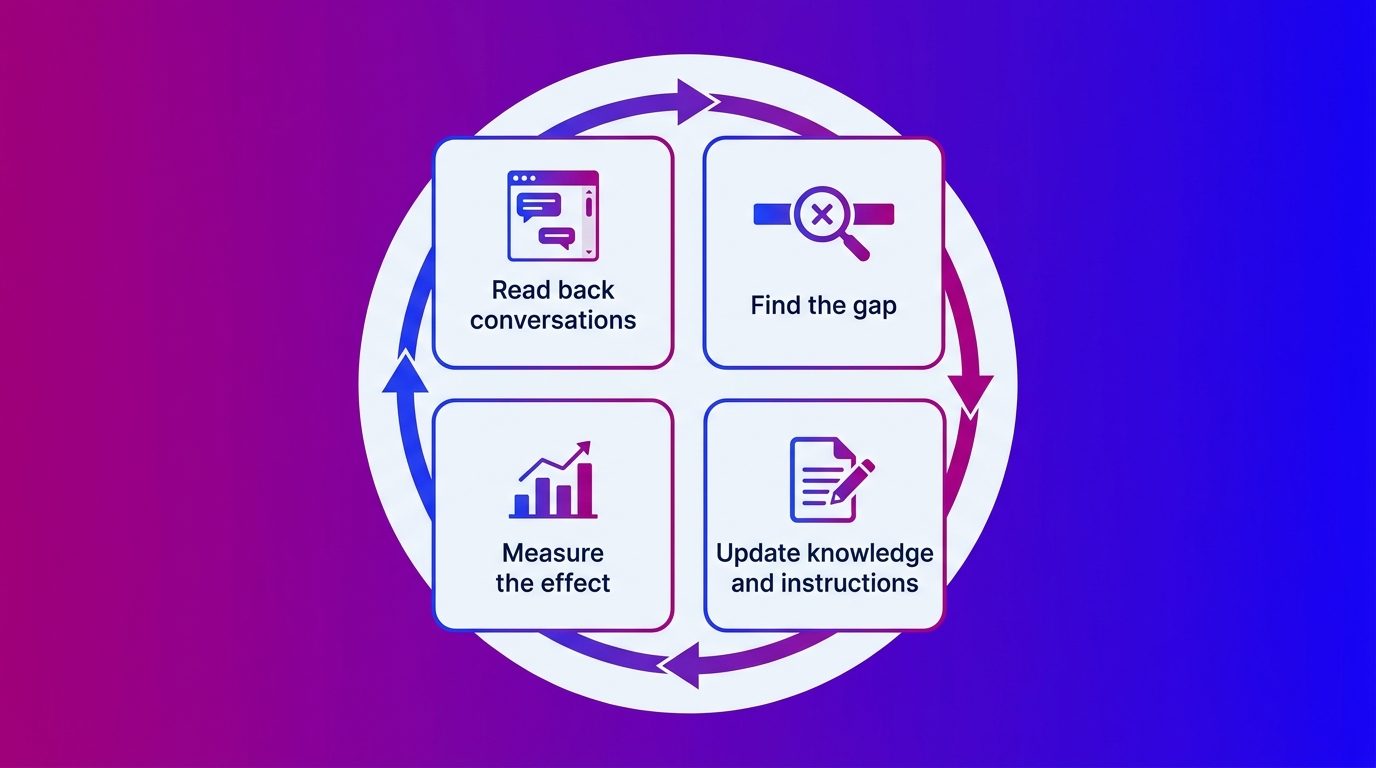
A conversational AI that keeps performing well is one that keeps learning. Read back conversations, find the places where the AI gets stuck, update knowledge, instructions and handover, and measure whether it improves. If you skip that, the AI stays stuck at its day-one level, with all the limitations of conversational AI that come with it.
Frequently asked questions about conversational AI training
How do you train conversational AI?
You train conversational AI by updating the knowledge base, the instructions and the handover rules based on real conversations. You read back conversations, find where the AI gets stuck and add what is missing. You do not need to train the language model itself.
How long does conversational AI training take?
The initial setup happens before go-live. After that, training does not stop: the first weeks after go-live need the most attention, because that is when most gaps become visible. After that, a fixed rhythm is enough.
What is the difference between training and optimising?
Training gives the AI its foundation: knowledge, instructions and the intents it must recognise. Optimising is the adjustment afterwards, based on real conversations. In practice they merge, because after go-live training is mainly optimising.
Can I train conversational AI myself?
Yes, if you have someone with structural time to read back conversations and keep the knowledge base up to date. If you do not have that time, you can leave the adjustment to a partner, so it does not get left undone.
How many conversations do you need for training?
You do not need thousands of conversations to start. The questions your team answers every week are enough for a first version. After go-live, real conversations provide the best training material.
How do you know whether the training works?
You can see it in fewer unnecessary handovers, fewer abandoned conversations, fewer repeated questions and more questions the AI handles on its own. Also read back conversations regularly, because figures do not always show whether an answer was actually correct.