A chatbot can help your customers quickly, but it can also frustrate them. Almost every disadvantage of a chatbot comes down to the same thing: it gets a question it cannot handle, and nobody takes over. Below are the disadvantages of chatbots set out honestly, with what you can do about each one.
What are the disadvantages of chatbots?
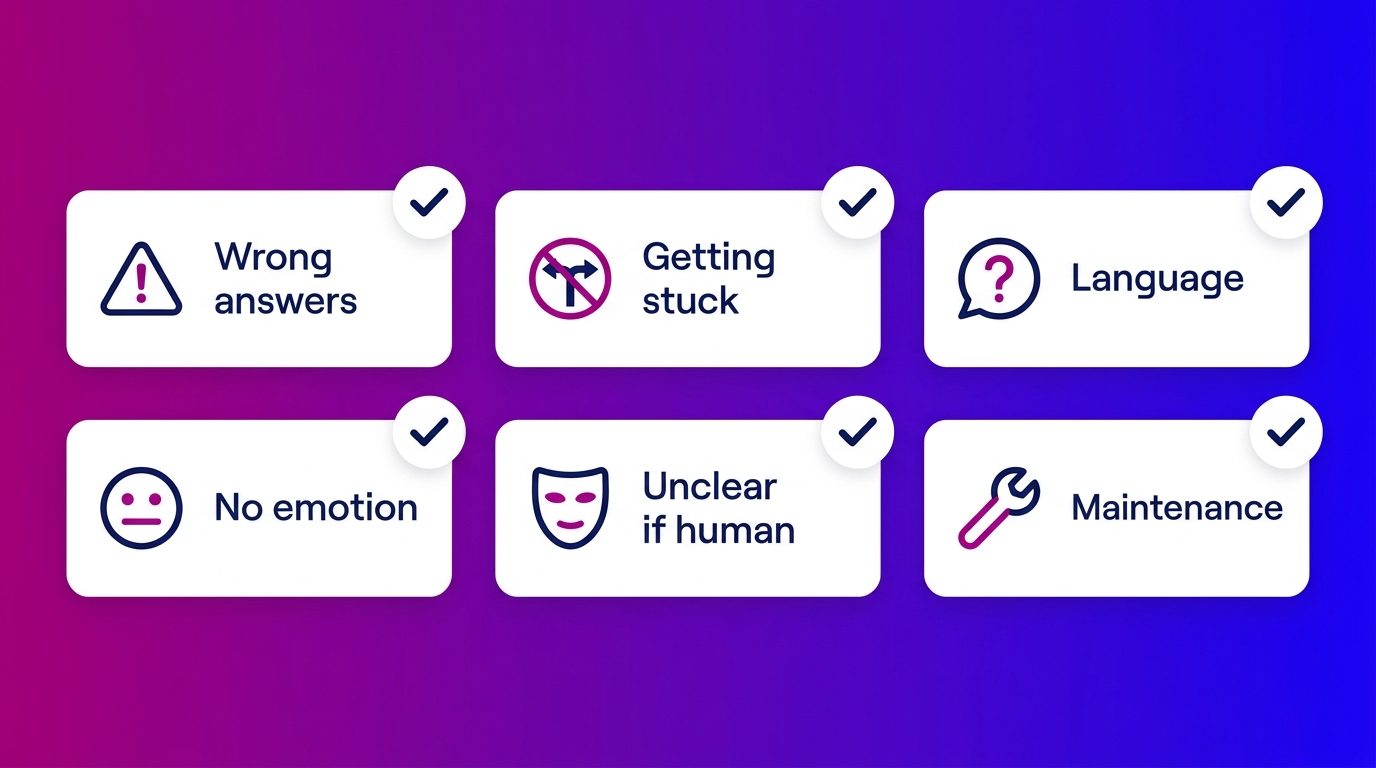
The main disadvantages of chatbots are wrong answers, getting stuck on specific questions, difficulty with language and emotion, unclarity about whether you are talking to a person, and the maintenance a chatbot requires. At a glance:
- Wrong or invented answers
- Getting stuck on specific questions
- Difficulty with spelling, language and dialect
- No emotion or empathy
- Unclear whether you are talking to a person
- Ongoing maintenance
How big those disadvantages are depends on the set-up. The rest of this article takes them one by one.
1. Wrong or invented answers
A chatbot can give a wrong answer with great confidence. With an AI chatbot that happens mainly when the knowledge source has a gap: the language model then fills in something that sounds logical but is not true, such as a delivery time or a condition that does not exist.
You prevent that by letting the chatbot answer only from your own, checked information, and by having it hand over as soon as the answer is not in there. You remain responsible for what it says.
2. Getting stuck on specific questions
A chatbot helps well with questions that keep coming back, but gets stuck on exceptions: a composite quote, a complaint with a history, a question about a specific situation. The visitor then gets a standard answer or a repetition of their own question.
That exact moment determines whether a chatbot works. A chatbot that recognises it is not getting anywhere and passes the conversation to a member of staff still delivers a customer who has been helped.
3. Difficulty with spelling, language and dialect
A chatbot with fixed buttons or keywords does not recognise a question if it is phrased differently, is full of typos or is asked in another language. An AI chatbot handles that far better, because it reads the meaning of a question instead of individual words. How that works is covered in how do chatbots work.
Language still needs attention, though. Technical terms, abbreviations from your sector and multilingual visitors call for a chatbot that has been tested on them.
4. No emotion or empathy
A chatbot can adopt a friendly tone, but it does not empathise. With a complaint, a disappointment or sarcasm, an automatic answer falls short, and a visitor who does not feel heard gets irritated sooner.
That is where a person comes in. Agree in advance on which signals make the chatbot hand over, such as a complaint, angry words or the same question a second time.
5. Unclear whether you are talking to a person
A chatbot with a name and a photo quickly looks like a member of staff. If a visitor realises halfway through that they are talking to a program, they feel misled.
It is not a free choice either. For businesses serving customers in the EU, the European Commission explains that the AI Act requires a chatbot to make clear from the start of the conversation that the person is interacting with an AI system. So be clear from the first message, wherever your customers are.
6. Ongoing maintenance
A chatbot is never finished. Prices, delivery times, terms and products change, and every change has to go into the chatbot too. New questions it does not yet know also keep coming in.
Anyone who underestimates that work sees the quality slowly decline. Allow regular time to read back conversations and update answers. How to go about that is covered in chatbot training.
How good is the quality of chatbot answers?
The quality of a chatbot depends less on the software than on three other things: the knowledge source it answers from, the boundaries you give it and how often someone reviews its conversations. A modern chatbot with a good knowledge source gives reliable, natural answers to frequently asked questions.
An answer from a bot is only as good as the information behind it. If that information is missing, you get a vague answer, a wrong answer or a referral. So test a chatbot with the questions customers really ask, not with the questions you think up yourself.
That is why quality ultimately comes down to maintenance: whoever keeps the knowledge source up to date and reads back conversations sees the answers improve.
Challenges of chat AI for businesses
Besides the disadvantages for the visitor, there are challenges for the business itself. The three main ones:
- Privacy: chat conversations often contain personal data. Record which data the chatbot asks for, where it is stored and who can access it. If a third party runs the chatbot for you, the ICO explains that a written contract between controller and processor is required under UK GDPR.
- Responsibility: you remain accountable for the information a chatbot gives, so keep control of its knowledge source and make sure there is always a route to human contact.
- Integrations: a chatbot that is not connected to your CRM or diary leaves leads and appointments lying around.
Anyone choosing between building and outsourcing weighs these challenges up. The trade-off is in building a chatbot yourself or outsourcing it.
When is a chatbot not a good idea?
A chatbot on its own is not a good idea if almost every question is bespoke, if conversations are often emotional, or if nobody has time to keep it up to date. With little website traffic, an extensive chatbot also delivers little.
In those cases human chat contact works better, or a combination in which a person does most of the work. The differences are shown in chatbot vs live chat.
How do you deal with the disadvantages of a chatbot?
Most disadvantages of a chatbot can be addressed with four agreements:
- One checked knowledge source: the chatbot answers only from information you have approved.
- Clear boundaries: record which questions the chatbot handles itself and which go straight to a person.
- Handover with the conversation attached: the member of staff sees what has already been discussed, so the customer does not have to repeat anything.
- Regular management: read back conversations every week and update answers.
With those four agreements, mainly the benefits of chatbots remain: speed, availability and fewer repeat questions.
How we address the disadvantages of chatbots
At Bconnect we see that the disadvantages only become visible where the chatbot is left on its own. That is why we work with three models: Operator Assisted AI, AI First + Human Handoff and AI Only. In the first two, one of our chat specialists takes over the conversation as soon as the AI cannot get any further.
Take a dealership. A visitor asks in the evening whether they can part-exchange their car and roughly what it would fetch. The AI answers the general questions about part-exchange and asks for make, model and mileage. If the visitor wants a concrete estimate, a chat specialist takes over and books a valuation appointment, with the whole conversation attached.
For every client we build a dedicated knowledge source, and after go-live our chat specialists read along to sharpen the answers. If you want to work that way, take a look at an AI chatbot with human handover.
Disadvantages are mainly a matter of set-up
The disadvantages of chatbots are real: wrong answers, getting stuck, no emotion and maintenance that never stops. But almost every disadvantage arises where a chatbot gets questions it cannot handle and there is no person to take over. With a checked knowledge source, clear boundaries and a handover to a member of staff, you keep the disadvantages small. What exactly a chatbot is, you can read in what is a chatbot. All the articles on this topic are in the overview of chatbots.
Frequently asked questions about the disadvantages of chatbots
What are the biggest disadvantages of a chatbot?
A chatbot can give wrong answers, gets stuck on specific questions, struggles with emotion and needs ongoing maintenance. The biggest disadvantage is a chatbot with no way out to a person: then the customer is left without help.
Can a chatbot give wrong answers?
Yes. An AI chatbot in particular can invent an answer that sounds logical but is not true, when the right information is missing. So let the chatbot answer only from your own, checked information and have it hand over when the answer is not in there.
Do customers find chatbots annoying?
Customers accept a chatbot for simple questions and value the speed. They get irritated when the chatbot does not help them further and no member of staff is reachable.
When is a chatbot not a good idea?
If almost every question is bespoke, if conversations are often emotional, if there is little website traffic, or if nobody has time to keep the chatbot up to date. Then human chat contact or a combination works better.
How do you prevent a chatbot getting stuck?
Give the chatbot a complete, up-to-date knowledge source, record which questions go straight to a person and make sure that handover also works outside office hours. Read back conversations to see where it got stuck.
How good is the quality of a chatbot?
That depends mainly on the knowledge source, the boundaries and the management. With good information, a modern chatbot gives reliable answers to frequently asked questions. Without management, the quality declines.
What are the benefits of a chatbot?
A chatbot always gives an immediate first answer, relieves your team of repeat questions and gets more enquiries from the same website traffic. All the benefits at a glance are in the article on the benefits of chatbots.