Saturday evening, 9.40pm. One customer wants to know whether their car will be out of the workshop on Monday, another when the new kitchen will be fitted. No difficult questions, but your team has already gone home.
AI customer service answers questions like these immediately. What AI cannot resolve goes to a person with the full context.
The line between what AI handles and what a person does determines whether AI makes your customer service better or simply unreachable. That line is also the subject of the rules that apply in the EU since August 2026.
What is AI customer service?
AI customer service is customer service in which an AI system understands and answers customer questions in plain language based on your company’s information. That happens via website chat, WhatsApp or email. If the AI cannot answer a question well, it hands the conversation over to a person.
The difference from a classic customer service chatbot lies in the freedom. A chatbot with buttons follows fixed paths: anyone who falls outside the script gets stuck. AI customer service also understands a question phrased slightly differently, asks follow-up questions when information is missing and summarises the conversation at a handover.
The AI that handles these service questions focuses on customers who have already bought or requested something: status, appointments, delivery times, standard requests.
How does AI customer service work?
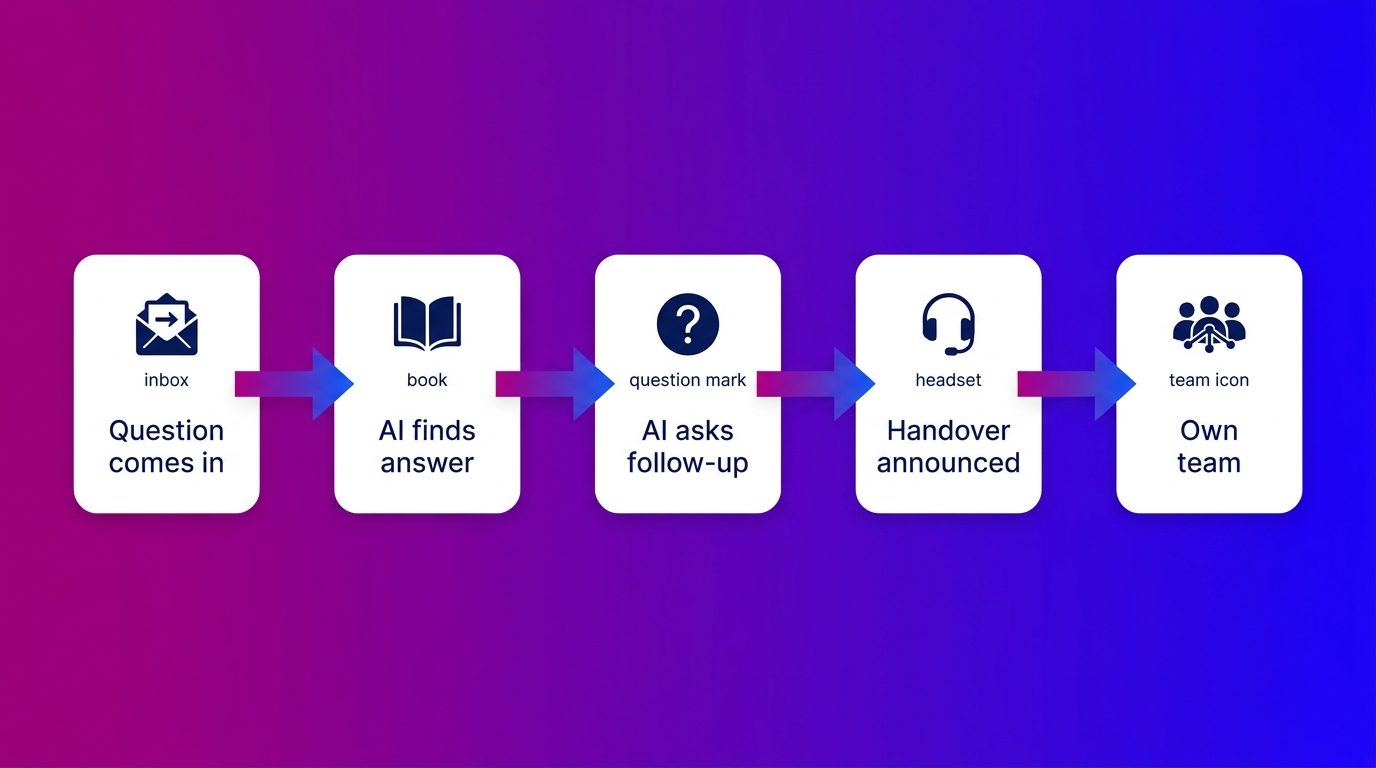
AI customer service works like a fixed route: the AI answers what it knows for sure, asks follow-up questions where information is missing and passes the conversation on as soon as a person is needed.
- The question comes in via chat, WhatsApp or email.
- The AI looks up the answer in the knowledge base: product information, terms, opening hours and, if there is an integration, the current status in your systems.
- The AI asks follow-up questions if the question is not yet complete, for example for the registration number or the order number.
- The AI announces the handover if the question is too complex or too sensitive. The person who takes over sees the whole conversation.
- What nobody can resolve in the first contact goes to the company’s own team with context.
Three ways to divide AI and people
How much the AI does itself is a choice. With AI Only the AI handles everything independently, which suits fixed questions such as status and appointment confirmations. With AI First + Human Handoff the AI holds the conversation and a specialist takes over where needed. With Operator Assisted AI a specialist holds the conversation and the AI helps in the background.
For most customer service teams, AI First + Human Handoff is the logical starting point: the AI absorbs the volume, people keep the exceptions. You can build that set-up yourself, have an AI chatbot set up for service questions, or hand your customer service AI and people to one partner that also provides the people.
Which service questions you automate, and on which channel
Automate a service question if the answer is in a source, is the same for every customer and carries little risk if it is not quite right once. Questions that require judgement, bespoke work or empathy stay with people.
Questions that automate well
- Status and planning: when is the car ready, when will delivery or fitting take place, has the quote been sent.
- Appointments: booking, moving or confirming a workshop appointment, or a reminder for the MOT.
- Fixed information: opening hours, directions, warranty conditions, what is needed for an appointment.
In the motor trade it is about questions on MOTs, servicing and the status in the workshop, for example. With AI you can catch service questions from car owners, even when the workshop is closed. In home and living, delivery time, fitting and quote status are the regulars.
Questions that belong with a person
Complaints, damage, deviating appointments and technical advice are not left to AI. A photo of a warning light belongs with the workshop, not with a language model.
Which channel for which question
Website chat suits questions that arise while browsing the site. WhatsApp suits status and follow-up, because the customer can read back and continue the conversation later. Email is the channel for longer questions with attachments, and that is where waiting time grows fastest.
Answering customer questions automatically via email and WhatsApp
Answering customer questions automatically via email and WhatsApp works differently from a chat on your website: there is no live conversation, but a stream of messages that AI reads, sorts and answers.
With email, the AI reads every incoming message, recognises the subject and answers the standard questions itself. What deviates, it passes to the right colleague, with a summary attached.
That way no email is left lying around because nobody knows who should pick it up. This kind of automation falls under customer contact workflows: you can have your email inbox answered with AI workflows, with automatic escalation to your team.
On WhatsApp, a fixed rule from Meta applies: as soon as a customer messages you, a service window opens in which you can reply freely. After it closes, you can only reach the customer with pre-approved message templates.
For AI that is an advantage: it responds within the window immediately, even at night. A question from Saturday evening then no longer expires before your team starts again on Monday.
Automating customer service with AI: what is already possible
Automating customer service with AI is possible today for questions in free text, in several languages and via all written channels, as long as the AI has access to reliable information.
What works well now
- Understanding free text, even with typos, colloquial language or three questions in one message.
- Answering in several languages without a separate script per language.
- Summarising at a handover, so the customer does not have to tell their story again.
- Looking up current data in a CRM, dealer management system or planning system, if there is an integration.
Where it still gets stuck
Without an integration, the AI only knows what is in the knowledge base. A status question then gets a general answer instead of the real status. A knowledge base also ages: new terms, changed opening hours or a new model have to go in, otherwise the AI gives old information with great conviction.
Where service questions become sales opportunities
A service question is rarely only about service. At Bconnect, AI and our chat specialists hold service conversations every day for car dealers and home and living businesses, and a second question often comes up in them.
A customer asking when their car will be out of the workshop may ask in the same conversation what their car is still worth in part-exchange. A customer checking the fitting date of their kitchen may also have a question about the utility room. An AI that only answers the service question leaves that opportunity lying there.
That is why we set up the handover so that buying signals do not disappear. If the AI recognises a commercial question, a chat specialist takes over the conversation, or the question goes to the sales team with the transcript. That way you can turn service questions into sales opportunities without the customer feeling they are getting a sales pitch.
The starting point: the customer always knows they are talking to AI, and a person is reachable when it gets complicated. Our specialists are available from 08:00 to 23:30, seven days a week. Outside those hours the AI catches the questions and a specialist or the client’s own team picks up the rest the next morning.
What AI in customer service does not solve
AI does not fix a customer service that people cannot reach. That is also the core of the criticism of badly set-up AI: customers accept a chatbot for simple questions, but lose trust when it becomes a wall between them and a human.
What regulators and the law require
The ICO reminds organisations that they remain responsible for personal data handled by a supplier: under UK GDPR a written contract between controller and processor is required whenever a third party processes customer data for you, which includes an AI provider running your chat.
Transparency is a legal obligation for anyone serving customers in the EU. Since 2 August 2026, the AI Act requires that people are informed when they are interacting with an AI system, as the European Commission explains.
For AI customer service that means: the AI introduces itself as AI, invents nothing when it does not know the answer, and hands over to a person as soon as the customer asks for one.
What AI customer service costs and how to start
The cost of AI customer service depends mainly on the split between AI and people, the number of conversations, the channels and the integrations with your systems. The more the AI handles independently, the lower the cost per conversation, but the more important a good knowledge base becomes.
Do not forget maintenance in a comparison. An AI that is not adjusted gets worse after a few months, because the offering and the terms change. What the pricing models look like is covered in customer service outsourcing cost.
How to start
- Collect the questions your team gets most often, per channel.
- Split them into questions with a fixed answer and questions that require judgement.
- Record the sources for the fixed answers: terms, delivery times, opening hours.
- Decide the handover moment: when does a person take over, and who is that outside office hours?
- Read along in the first weeks and adjust the answers.
AI for the predictable, people for the rest
AI customer service works best if you do not see it as a replacement for your team, but as the first line that takes over the predictable work. Status questions, appointments and fixed information AI handles day and night. Complaints, exceptions and commercial opportunities belong with people, with the full context of the conversation.
Anyone who draws that line sharply and always lets the customer know who they are talking to gets a customer service that is faster without becoming unreachable. All the topics are brought together in our overview of customer service.
Frequently asked questions about AI customer service
What is the difference between AI customer service and a chatbot?
A classic chatbot follows fixed paths with buttons or keywords and gets stuck if a question falls outside the script. AI customer service understands questions in plain language, asks follow-up questions when information is missing and hands the conversation to a person with a summary if needed.
Can AI take over customer service completely?
For predictable questions such as status, opening hours and appointment confirmations, AI can work independently. A complete customer service without people is not wise: complaints, exceptions and complex questions require judgement, and customers should always be able to reach a person.
Which questions can AI not answer well?
AI struggles with questions whose answer is not in the knowledge base or a connected system, with complaints involving emotion and with technical assessments. A well set-up AI recognises those questions and hands them to a person instead of inventing an answer.
Does a customer have to know they are talking to AI?
For anyone serving customers in the EU, yes: since 2 August 2026 the transparency obligation of the AI Act applies, so users must clearly know they are communicating with an AI system and not with a person. It is also sensible for trust, because customers accept AI more readily when they know where they stand.
What does AI customer service cost?
The costs depend on the split between AI and people, the number of conversations per month, the channels and the integrations with your systems. Also allow time or budget for maintaining the knowledge base, because the offering and the terms keep changing.
How quickly is AI customer service set up?
That depends mainly on the channels and the integrations. An AI that answers fixed questions on the website chat goes live faster than a set-up that also looks up statuses in a dealer management system or planning system. In any case, allow for a period after go-live in which you read along and adjust.
Does AI customer service work with our CRM or dealer management system?
Yes, if there is an integration. Through an integration the AI can look up current data, such as the status of a workshop order, and write conversations or requests back. Without an integration the AI only answers questions based on the knowledge base and requests come in by email.
Can AI customer service also answer in other languages?
Yes. Modern AI understands and answers questions in several languages without a separate script per language. Do pay attention to the handover: the person who takes over the conversation must also speak the customer’s language.