A chatbot answers immediately and always, but gets stuck as soon as a question deviates. Live chat with people understands every question, but is not staffed day and night. Most businesses torn between the two are asking the wrong question. It is not chatbot or live chat, but who holds which part of the conversation.
What is the difference between a chatbot and live chat?
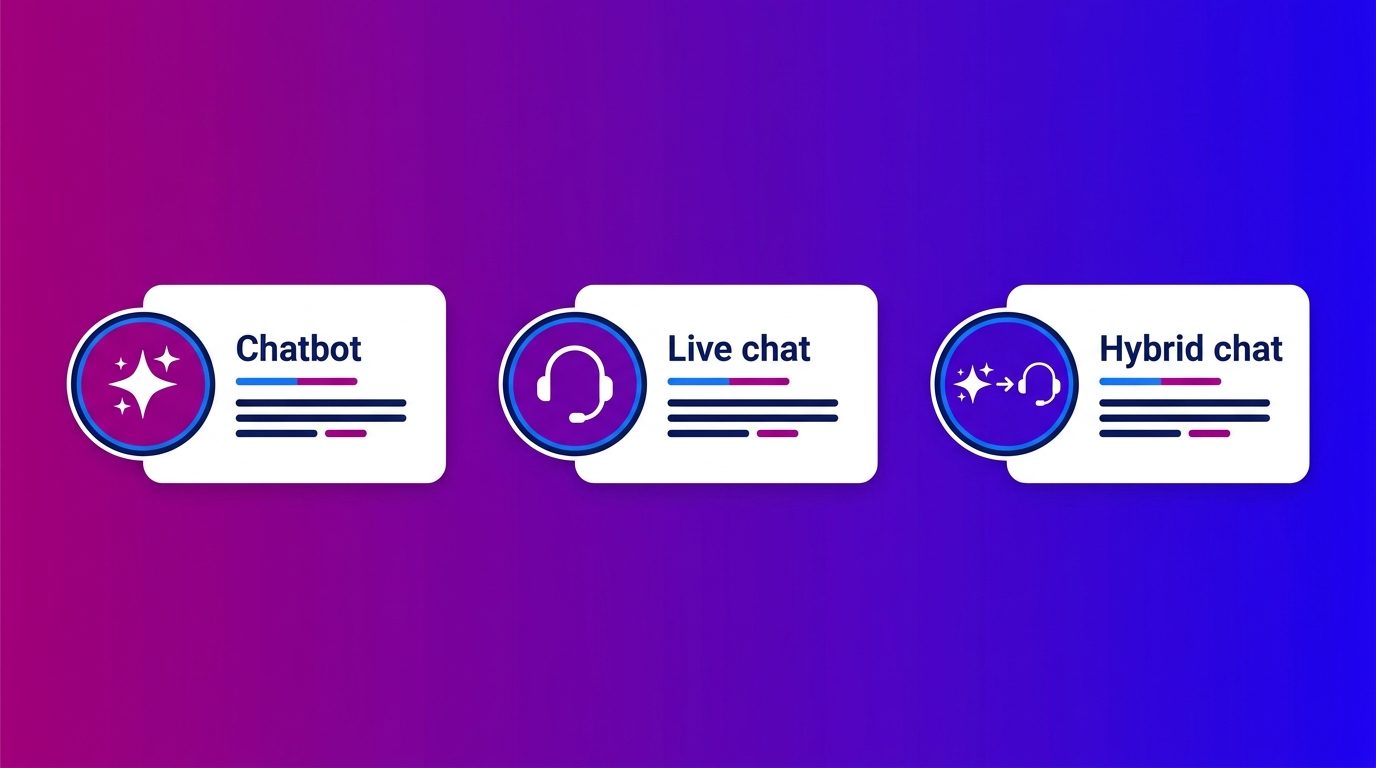
With a chatbot, software gives the answer; with live chat, a person does. The chat window on your website looks the same in both cases; the difference lies in who is behind it.
A chatbot works with fixed answers or with AI and is available day and night. What exactly a chatbot is and which types exist is covered in what is a chatbot. With live chat, a member of staff or chat specialist types along in real time, with all the knowledge and judgement of a person.
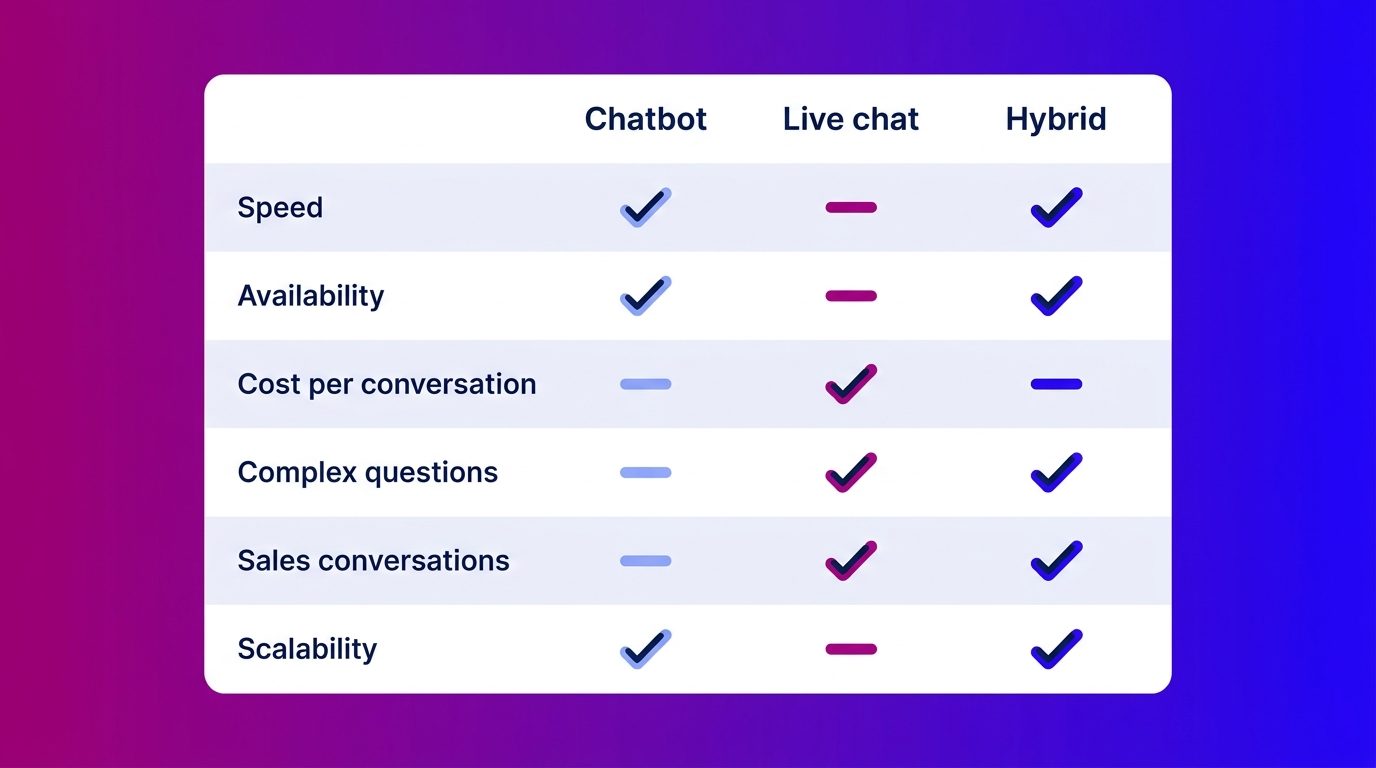
Chatbot vs live chat: a comparison on six points
A chatbot wins on speed, availability and cost per conversation; live chat wins on complex questions and sales conversations. A hybrid set-up gets the best of both.
When do you choose a chatbot?
Choose a chatbot if most questions are predictable and have a short, factual answer. Think of opening hours, delivery times, the status of an order or the conditions of a warranty.
A chatbot also fits if you mainly want to be available outside office hours and the volume is too high to have everything answered by people. What that delivers is in the benefits of chatbots. Where it goes wrong is covered in the disadvantages of chatbots: mainly with questions that deviate from what it knows.
When do you choose live chat with people?
Choose live chat with people if your visitors need advice before they buy, or if a wrong answer costs you a customer. With a car, a kitchen or made-to-measure windows, a visitor asks questions that sit just outside the standard.
A person hears the doubt behind a question, asks follow-up questions and knows when suggesting an appointment is appropriate. That is hard to automate. If you would rather not hold those conversations with your own team, you can work with external chat specialists for your live chat. If it is mainly about availability for existing customers, customer service via chat is the better fit for your question.
AI or human customer service: what do customers expect?
Customers accept a chatbot for simple questions, but want a person as soon as it gets complicated. They value the speed of a chatbot for a quick factual answer, and lose patience when the chatbot keeps them in a loop.
Two things weigh heavily here. Customers want to know whether they are talking to a chatbot or a person, and they want to be able to switch to a member of staff easily. For businesses serving customers in the EU, the first point is a legal requirement: the European Commission explains that under the AI Act people must be informed from the start that they are interacting with an AI system. A chatbot with no way out to a person is therefore not a saving, but a risk.
The third option: a chatbot that hands over to a person
For most businesses the best choice is not a choice: a chatbot that starts the conversation and a person who takes over as soon as needed. That set-up is called hybrid chat.
It works in three steps:
- The AI catches the question: it answers the standard questions immediately, including evenings and weekends.
- The AI recognises its limit: with doubt, a complaint, an exception or a concrete buying question, it announces a handover.
- A person takes over: with the full conversation attached, so the visitor does not have to repeat anything.
The difference from a stand-alone chatbot lies in step 2. A chatbot that does not know when to stop produces exactly the frustration customers report. With a chatbot that hands over to a person, that limit is fixed in advance.
That is also where the future of live chat lies: not AI or people, but AI holding the first part of the conversation and a person taking over where it matters. How an AI chatbot is built for that is covered in the article on how chatbots work.
How we set up the choice between people and AI
At Bconnect we do not leave the choice between chatbot and live chat to the visitor, but put it in the set-up. We work with three models. With Operator Assisted AI the person comes first: our chat specialists hold the conversation and AI supports them. With AI First + Human Handoff the AI comes first and a specialist or your own team takes over where needed. With AI Only the AI handles everything itself.
An example from automotive. A visitor asks in the evening about the range of an electric car. The AI answers that immediately from the dealer’s knowledge base. Then the visitor asks whether their current car can be part-exchanged and whether they can take a test drive on Saturday. That is the moment a specialist takes over: they ask about the part-exchange car, record the test drive and pass the request with the whole conversation to the right branch.
If the visitor later sends a question via WhatsApp or email, it arrives in the same inbox, with the earlier chat attached. How that works across channels is explained on our omnichannel page.
The question is not whether, but when
A chatbot is fast, always available and cheap per conversation, but gets stuck on questions that deviate. Live chat with people is strong in advice and sales, but not staffed day and night. Anyone who combines both and fixes in advance when the chatbot brings in a person does not have to choose. More about chatbots and how to use them is in the overview of chatbots.
Frequently asked questions about chatbot vs live chat
Which is better: a chatbot or live chat?
That depends on your questions. For predictable questions with a short answer, a chatbot is faster and cheaper. For advice, sales and exceptions, live chat with people is stronger. For most businesses a combination works best.
Can a chatbot replace live chat?
For simple questions, yes; for complex questions and sales conversations, no. Customers want to be able to reach a member of staff if the chatbot does not help them, and a chatbot without that route to a person quickly becomes a liability.
When should a chatbot hand over to a person?
When it is unsure of the answer, with a complaint, with a question that deviates from the standard and with a concrete buying question such as a test drive or quote. If the visitor asks for a member of staff themselves, the chatbot should hand over immediately as well.
What does live chat cost compared with a chatbot?
A chatbot is cheaper per conversation, because no person is involved. Live chat costs more because of the staffing, but often delivers more in advisory conversations. A hybrid set-up only uses people where they add something.
Can you combine a chatbot and live chat?
Yes. In a hybrid set-up the chatbot answers the standard questions and a person takes over the conversation as soon as needed, with the full conversation attached. The visitor simply uses the same chat window.
Do customers notice they are talking to a chatbot?
They should. A chatbot should make clear that the visitor is talking to an AI system. Customers value that clarity, as long as they can easily switch to a person.
What is hybrid chat?
Hybrid chat is a set-up in which a chatbot and people work together in the same chat window. The chatbot catches the first questions and hands the conversation to a member of staff as soon as a question calls for knowledge, advice or judgement.