A chatbot only delivers if it solves a problem you already have: questions left unanswered, visitors dropping out or a team typing the same answers every day. Below are the seven benefits that make the difference in practice, each with what it concretely means for your enquiries and your service.
What are the benefits of chatbots?
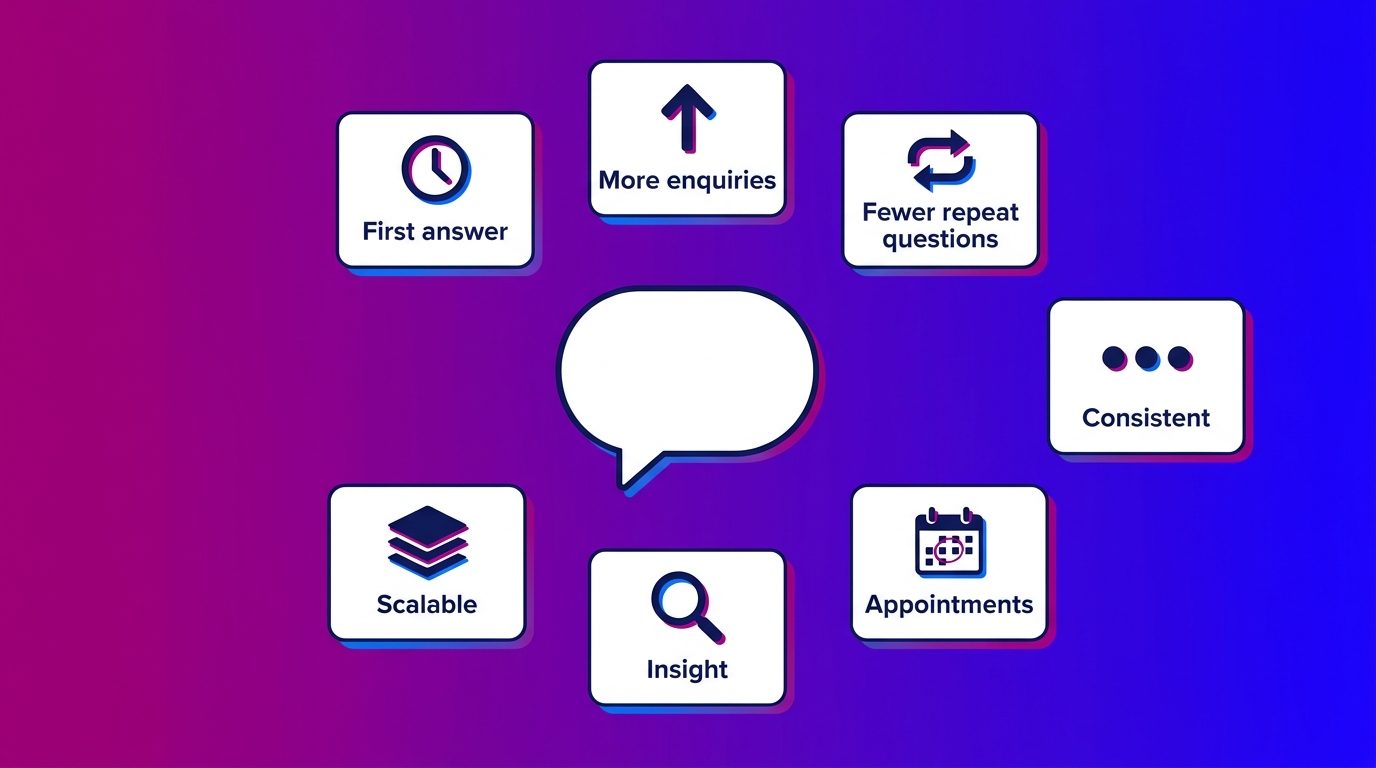
Why a chatbot? The main benefits of chatbots are speed, availability and relief for your team, and as a result more enquiries from the same website traffic. The strength of a chatbot lies in that combination. At a glance:
- Always a first answer, including evenings and weekends
- More enquiries from existing traffic
- Fewer repeat questions for your team
- Consistent answers on every channel
- Appointments booked straight away
- Insight into what visitors ask
- Scalable without extra people
What exactly a chatbot is and which types exist is covered in what is a chatbot.
1. Always a first answer
A chatbot answers immediately, at any time of day. Many visitors do their research outside office hours in particular, and without an answer they carry on looking elsewhere.
Visitors value that speed most with simple questions. A delivery time, an opening time or a warranty question does not have to wait until tomorrow.
2. More enquiries from existing traffic
A chatbot turns questions into enquiries while the visitor is still on your site. It answers the question, asks about the wish behind it and records contact details. That is how you raise conversion with a chatbot, without needing more visitors.
Speed makes the difference here. Research in the Harvard Business Review showed back in 2011 that most companies respond far too slowly to online enquiries, while those enquiries cool off quickly. A chatbot removes that waiting time. More on this approach is on our page about generating leads via chat.
3. Fewer repeat questions for your team
A chatbot takes over the questions your team answers again every day. That leaves staff with time for conversations where they really add something: advice, a complaint, a hesitant buyer.
That benefit is greatest where many of the same questions come in, such as delivery, lead times and opening hours. For the questions a chatbot should leave to people, see the disadvantages of chatbots.
4. Consistent answers on every channel
A chatbot gives the same answer whether the question comes in via website chat, WhatsApp, email or SMS. It works from one knowledge source, so a changed delivery time only has to be updated in one place.
With staff, the answer often differs per person and per day. A chatbot removes that noise.
5. Appointments booked straight away
A chatbot can record an appointment immediately, connected to your diary or CRM. Think of a test drive at a dealership or a showroom or measuring appointment in home and living.
That way a conversation does not end with “we will call you back”, but with a concrete appointment in your salesperson’s diary.
6. Insight into what visitors ask
Every chat is a question you would otherwise never have seen. Anyone who reads back the conversations sees where visitors get stuck, which information is missing from the website and which products often raise questions.
That insight helps you improve your website, your offering and your chatbot itself.
7. Scalable without extra people
A chatbot holds dozens of conversations at the same time, without a queue. A busy campaign or a seasonal peak therefore does not require extra staff.
For the conversations that do need a person, it hands over to your team. That way your availability grows without your staff costs growing with it.
When do the benefits not outweigh the drawbacks?
The benefits do not outweigh the drawbacks when a chatbot gets questions it cannot handle and there is no person to take over. Then it produces frustration instead of enquiries.
That risk is greatest with bespoke work, complaints and questions that differ per customer. Where it can go wrong is covered in the disadvantages of chatbots. If you are unsure whether to build it yourself or outsource it, see building a chatbot yourself or outsourcing it.
What those benefits deliver in practice
At Bconnect we see that the benefits only come into their own together: a quick first answer, follow-up questions, an appointment or lead, and a person who takes over where needed.
Take a kitchen showroom. In the evening a visitor asks about the delivery time of a kitchen and whether installation is included. The AI answers that immediately, asks for the dimensions of the room and suggests a showroom appointment. If the visitor wants advice on a bespoke solution, one of our chat specialists takes over the conversation, with everything that has already been discussed.
The appointment and the conversation go straight to the sales team. If you would rather not set up and maintain such a chatbot yourself, you can have a managed AI chatbot built and run for you. More examples per sector are in the chatbot examples.
Benefits you only notice once a person takes over
A chatbot delivers speed, availability and relief, and as a result more enquiries from the same traffic. Those benefits only hold up if the chatbot knows when to hand over to a person. Get that right and you get the most out of both. All the articles on this topic are in the overview of chatbots.
Frequently asked questions about the benefits of chatbots
What are the main benefits of chatbots?
A chatbot always gives an immediate first answer, turns questions into enquiries, relieves your team of repeat questions, gives consistent answers on every channel, books appointments, gives insight into what visitors ask and scales without extra people.
What are the benefits of an AI chatbot compared with an ordinary chatbot?
An AI chatbot understands free questions, even with typos or in colloquial language, and does not have to choose from a fixed menu. That lets it help with more questions than a chatbot with buttons. It does require a good knowledge source and clear agreements about when it hands over.
Why would a business use a chatbot?
To help visitors immediately, including outside office hours, and to get more enquiries from existing website traffic. It also leaves the team with time for conversations where a person makes the difference.
What are the disadvantages of a chatbot?
A chatbot gets stuck on questions outside its knowledge and needs ongoing maintenance. Without a handover to a person, visitors then get frustrated.
Does a chatbot generate more leads?
A chatbot can produce more enquiries, because it responds immediately and asks follow-up questions while the visitor is still on your site. How much that delivers depends on your visitor numbers, your offering and how well the chatbot is set up.
Is a chatbot suitable for small businesses?
A simple chatbot can be useful for any business if many of the same questions come in. A chatbot with management and handover to a person pays off mainly with enough visitors on your website.
Does a chatbot replace my customer service?
No. A chatbot takes over the simple questions, but for complaints, exceptions and advice a person is still needed. The best results come from a combination of both.