The best chatbot examples right now do not come from demos, but from businesses that have been working with them for years: from a payments company and a furniture retailer to an airline that learnt an expensive lesson. They show what a chatbot delivers, and also where it goes wrong.
Below you will find chatbot examples with name, source and result. For each example you see what kind of chatbot it is, which task it has and which lesson it holds.
What are examples of chatbots?
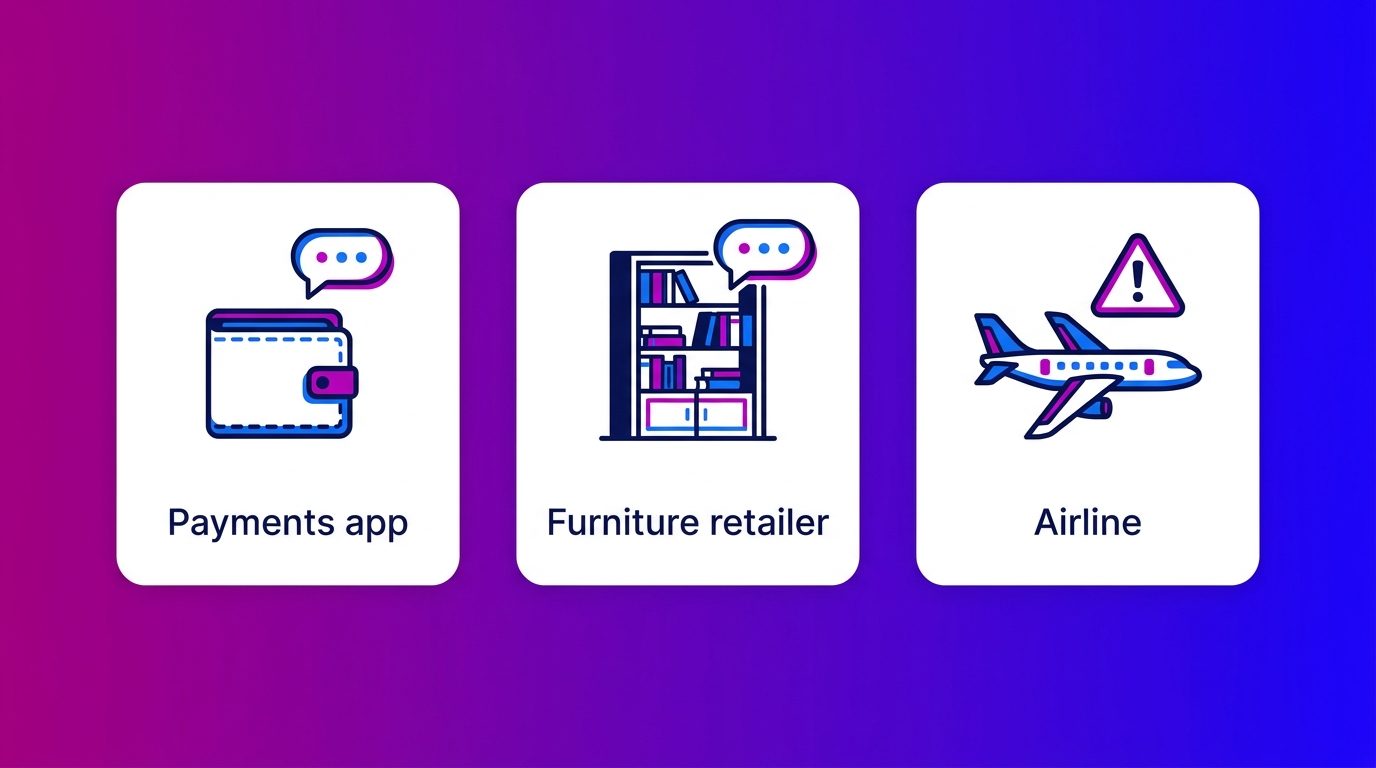
Well-known chatbot examples are the AI assistant in the Klarna app and Billie at IKEA. They differ in technology and task, but they all answer questions that keep coming back, and the best ones use a person for the rest. Many businesses start smaller, with a menu bot or a click bot for a handful of fixed tasks.
What exactly a chatbot is and which types exist is covered in what is a chatbot.
Example of an AI chatbot: Klarna
An AI chatbot understands free questions and formulates an answer itself, and through integrations can also arrange something. Klarna is one of the best-documented examples, precisely because it also shows what it costs.
The Swedish payments company launched an AI assistant in its app in February 2024. In its first month it held 2.3 million conversations, two thirds of all customer service chats, in 35 languages, as Euronews reported at the time. It handles refunds, returns and payment questions around the clock.
Just over a year later, Klarna adjusted course. Customers must always be able to speak to a person if they want to, the company told CX Dive in May 2025, and it started recruiting customer service staff again. The AI still handles a large share of the questions, but Klarna invests in people again for the conversations that matter.
Klarna’s example comes from e-commerce and payments, where a chatbot mainly catches questions about orders, delivery and returns. With advisory products such as a car or a kitchen, the limit comes sooner: then the question is whether you choose a chatbot or live chat, or a combination of both.
Chatbot examples in home and living and automotive
In sectors where customers want advice before they buy, a chatbot works best as a front door: it handles the routine and passes the customer to someone who can advise. IKEA is the best-known example of that.
IKEA: chatbot for the routine, people for the advice
IKEA retailer Ingka Group has been using the AI chatbot Billie since 2021 for questions about orders, stock and stores. According to Reuters, as reported by Retail Week, Billie handled 47% of customer enquiries in the two years after its launch.
The interesting part is what IKEA did with the time freed up. Ingka trained around 8,500 call centre workers as interior design advisers for remote consultations, and expanded those design services to the UK in 2023. The questions the chatbot could not answer turned out to be a sales opportunity.
For a kitchen showroom, a window and door company or a bathroom specialist that is recognisable. A chatbot can answer questions about delivery times and sizes, but a visitor who is unsure about a design wants to speak to a person. How that works in the sector is explained on our page about chat for home and living.
Automotive: the test drive as the goal
At dealerships a good chatbot revolves around one goal: from a question to an appointment. It answers questions about models, specifications and range, suggests a test drive or workshop appointment and passes the request to the right branch.
As soon as the question concerns part-exchange, finance or a concrete price, a person should take over. That is no detail, as the following example shows. More about the approach in this sector is on our page about chat for the automotive sector.
When a chatbot goes wrong
The best-known failed chatbots have one thing in common: they were not given clear boundaries. One example shows what happens then.
Air Canada: responsible for every answer
Air Canada’s chatbot told a traveller that he could apply for a bereavement discount after booking a flight to a funeral. That turned out to be wrong. Air Canada argued that the chatbot was responsible for its own answers, but a Canadian tribunal rejected that in February 2024: the chatbot is simply part of the website, the tribunal found, as the American Bar Association describes. The traveller was awarded damages.
The lesson: what your chatbot promises, you have promised. A link to the correct terms underneath a wrong answer does not make it right.
A second lesson comes from businesses that put a general language model on their website without boundaries. A language model that is allowed to talk about everything will agree to everything, including prices and commitments the business never intended to make. A chatbot that is not allowed to promise prices or appointments must really not be able to.
What the good examples have in common
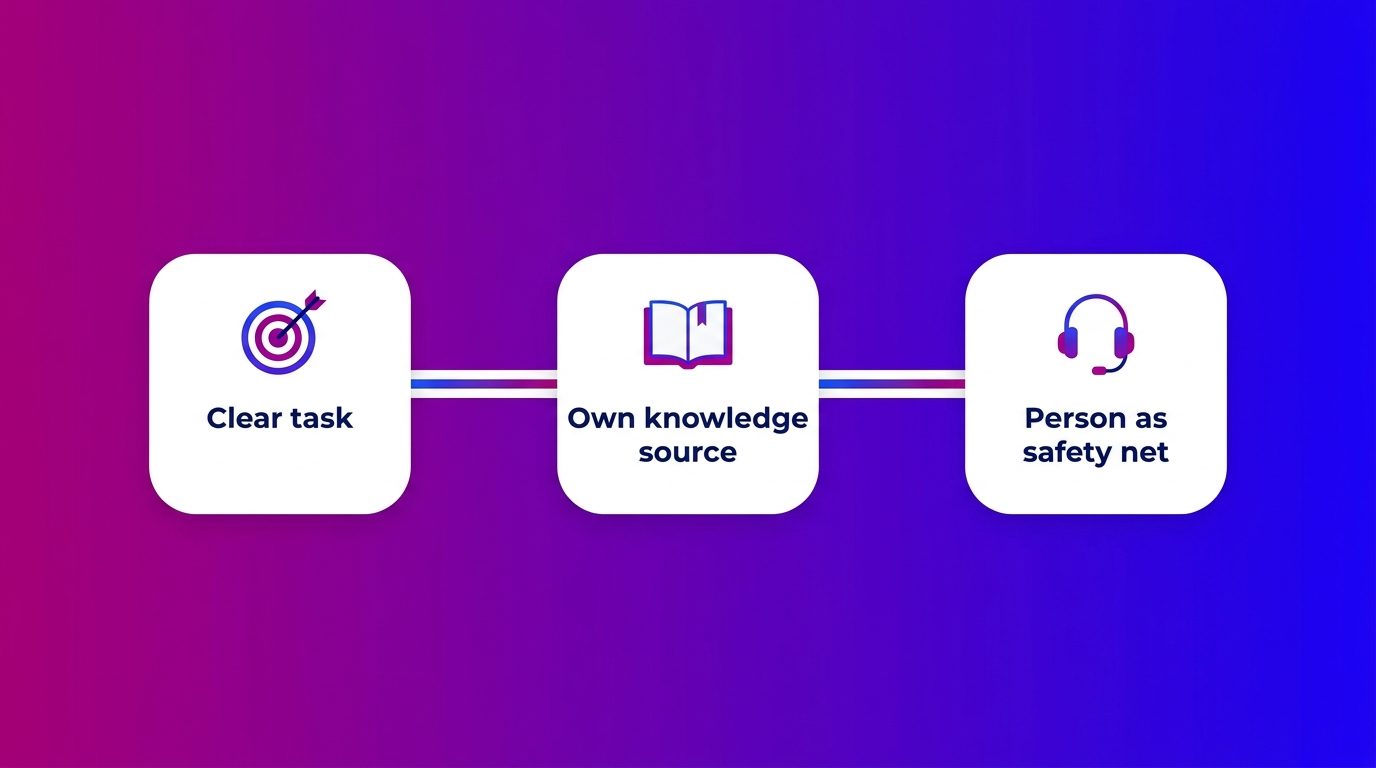
The chatbots that work have three things in common: a clear task, their own knowledge source and a person as a safety net. The difference between IKEA and Air Canada is not in the technology, but in those three choices.
- A clear task. Billie at IKEA answers the routine questions. Every good chatbot knows what it does and does not do, and promises nothing it is not allowed to promise.
- Its own knowledge source. A chatbot is only as good as the information it draws on. Anyone who does not keep that source up to date gets an Air Canada situation. How to go about that is covered in chatbot training.
- A person as a safety net. Klarna came back to it after a year, IKEA built a sales channel on it. The handover to a person determines whether a customer leaves having been helped. The difference between the two is covered in chatbot vs live chat.
You can make those three choices yourself, or have them made for you. The trade-off is in building a chatbot yourself or outsourcing it. If you would rather not do the work yourself, you can see how Bconnect deploys AI chatbots that are set up and managed for you.
Chatbot trends: where the development is heading
The main chatbot trends are not about smarter answers, but about what a chatbot is allowed to do and when it brings in a person. Anyone following chatbot development over recent years sees four shifts.
From answer to action. Chatbots increasingly not only answer questions, but also arrange something: a refund, a change of address, an appointment. How that works technically is covered in how do chatbots work.
AI is becoming mainstream. According to the Office for National Statistics, around 3 in 10 UK businesses reported using at least one type of AI technology in September 2026, up from 9% when the question was first asked in September 2023. Consumers are getting used to it as well: Ofcom counted 1.8 billion UK visits to ChatGPT in the first eight months of 2025. Visitors who talk to AI every day expect a business chatbot to be at least as good.
The person stays available. After Klarna’s change of course, a clear route to a member of staff is the norm. A chatbot without a way out produces exactly the frustration businesses want to avoid. Where that goes wrong is covered in the disadvantages of chatbots.
Transparency is mandatory. Since 2 August 2026 the transparency rules of the EU AI Act apply. According to the European Commission, people must know when they are talking to an AI system. For any business serving customers in the EU, a chatbot that pretends to be a member of staff is no longer an option.
How we make people and AI work together at dealers and home and living retailers
We see the lesson from Klarna and IKEA every day: a chatbot only really delivers once it is fixed in advance what the AI does itself and when a person takes over the conversation. At Bconnect we set that boundary per client, in three models. With Operator Assisted AI our chat specialists hold the conversation with AI support, with AI First + Human Handoff the AI holds the conversation and a specialist takes over where needed, and with AI Only the AI handles everything itself.
Which model fits depends on the questions. Predictable service questions, such as a delivery time or an appointment confirmation, the AI can handle well on its own. A visitor who is torn between two models or wants to know what their part-exchange is worth wants someone who asks follow-up questions. How that works out for dealers and showrooms is shown in our case studies.
What is the same for every client: we build the knowledge base together from the business’s own information, and a handover is announced and goes to the specialist or the sales team with the full conversation.
What you take away from these examples
The best chatbot examples all show the same thing: the technology does not make the difference, the choices around it do. Klarna works because people stay available, IKEA because people do the advice, and Air Canada went wrong because boundaries were missing. Anyone who gives a chatbot a clear task, lets it answer from its own information and keeps a person on hand is in the list of good examples. What a chatbot can deliver for your business is covered in the benefits of chatbots. All the topics around this theme are in the overview of chatbots.
Frequently asked questions about chatbot examples
What are examples of chatbots?
Well-known examples are the AI assistant in the Klarna app and Billie at IKEA. On business websites you see chatbots that answer questions about products, book appointments and pass visitors to a member of staff.
Which businesses use chatbots?
Chatbots are used by payment companies, online shops, home and living retailers, dealerships and public bodies. The common denominator is that many of the same questions come in, such as about opening hours, delivery times, orders or appointments.
What is an example of an AI chatbot?
Klarna’s assistant is a well-known example: it understands free questions in 35 languages and handles refunds and returns, among other things. Billie at IKEA answers questions about orders, stock and stores and passes the rest to people.
Is ChatGPT a chatbot?
Yes, ChatGPT is an AI chatbot, but a general one. It knows a lot about many subjects and nothing about your business. A chatbot on a business website is set up on the offering and terms of one business and only talks about agreed topics.
How do I build a chatbot like that myself?
Start with the questions that come in most often now, choose a type of chatbot and build a knowledge source with the right answers. Record when the chatbot brings in a person and test with real questions. After that, someone has to keep the chatbot up to date.
What are the main chatbot trends?
Chatbots increasingly carry out actions themselves, AI use among UK businesses keeps growing, a clear route to a member of staff has become the norm, and since August 2026 chatbots serving EU customers must make clear that the user is talking to AI.
Why do chatbots sometimes go wrong?
Usually because they have no clear boundaries. A chatbot that is allowed to talk about everything or draws on outdated information gives wrong answers or makes commitments the business does not want to make. The business remains responsible for that.