You can build a chatbot yourself today without any programming knowledge. The software is not the problem. The question is who fills, tests, connects and, months later, still maintains the chatbot. That is where the real work is, and that is also where most of the cost is.
This guide puts both routes side by side: what building a chatbot yourself requires, what the cost consists of and when outsourcing is the better choice.
Building a chatbot yourself: what is involved?
Building a chatbot yourself means you arrange four things yourself: the technology, the knowledge, the integrations and the maintenance. Choosing the platform is usually the easy part.
Technology and platform
You choose a build platform, set up the conversation flows or the AI model and place the chatbot on your website. With today’s tools that is often done in a few days. A working chatbot is not yet a good chatbot, though.
Knowledge and answers
A chatbot only knows what you tell it. You collect product information, terms, delivery times and the questions customers really ask, and turn that into answers that are correct. That is more work than most businesses expect, and it does not stop at go-live. How to go about it is covered in chatbot training.
Integrations and responsibility
A chatbot only delivers once the result lands somewhere: a lead in your CRM, an appointment in your diary. You are also responsible for what it says. If you serve customers in the EU, the European Commission explains that under the AI Act a chatbot must make clear that the person is interacting with an AI system. And if a third party processes the chat data for you, the ICO explains that a written contract between controller and processor is required under UK GDPR.
Chatbot cost: what does it consist of?
The cost of a chatbot consists of six items, and the software licence is rarely the largest of them. Anyone who only looks at the subscription underestimates how much a chatbot costs.
- Build and set-up: setting up conversation flows or the AI model, defining the tone, placing the chatbot on the website.
- Filling the knowledge: collecting all the information and turning it into correct answers.
- Integrations: connection with CRM, diary, ticketing system or stock.
- Training and management: reading back conversations, correcting wrong answers, adding new questions.
- Staffing: who takes over the conversation when the chatbot gets stuck, including evenings and weekends?
- Usage costs: per conversation or per message, for example with AI models or WhatsApp.
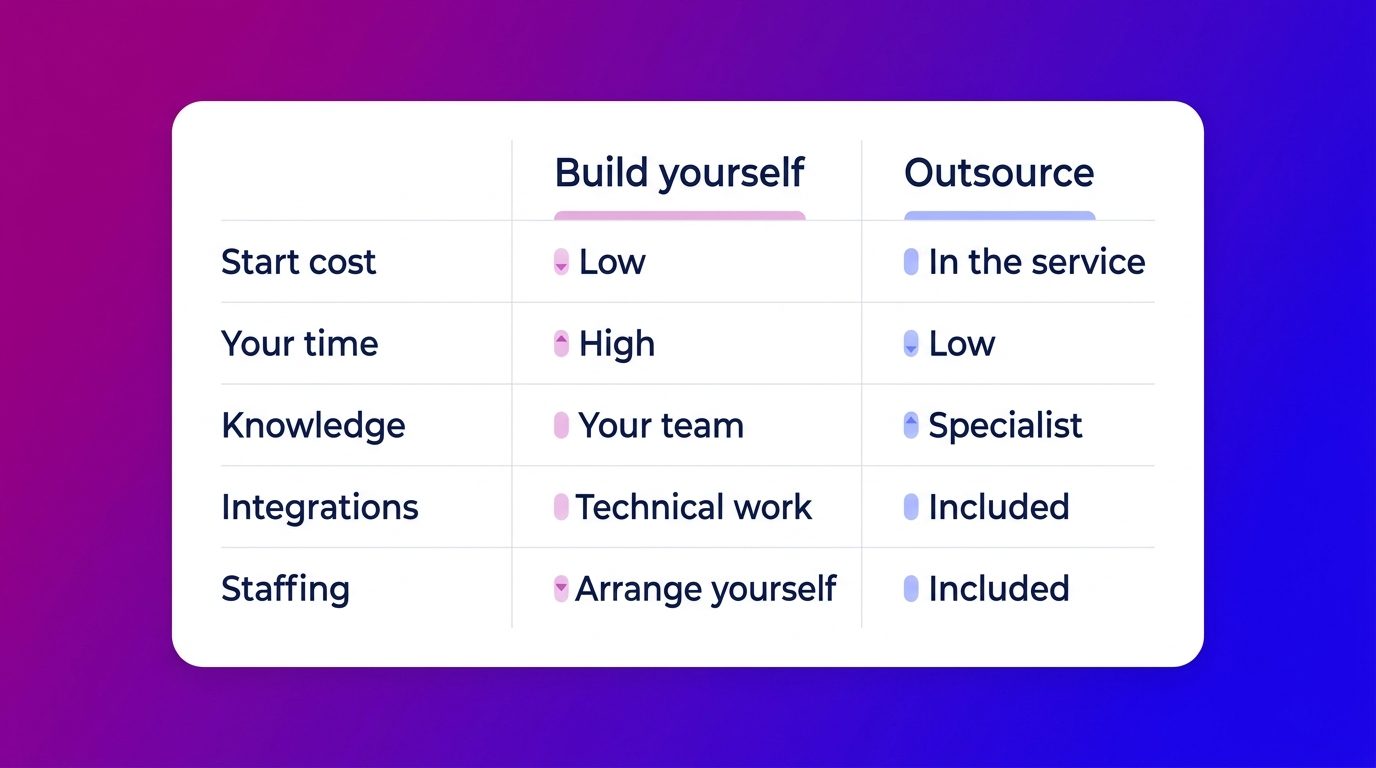
When you build it yourself, you pay items 2, 4 and 5 mainly in hours of your own team. When you outsource, they are included in the price of the service. So you only see what building it yourself really costs once you count those hours.
When is outsourcing smarter?
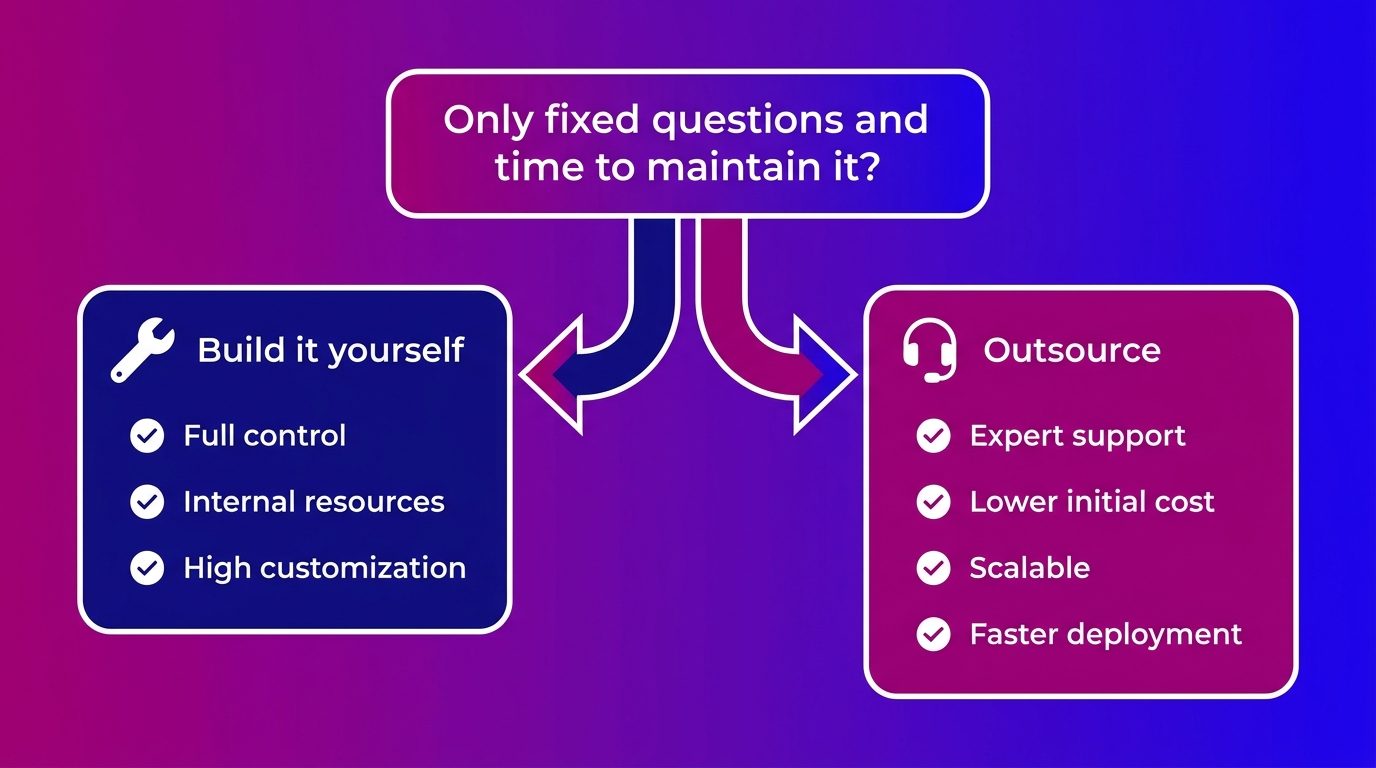
Outsourcing is smarter as soon as your chatbot has to do more than answer a handful of fixed questions, or if nobody in your team has time for it on a structural basis. In practice that is the biggest stumbling block: the software is available, the hours and the experience are not.
Outsourcing is the obvious choice if:
- the chatbot has to qualify, book appointments or pass leads to sales;
- you need integrations with a CRM, diary or dealer management system;
- you also want to be able to bring in a person outside office hours;
- you want to see results without first building up a specialism of your own.
Building it yourself suits a small, well-defined application with fixed answers and someone who likes to maintain it. If you are unsure whether a chatbot is the right form at all, first read chatbot vs live chat.
Build it yourself or outsource: the differences at a glance
Chatbots for business: which type suits you?
The type of chatbot follows from your questions: fixed questions call for a menu, free questions for an AI chatbot, and questions that sometimes need a person for a hybrid set-up. What each type is exactly is in what is a chatbot.
That choice also determines the route. You can build a menu bot well yourself. An AI chatbot with handover to a person requires far more set-up and management, and there outsourcing often becomes the logical choice.
How do you approach implementing a chatbot?
Start small, with one goal and one channel, and only expand once that works. That applies to both routes.
- Choose a goal: catching questions, collecting leads or booking appointments.
- Collect questions: take them from your inbox, phone notes and chat conversations.
- Set boundaries: what does the chatbot handle itself and what goes to a person?
- Connect: make sure leads and appointments land in the right place immediately.
- Test with real questions: not with the questions you think up yourself.
- Adjust after go-live: read back every conversation in the first weeks and improve the answers.
What we do if you place the chatbot with us
At Bconnect we see that the difference between a chatbot that works and one that stalls is almost always in the management, not in the build. That is why management is a standard part of our service.
We start with a consultation about your goal, your volume and your channels. Then we build a knowledge base together with your product information, terms and lead criteria. You supply that information, we turn it into answers and place the chat script on your site. You choose from three models: Operator Assisted AI, AI First + Human Handoff or AI Only. An AI chatbot is usually live within two to three weeks.
After go-live our chat specialists read along, sharpen the answers and keep the mix of people and AI up to date with a dedicated contact. Outsourcing works with us from 5,000 website visitors a month. If you want to know what a chatbot costs at Bconnect, you can see there how the price is built up. If you want to have the chatbot built straight away, read more about outsourcing chatbot development and management.
The choice is in the management, not in the build
Building a chatbot yourself is cheap to start and gives you full control, but you pay in time: filling knowledge, connecting, adjusting and arranging a person for when it gets stuck. For a simple chatbot with fixed questions that is manageable. If the chatbot has to qualify, make appointments or keep working well outside office hours, outsourcing is usually the wiser choice. More on all the topics around chatbots is in the overview of chatbots.
Frequently asked questions about building a chatbot yourself or outsourcing it
How much does a chatbot cost?
That depends on six items: build, filling knowledge, integrations, training and management, staffing and usage costs per conversation. When you build it yourself, most of it is in hours of your own team; when you outsource, it is in the price of the service. A fixed price without knowing those items says little.
Can I build a chatbot for free?
Yes, with a free build platform you can make a simple chatbot with fixed answers. The features are then limited and the cost shifts to your own time: filling knowledge, testing and maintaining remain work.
How long does it take to build a chatbot?
A simple first version is sometimes ready within a few days. A chatbot that gives good answers and is connected to your systems takes more time, usually a few weeks. After that it keeps needing attention.
What do I need to build a chatbot myself?
A build platform, an overview of the questions customers ask, the right answers to them, someone to test and maintain the chatbot, and a plan for the handover to a member of staff. Integrations with a CRM or diary require technical knowledge.
What is the difference between a chatbot and ChatGPT?
ChatGPT is a general chatbot with broad knowledge. A chatbot on your website is set up on your offering, only talks about agreed topics and passes conversations to your CRM, diary or a member of staff.
Who maintains the chatbot after go-live?
When you build it yourself, your own team does that: reading back conversations, improving answers and implementing changes in products or prices. When you outsource, the specialist does that work and you only supply the changes.
Is a chatbot suitable for a small business?
A simple chatbot can be useful for any business if many of the same questions come in. An outsourced chatbot with management and handover to a person pays off mainly with enough visitors; at Bconnect that is from 5,000 website visitors a month.