What is an AI agent? It is software that is given a goal and decides for itself which steps are needed to reach it. Where an ordinary chatbot answers a question and then waits, an AI agent looks up information, makes a decision and carries out an action, such as booking a test drive or adding a lead to your CRM. It always does this within limits you set in advance.
So what exactly is an AI agent, how does it work under the bonnet and where does it stop? This article explains it from a customer contact perspective, with practical examples. You will also see where an AI agent hands over to a person. For the full overview, see AI agents.
What is an AI agent?
An AI agent is an AI system that independently perceives, decides and acts to reach a goal set in advance. The key is that last word: acting. An AI agent does not just give an answer, it also does something with that answer.
Four characteristics turn a system into an AI agent:
- A goal. For example: help a website visitor and, if there is buying intent, pass a complete enquiry to sales.
- Its own plan. The agent decides in each conversation which question or step makes sense, instead of following a fixed route.
- Tools. It can consult and update systems such as a knowledge base, a calendar or a CRM.
- Limits. Rules determine what it may and may not do, and when it brings in a person.
If one of these four is missing, you are usually dealing with a chatbot or a fixed workflow. In practice, that difference is bigger than it sounds.
How does an AI agent work?
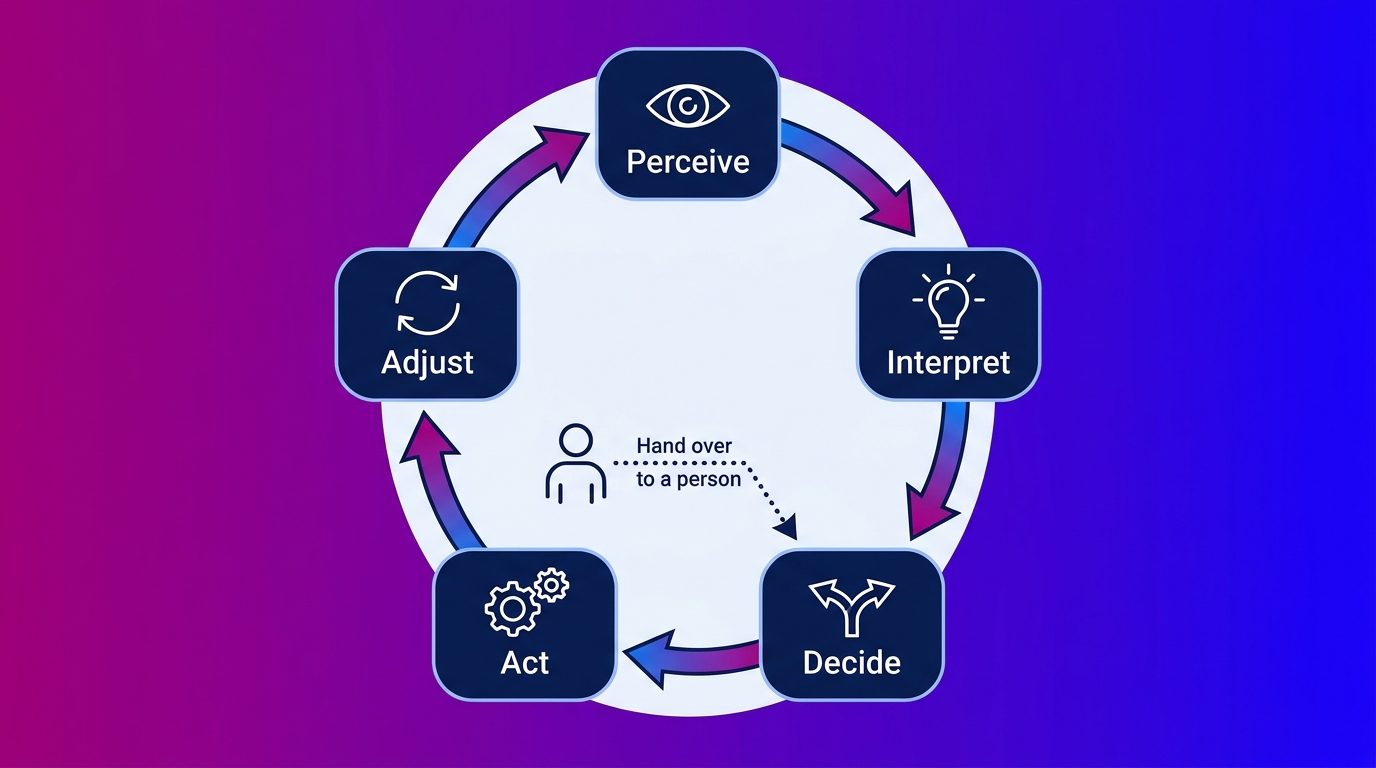
An AI agent works in a cycle of five steps: perceive, interpret, decide, act and adjust. The cycle repeats until the goal is reached or until the agent decides a person should take over.
The five steps
- Perceive. The agent reads the question, but also the context: which page the visitor is on, what was said earlier and which channel the message came in on.
- Interpret. It works out what is meant. At a car dealership, “Can I come in on Saturday?” is a request for an appointment, not a question about opening hours.
- Decide. Based on its goal and rules, it chooses the next step: give an answer, ask a question, look something up or hand over.
- Act. It carries out that step. That can be an answer, but also an action in another system.
- Adjust. It checks the result. If the answer does not match what the visitor meant, it asks a follow-up question.
What an AI agent relies on
Under the bonnet, an AI agent runs on a large language model extended with extra capabilities. In its guide to building effective agents, Anthropic calls this the basic building block: a language model with access to information, tools and memory. In customer contact, that means three things:
- Knowledge: a knowledge base with your products, prices and processes, so the agent does not guess.
- Integrations: connections to your CRM, calendar or ticketing system, so it can act.
- Rules and prompts: instructions on tone, limits and the moment of handover.
An agent is only as good as the information and rules it works with. That is also where most of the time in a good setup goes.
AI agent, chatbot or workflow: what is the difference?
A chatbot answers questions, a workflow follows a fixed route and an AI agent chooses its own route to a goal. Anthropic makes the same distinction in its guide: in a workflow the steps are fixed in code in advance, while in an agent the language model decides which steps and tools to use.
An example makes it concrete. A visitor to a kitchen showroom asks whether a kitchen island will fit in their space.
- A chatbot gives a general answer about kitchen islands and commonly used dimensions.
- A workflow always sends a form for a measuring appointment after a fixed question.
- An AI agent asks for the dimensions, assesses whether it fits, explains the options and, if the visitor is interested, books a design consultation in the calendar.
You can read about the difference between these three in detail in the article on the difference between an AI agent and a chatbot. To see how AI agents relate to AI that mainly produces text, read more about agentic AI.
Examples of AI agents in customer contact
In customer contact we see two main types: agents that create sales opportunities and agents that help existing customers. The first type works before the purchase, the second after it.
An agent for sales
An AI sales agent engages website visitors, recognises buying intent and asks the questions sales needs. At a car dealership, for example, it asks about the preferred trim, a possible part-exchange and when someone wants to buy. The complete enquiry then goes to the sales team, including the conversation.
An agent for service
An AI service agent handles recurring customer questions and requests. Think of booking a workshop appointment, answering a delivery status question or sending a reminder for an MOT. The team has more time left for the questions that really need attention.
In both cases, these are AI agents that take over tasks in your customer contact, not a standalone tool that only produces text. The difference lies in the connection to your systems and the goal the agent is given.
Benefits and limits of an AI agent
An AI agent makes customer contact scalable and always available, but only for questions that are predictable enough. Knowing the limits is how you get the most out of it.
What an AI agent delivers
- Availability outside office hours. An agent also replies in the evening and at the weekend, exactly when many people are researching.
- Scale without extra people. It handles many conversations at once, without quality dropping when it gets busy.
- Consistent follow-up. Every visitor gets the same questions and every enquiry arrives complete.
- Relief for your team. Routine questions are dealt with before they reach a colleague.
Where an AI agent stops
An AI agent does not replace every conversation. With questions that deviate from the standard, a poorly configured agent gets stuck, and customers end up in a loop of the same answer with no way through to a person.
Regulators are clear on this too. In the EU, Article 50 of the AI Act requires from 2 August 2026 that people know they are talking to an AI system. In the UK, the ICO expects organisations to be open about how they use AI and personal data. And customers should always be able to reach a person. You can read more about what can go wrong under the risks of AI agents.
How AI agents are developing
AI agents are mainly developing towards more integrations and more specialisation. Agents are getting access to more systems, so they can resolve more on their own. At the same time, organisations increasingly prefer several agents with a narrow task over one agent that has to do everything. Reliability is becoming more important than cleverness.
Where an AI agent stops in our conversations and a person takes over
At Bconnect, an AI agent is never the end point of a conversation. If the AI cannot resolve something, a person takes over, announced and with the full context. That is not a stopgap but a deliberate choice in how we set up conversations.
In practice, that means a few fixed agreements. Our AI does not make things up: if it does not know the answer, it says so and hands over. The visitor can also ask for a colleague themselves. The client sets the moment of handover, for example for a price question about a bespoke product or a complaint.
That is why we work with three models. With AI Only, the AI Service Agent handles predictable questions entirely on its own, such as an appointment confirmation. With AI First + Human Handoff, the AI leads the conversation and our chat specialists or the client’s own team take over where needed. With Operator Assisted AI, a chat specialist leads the conversation, supported by AI in real time. For lead generation, that is often the starting point, because asking follow-up questions and qualifying makes the difference there.
Using an AI agent: where do you start?
Start with one concrete task that comes up often and has a clear result. “Using AI” is not a starting point; “no longer missing test drive requests in the evening” is.
Three steps follow. Record what information the agent needs and where it lives. Decide which systems need to be connected for it to really act. Agree when a person takes over and how you measure the result. How to approach that step by step is covered in the article on implementing AI agents. The technology you need is explained under AI agent software.
Ultimately, an AI agent is not a smarter chatbot but a colleague with a clearly defined task. The sharper that task and its limits are described, the more it delivers. The technology is rarely the problem. The setup, the knowledge and the moment a person takes over decide whether an agent really helps your customers.
Frequently asked questions about AI agents
What is an AI agent in simple terms?
An AI agent is software that is given a goal and works out for itself how to reach it. It does not just answer questions; it can also carry out actions, such as booking an appointment or passing on an enquiry. It does this within rules that are set in advance.
What is the difference between an AI agent and ChatGPT?
ChatGPT is an AI assistant that mainly produces text and answers questions. An AI agent often uses a language model like this as its basis, but it is connected to systems and has its own goal. That lets an agent complete tasks independently, such as adding a lead to your CRM.
What is an AI chat agent?
An AI chat agent is an AI agent that works through a chat channel, such as the chat on your website or WhatsApp. It holds the conversation with the visitor and can look up information, ask questions and carry out actions during that conversation. If in doubt, it hands over to a colleague.
Can an AI agent make decisions on its own?
Yes, within the limits you set. An AI agent decides for itself which question or step makes sense in a conversation. Decisions it may not take, such as price agreements or exceptions, are recorded in advance. Those go to a person.
Does an AI agent replace staff?
No, not in well-designed customer contact. An AI agent takes over routine questions and repeated tasks. That gives staff more time for advice, exceptions and conversations where trust and asking the right questions make the difference.
Are you allowed to use an AI agent?
Yes, with conditions. Users need to know they are talking to an AI system, and there should be a way to speak to a person. Data protection law, such as the UK GDPR, also applies to the personal data the agent processes.
What do the costs of an AI agent depend on?
The costs mainly depend on the number of conversations, the channels, the integrations with your systems and how much people monitor or take over. An agent that works fully on its own needs a different setup from one that works alongside chat specialists.