AI agent software is the software that makes an AI agent work in your customer contact: the language model, the knowledge base, the integrations with your systems, the channels, the handover to a person and the measurement of results. You can build that software yourself, use a no-code platform or buy a managed service. The best choice depends less on features than on who manages the agent after go-live.
In this article you learn which components good AI agent software has, which three routes there are and which questions to ask before you choose. What an AI agent itself is, you can read in what an AI agent is.
What is AI agent software?
AI agent software is software that lets an AI agent hold conversations and carry out actions in your systems on its own. Where an ordinary chatbot only gives answers, an agent with the right software can also record a lead, book an appointment or hand a conversation over to a colleague.
The language model is only one component. In its guide to AI agents, Anthropic describes the basis of an agent as a language model with access to information, tools and memory. It is exactly that access that the software around it provides.
Which components does good AI agent software have?
Good AI agent software has six components. If one is missing, you usually only notice after go-live.
- Language model. The model that understands the question and phrases the answer.
- Knowledge base. The checked information the agent may rely on: products, terms, procedures and frequently asked questions.
- Integrations. Connections to your CRM, calendar or ticketing system, so the agent can record and book.
- Channels. The places where customers meet the agent, such as the chat on your website, WhatsApp and Messenger.
- Handover to a person. Rules for when a colleague takes over, with the full conversation attached.
- Monitoring. Insight into conversations, handovers and results, so you can adjust.
For an AI sales agent, the CRM integrations and the lead criteria weigh most heavily. For an AI service agent, the knowledge base and the connection to your calendar or ticketing system are often the most important.
Three routes: build it yourself, a no-code platform or a managed service
There are roughly three ways to use AI agent software. They mainly differ in how much work stays with you.
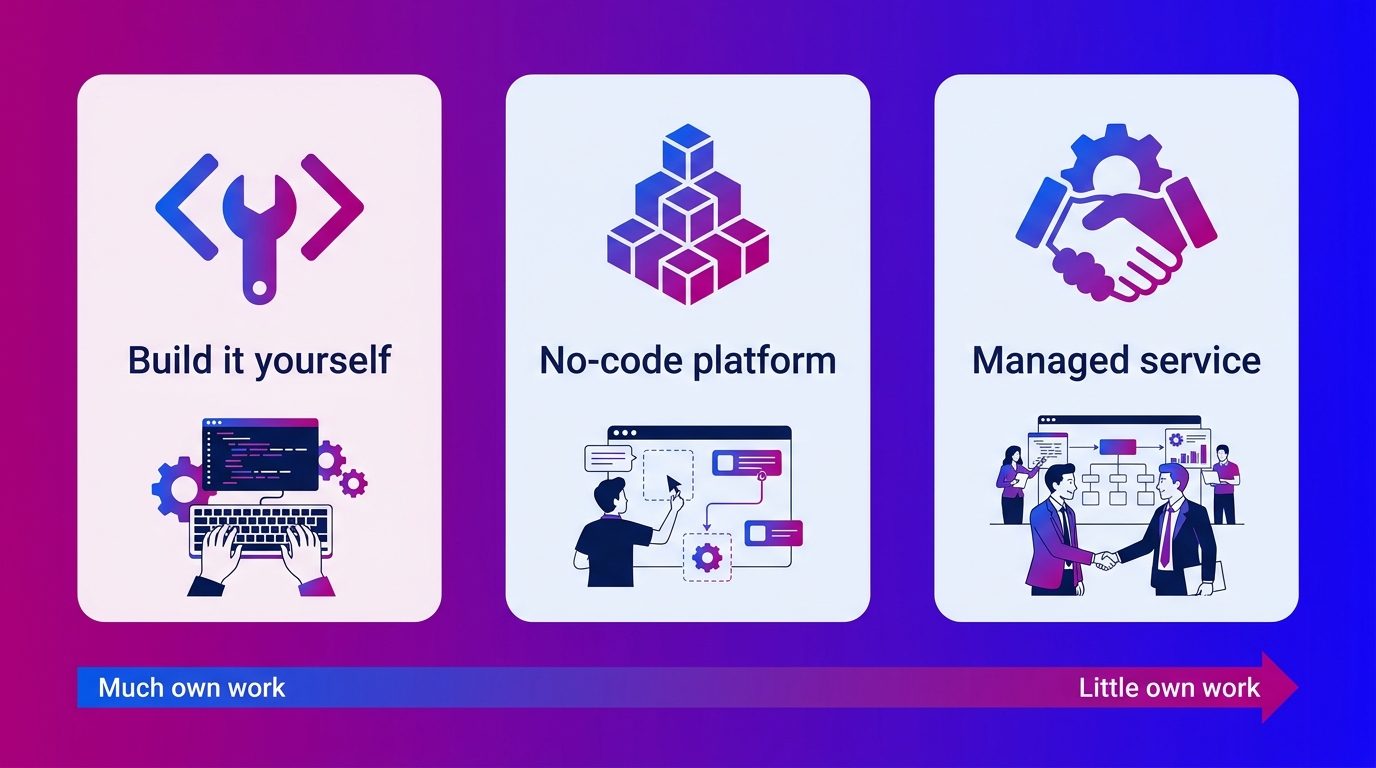
Build it yourself
Building it yourself gives the most freedom, but also the most responsibility. You arrange the integrations, security, privacy and maintenance yourself. That mainly pays off if your processes are so specific that no existing platform fits.
A no-code platform
With a no-code platform you build an agent without programming. That makes it easy to get started. The pitfall is management: someone has to keep the knowledge base up to date, read back conversations and adjust the agent. If that person is not there, the agent quickly becomes outdated.
A managed service
With a managed service, a partner sets up the agent, connects it to your systems and adjusts it based on real conversations. Many organisations choose AI automation as a complete service because they want the result but do not have their own team for management.
What should you look for when choosing AI agent software?
Ask these seven questions before you choose. They are about what happens after go-live, because that is where most of the differences are.
- Does it integrate with my systems? Can the agent add leads to your CRM and book appointments in your calendar?
- Does it work on my channels? Website, WhatsApp, Messenger, and do conversations come together in one place?
- How does the handover to a person work? When does someone take over, who is it and do they get the whole conversation?
- Where is the data stored? Where is the data processed, how long is it kept and is it used to train models?
- Does the agent say it is AI? In the EU, Article 50 of the AI Act requires from 2 August 2026 that visitors know they are talking to AI. In the UK, transparency is also what the ICO expects.
- Who manages the knowledge base? Can you do it yourself, or does the supplier?
- How do I measure the result? Can you see the resolution rate, handovers and lead quality?
Questions 3 to 5 are also where things go wrong if you skip them. The article on the risks of AI agents goes into this further. How to roll out the chosen software is covered in implementing AI agents.
Why we chose software plus people
At Bconnect, AI and our chat specialists work in one environment. Conversations via the website, WhatsApp and Messenger come together in one place. The AI holds conversations on its own where it can, and a specialist or the client’s own team takes over where needed, with the full context.
That choice comes from what we see in practice. Software alone is rarely the problem. The difference lies in the knowledge base, the handover agreements and adjusting based on real conversations. That is why we set up the agent together with the client, connect it to the systems where leads need to go and keep adjusting after go-live.
Choosing AI agent software is therefore mainly a choice about management. If you have your own team, you can build or use a platform. If you want the result without that management, choose a service. You will find more on the whole topic under AI agents.
Frequently asked questions about AI agent software
How much does AI agent software cost?
That depends on the route. If you build it yourself, you mainly pay for development time and model usage. With a platform you usually pay per month or per conversation, plus the time of your own administrator. With a service, setup and management are included in the price.
Can you build an AI agent yourself without programming?
Yes, with a no-code platform. You configure the knowledge base and conversation flows yourself. Bear in mind that someone has to maintain and adjust the agent afterwards, otherwise it quickly becomes outdated.
What is the difference between an AI agent platform and standalone AI tools?
A platform bundles the components an agent needs: language model, knowledge base, integrations, channels, handover and monitoring. Standalone AI tools often provide only one component, such as a language model, without a connection to your processes.
Does AI agent software work with WhatsApp?
Most serious AI agent software works with WhatsApp and other messaging channels alongside the chat on your website. Do check whether conversations from all channels come together in one place.
Is AI agent software GDPR compliant?
That depends on the supplier and the setup. Ask where the data is processed, how long it is kept and whether it is used to train models. Also record which data the agent is allowed to ask for.
What is the minimum software you need to get started?
At minimum, a language model with your own knowledge base, one channel and a way to hand conversations over to a colleague. Integrations with your CRM or calendar make the agent truly useful, but you can also add them in a second step.
Should you choose software or a service?
Choose software if you have your own team that can manage and adjust the agent. Choose a service if you want the result but do not have the time or people for day-to-day management.