The difference between an AI agent and a chatbot is not how cleverly they talk, but what they finish. A chatbot answers a visitor’s question. An AI agent is given a goal, such as a booked test drive, and takes the steps to reach it. That difference decides whether a conversation ends with an answer or with a result.
In this article you see the difference side by side, with one example worked out both ways. Then comes a simple rule: when is a chatbot enough, and when do you need an agent? If you want the basics first, read what an AI agent is.
AI agent vs chatbot: what is the difference?
A chatbot is built to answer questions; an AI agent is built to complete a task. With a chatbot, the visitor stays in control. With an AI agent, the agent steers the conversation towards an outcome and carries out actions in your systems itself.
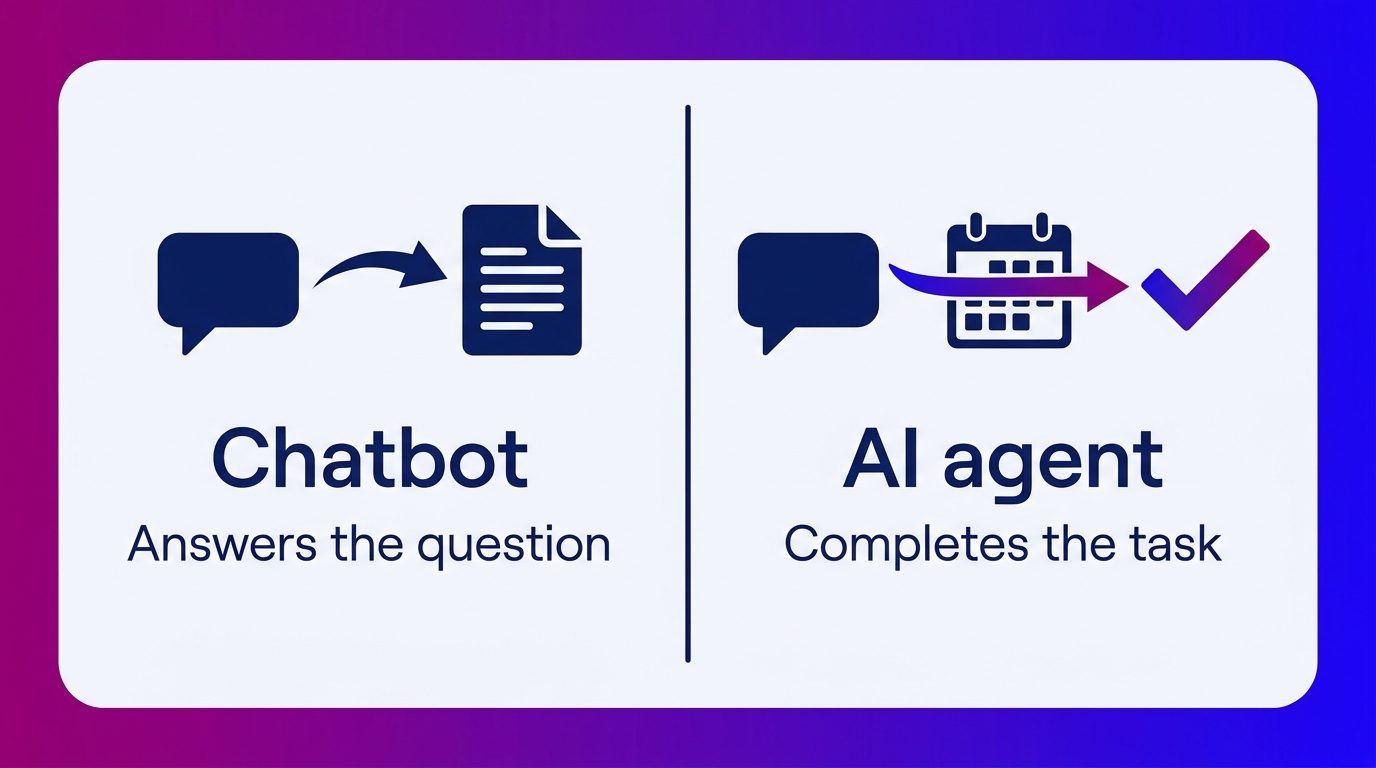
An AI agent often uses the same language technology as a modern AI chatbot. So the difference is not in the language model, but in what is built around it: a goal, integrations with systems and rules for when a person takes over.
A chatbot answers, an AI agent completes
The difference is clearest when you look at the same conversation twice. On Thursday evening, a visitor to a car dealership types: “Can I test drive the hybrid SUV on Saturday?”
How it goes with a chatbot
The chatbot recognises the words test drive and replies politely. It mentions the Saturday opening hours and adds a link to the test drive form. The visitor has to fill in the form themselves, and the sales team only sees the request on Friday. Nobody knows yet whether the car is available on Saturday.
How it goes with an AI agent
The AI agent sees a concrete request with a goal: a test drive on Saturday. It asks for the preferred time and whether there is a car to part-exchange. It then checks availability, books the test drive in the calendar and confirms it to the visitor. On Friday morning, the salesperson finds a complete appointment, including the conversation.
Both respond quickly and politely. But only with the agent is there an appointment in the calendar on Friday.
Rule-based chatbot, AI chatbot and AI agent
There are roughly three generations, and the difference between an AI agent and a chatbot depends on which chatbot you mean.
- The rule-based chatbot works with buttons and fixed paths. It is predictable, but gets stuck as soon as someone asks something that is not in the script.
- The AI chatbot understands free text thanks to a language model and gives answers based on your own content. It is much more flexible, but mainly stays informative.
- The AI agent uses the same language understanding, but adds a goal, integrations and decision rules. That lets it act instead of just answering.
With the first two, a common frustration is the loop: the chatbot does not say clearly that it has not understood a question, so the customer keeps getting the same answer.
The term agentic AI often comes up in this discussion too. It is the umbrella term for AI that pursues goals independently, and an AI agent is the practical application of it. How that relates to AI that mainly creates text and images is covered under agentic AI vs generative AI.
When do you choose a chatbot and when an AI agent?
Choose a chatbot if your conversations are mainly informative, and an AI agent if your conversations usually need to end in an action. Five questions help you decide:
- Do most conversations end in an action? Think of an appointment, a quote or a workshop visit. If so, an agent delivers more.
- Does the same task come up often? An agent pays for itself through repetition. With a handful of conversations a week, that is rarely the case.
- Can the agent access your systems? Without a connection to a calendar or CRM, even an agent stays stuck at informing.
- How bad is a mistake? A wrongly booked test drive can be fixed. Financial or legal commitments need a person at the wheel.
- Is there a person to hand over to? An agent without a safety net leaves visitors stuck on exactly the questions that are worth the most.
If you answer most questions with no, an AI chatbot that does more than answer questions is often the logical first step. If you are unsure about what can go wrong, look at the risks of AI agents.
When an AI agent is too early
An AI agent is too early if the basics are missing. Without an up-to-date knowledge base, fixed processes or a clear conversion goal, an agent has nothing to steer towards. Start by organising your frequently asked questions and your follow-up, and automate after that.
From chatbot to AI agent: how do you make the move?
You move from chatbot to AI agent process by process, not all at once. Start with the task that comes up most often and has the clearest result.
- Choose one process. For example, test drive requests at a car dealership or measuring appointments at a window company.
- Record the steps. Which questions need answering before the appointment is complete, and what information does sales need?
- Connect the systems. Only with access to a calendar or CRM can the agent really complete the task.
- Agree the handover. Decide which questions a person takes over, and make sure they get the full context.
Once the first process works well, you expand to the next. How to set up such a project and adjust it after go-live is covered in implementing an AI agent. In practice you see two directions: an AI sales agent for new enquiries and an AI service agent for existing customers.
Why a chatbot is rarely enough for leads
In our conversations at Bconnect we see a clear pattern: AI handles frequently asked questions well, but getting more leads from your website takes more than that. A visitor who is torn between two kitchens or two versions of a car needs someone who asks the right questions and moves the conversation towards an appointment.
Businesses sometimes opt for an AI-only solution because it seems faster and cheaper. For service questions, that often works fine. For lead generation, in our experience the results regularly disappoint, precisely because the qualifying and follow-up questions are missing.
That is why we advise a different model per goal. AI can handle predictable service questions entirely on its own. For leads, we prefer AI that opens the conversation and one of our chat specialists who takes over as soon as there is buying intent, announced and with the full context. Customers should also always be able to reach a person.
The choice between an AI agent and a chatbot is really a choice about what you expect from a conversation. If a good answer is enough, a chatbot will do. If something needs to be arranged after the conversation, you need an agent, with a person behind it for the conversations that are worth the most. You will find more on the whole topic under AI agents, and if you first want to know exactly what a chatbot does, read what a chatbot is.
Frequently asked questions about AI agents vs chatbots
Is an AI agent the same as a chatbot?
No. A chatbot answers questions; an AI agent completes a task. An agent often uses the same language technology as an AI chatbot, but it also has a goal, integrations with systems and rules for when a person takes over.
What is the difference between agentic AI and an AI chatbot?
Agentic AI is AI that pursues goals independently and carries out actions. An AI chatbot mainly responds to questions and provides information. An AI agent is the practical form of agentic AI, for example in the chat on your website.
When is a chatbot enough?
A chatbot is enough if your conversations are mainly informative, such as questions about opening hours, delivery times or product features. As soon as conversations need to end in an appointment, a quote or another action, an AI agent delivers more.
Can you combine a chatbot and an AI agent?
Yes. A chatbot can handle general questions, while an agent takes over as soon as there is a concrete task, such as booking an appointment. For the visitor, it feels like one conversation.
Can you turn an existing chatbot into an AI agent?
Often yes, if the chatbot runs on a language model. You then add a goal, integrations with your systems and agreements on handover. A rule-based chatbot with fixed buttons usually has to be set up again.
Is an AI agent more expensive than a chatbot?
An AI agent usually needs more setup, because integrations and decision rules are required. On the other hand, it completes tasks that would otherwise be manual work. Whether that pays off depends on how many conversations end in an action.
When is an AI agent too early?
An AI agent is too early if you have few conversations, no clear conversion goal or no up-to-date knowledge base. Then it is wiser to organise your frequently asked questions and processes first, and automate after that.