An AI customer service agent is an AI agent that answers questions from existing customers and completes simple requests itself, such as booking an appointment or looking up a status. That takes the predictable questions off your team’s plate. For complaints, bespoke requests or doubt, it hands over to a colleague, with the whole conversation attached.
In this article you learn which questions an AI customer service agent handles itself, how it works with your systems and where the line is. You also see when an AI service agent suits your organisation.
What is an AI customer service agent?
An AI customer service agent is a digital service colleague that handles customer questions based on your own knowledge base and systems. Where an AI sales agent helps new customers before the purchase, an AI service agent helps existing customers after it. Both are a form of what an AI agent is.
The difference with an ordinary chatbot is in the completing. A chatbot points to a form or an FAQ page. An AI service agent looks up the status, books the appointment or creates the ticket, and confirms it to the customer. You can read more about this in the difference between an AI agent and a chatbot.
Which questions does an AI service agent handle itself?
An AI service agent mainly handles questions that come up often and have a fixed answer or a fixed action. These questions cost your team a lot of time while needing little attention.
- Frequently asked questions. Opening hours, delivery times, warranty terms, returns policy.
- Status questions. Where is my order, is my car ready, has my request been received?
- Booking and changing appointments. Moving a workshop appointment, a service slot or a measuring appointment.
- Simple requests. Passing on a change of address, resending an invoice, creating a ticket.
Take a customer of a car dealership who wants to book an MOT on a Tuesday evening. The AI service agent asks for the registration number, checks which slots are free in the workshop calendar and books the appointment. The customer gets a confirmation straight away, and the workshop sees the appointment in the schedule the next morning.
That shifts your team’s work: less retyping and calling back, more time for questions where someone is really needed. If you want to use this more widely, you can have service questions handled automatically and automate follow-up and processes in the channels your customers already use.
How an agent arranges an appointment from start to finish is covered in booking appointments automatically with an AI agent.
How does an AI service agent work with your systems?
An AI service agent is only as good as the systems it can access. Without integrations, it stays stuck at explaining. With integrations, it can arrange things itself.
The knowledge base as the foundation
The knowledge base determines what the agent knows. It contains your products, terms, procedures and answers to frequently asked questions. If that knowledge base is outdated, the agent gives outdated answers. That is why it needs a fixed owner who keeps it up to date.
Integrations with CRM, ticketing system and calendar
With a connection to your CRM or ticketing system, the agent can look up customer data and record conversations. With access to the calendar, it can book appointments. That way, everything the customer says ends up in one place.
Keeping context across channels
Customers switch channels. Someone starts in the chat on the website and later sends a question via WhatsApp. A well-configured AI service agent sees that it is the same customer and does not have to ask again what it was about.
Which components such an agent needs and which routes there are to set it up is covered in AI agent software.
When does a person take over?
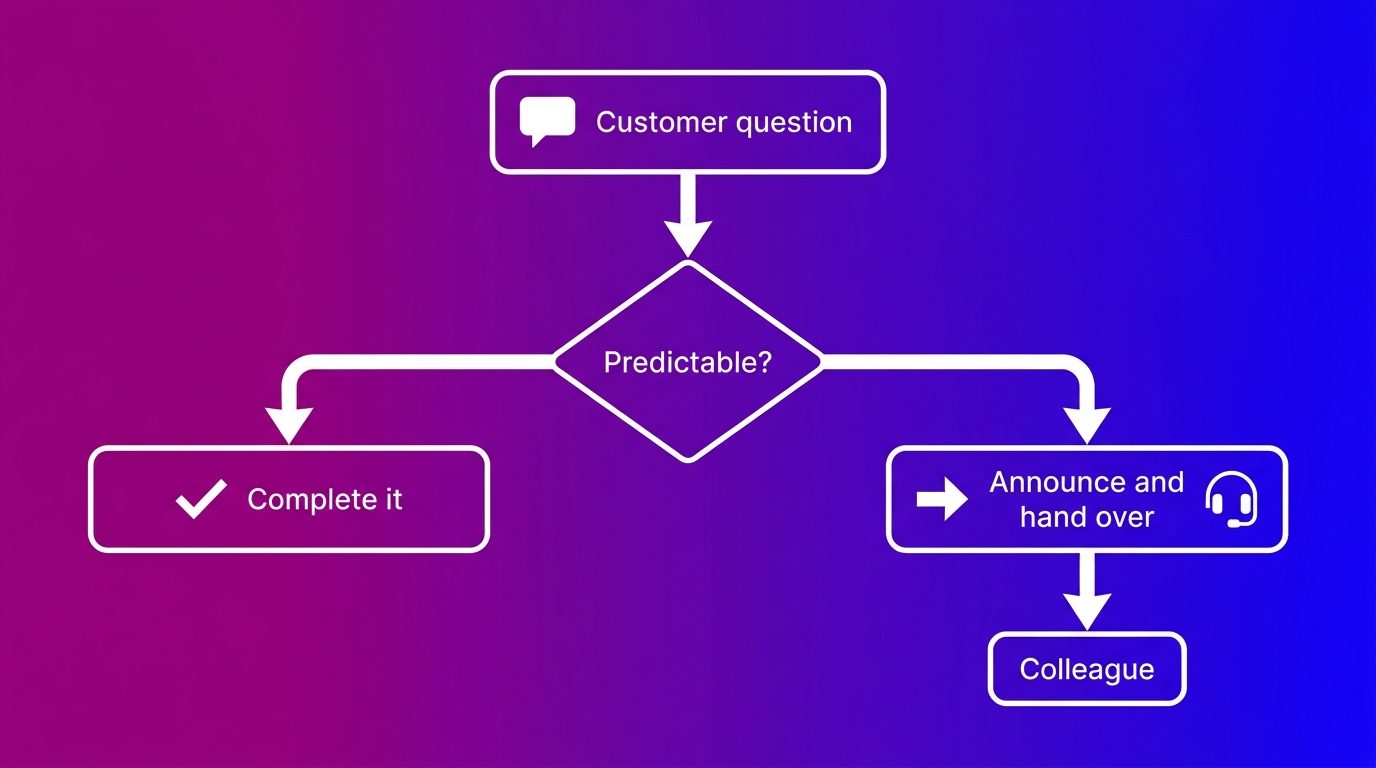
An AI service agent hands over as soon as a question needs more than a fixed answer or a fixed action. Typical moments are:
- Complaints and emotion. A customer who is angry or disappointed wants to be heard by a person.
- Bespoke requests. An exception to the terms or a situation that is not in the knowledge base.
- Doubt. If the agent is not sure of the answer, it does not make something up but says it is handing over.
- An explicit request. If the customer asks for a colleague, they get one.
At handover, the colleague receives the full conversation. The customer does not have to tell their story again. That prevents exactly the frustration many customers have with chatbots today: getting stuck in a loop without anyone who can help.
Customers should also know they are talking to AI and always be able to reach a person. What can go wrong if that line is missing is covered under the risks of AI agents.
Where we do and do not let AI do everything in service
At Bconnect, we decide per type of question how much AI does on its own. Predictable service questions, such as an appointment confirmation or a status question, can be handled entirely by AI. A person is only needed there if something deviates.
For questions with more nuance, AI acts as the first point of contact, with a handover to a person when needed. That can be one of our chat specialists or the client’s own team. The AI always announces that handover, and the customer can also ask for it themselves.
We make that choice together with the client, per channel and per type of question. The lesson we keep seeing: the clearer the line is agreed in advance, the fewer customers get stuck and the more the team gets out of the AI.
When does an AI service agent fit?
An AI service agent fits if your team spends a lot of time on questions that keep coming back. It fits less well if almost every question is bespoke.
A good fit if:
- a large share of your customer questions are predictable, such as status, appointments and terms;
- customers also get in touch in the evening and at the weekend;
- your knowledge base and processes are in order, or you are willing to get them in order.
A less good fit if:
- almost every question is an exception that needs discussion;
- your customers mainly have emotional or sensitive conversations;
- there is no owner who keeps the knowledge base up to date.
So an AI service agent does not replace your customer service, but removes the routine work so your team has time for the customers who really need attention. How to roll out and adjust such an agent step by step is covered in implementing AI agents. You will find a full overview under AI agents.
Frequently asked questions about the AI customer service agent
What is the difference between an AI service agent and a chatbot?
A chatbot gives answers and refers on. An AI service agent completes requests itself: it looks up a status, books an appointment or creates a ticket, and confirms it to the customer.
Can an AI service agent replace customer service completely?
No. An AI service agent takes over the predictable questions. Complaints, bespoke requests and sensitive conversations belong with a person. You see the best results when AI and staff each do what they are good at.
How do you prevent incorrect answers?
By letting the agent answer only based on your own, up-to-date knowledge base and having it hand over when in doubt instead of guessing. A fixed owner of the knowledge base is essential.
Which systems do you need at minimum?
At minimum, an up-to-date knowledge base. If you want the agent to arrange things itself, a connection to your CRM, ticketing system or calendar is needed. The more integrations, the more it can complete.
Does an AI service agent also work via WhatsApp?
Yes. An AI service agent can work via the chat on your website, WhatsApp and other messaging channels. If it is set up well, it keeps the context when a customer switches channel.
Does an AI service agent also do sales?
Not as its main task. An AI service agent helps existing customers. If it spots a sales opportunity, such as a customer asking about a new model, it can pass that on to sales or to an AI sales agent.
How does an AI service agent keep context across channels?
By linking conversations to the same customer, for example through a phone number or customer number, and recording them in one place. That way the agent sees what was discussed earlier, even if it was via another channel.