An AI sales agent is an AI agent that helps website visitors, recognises buying intent and asks the questions a salesperson needs. The result is not a chat, but a complete enquiry that can be followed up straight away. An AI sales agent does not close deals itself: it makes sure sales starts with the right information.
In this article you learn what an AI sales agent does, how it recognises and qualifies a lead, and when a person takes over. You also see the difference with an AI service agent and when an AI sales agent suits your organisation.
What is an AI sales agent?
An AI sales agent is a digital salesperson that holds conversations with visitors and passes opportunities to your sales team. It works before the purchase: at the moment someone is researching and still unsure. It is a form of what an AI agent is, with one clear goal: a qualified enquiry.
Just as important is what an AI sales agent does not do:
- No quotes and no price agreements.
- No negotiating on terms or discounts.
- No replacing salespeople. The salesperson follows up and closes the deal.
That division of tasks is deliberate. The agent is strong at first contact and at gathering information. The salesperson knows the product and has the conversation that tips the balance.
What does an AI sales agent do in a conversation?
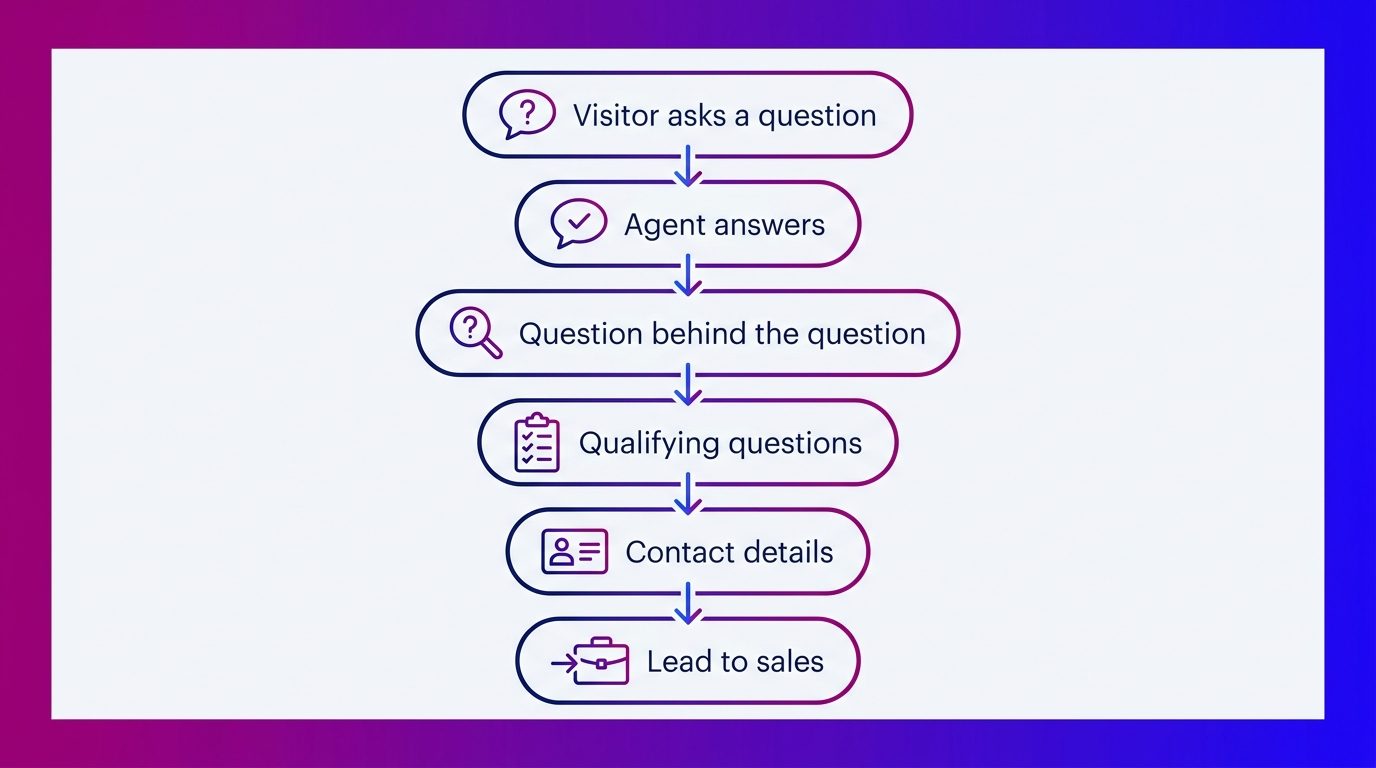
An AI sales agent leads a conversation in six steps from first question to complete lead. Take a visitor to a car dealership looking at a hybrid SUV on a Sunday evening.
- The visitor asks a question. “What is the range of this version?”
- The agent answers directly. From the knowledge base built for this dealership.
- The agent looks for the question behind the question. Is the visitor researching, or do they want to drive this car?
- The agent qualifies by asking follow-up questions. Is there a car to part-exchange, when do they want to buy, which trim do they prefer?
- The agent asks for contact details. Name, email and phone number, with a reason that fits the conversation, such as a test drive.
- The agent passes on the lead. To the CRM, by email or into the support system, including the full conversation.
On Monday morning, the salesperson does not find a loose name, but an enquiry with context. That is where lead generation with an AI agent makes the difference compared with a contact form that is only picked up days later.
That difference in speed matters. Research by Oldroyd, McElheran and Elkington in Harvard Business Review showed back in 2011 that most companies respond far too slowly to online enquiries.
If the visitor wants to book a test drive or showroom visit straight away, the agent can also put that appointment in the calendar itself. How that works is covered in booking appointments automatically.
How does an AI sales agent recognise and qualify a lead?
An AI sales agent recognises a lead by buying signals in the conversation and qualifies it against criteria you set in advance. Without those criteria, every chat is a lead, and that does not help sales.
Recognising buying signals
Typical signals are questions about availability, delivery time, price, finance or an appointment. Behaviour on the site counts too: someone who views several model pages or spends a long time on the specifications is further along than someone who opens one page.
Setting lead criteria
You decide the lead criteria. At minimum, they are name, email and phone number. You can add criteria that fit your sales process:
- Automotive: part-exchange, preferred trim, buying moment, preferred branch.
- Home & living: type of product, dimensions or situation, budget indication, preferred timing.
The sharper these criteria, the better the agent can tell the difference between someone who is browsing and someone who is ready for a conversation.
AI sales agent or AI service agent?
An AI sales agent helps new customers before the purchase; an AI service agent helps existing customers after it. They use the same technology, but have a different goal and are measured differently.
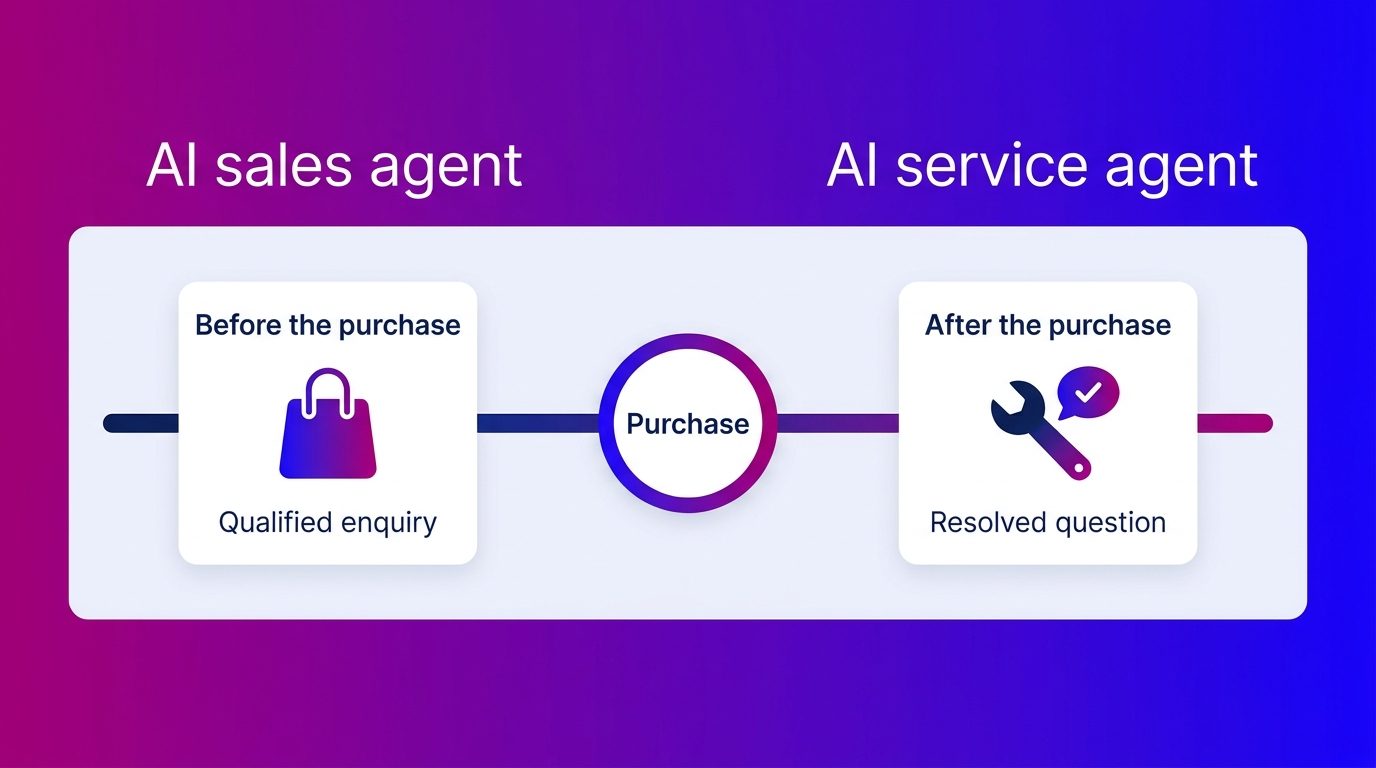
Many organisations use both, at different points in the customer journey. A visitor looking at a car talks to the sales agent. The same customer who later wants to book an MOT ends up with the service agent.
When does a person take over?
An AI sales agent hands over as soon as a conversation needs more than it can do well. Think of a question about a price agreement, a complaint, a complex bespoke question or a visitor who explicitly asks for a colleague.
At handover, the salesperson receives everything: the full conversation, the answers to the qualifying questions and the page the visitor came from. That way the visitor does not have to repeat anything. What happens next falls under lead follow-up: how quickly and personally your team picks up the enquiry.
Transparency is part of this. Visitors should know they are talking to AI and should always be able to reach a person.
What an AI sales agent does and does not do in our conversations
At Bconnect, we use the AI Sales Agent as the first point of contact on the website, in WhatsApp and in Messenger. A few fixed agreements determine how it behaves.
It only starts a conversation at agreed moments, for example when someone views several model pages. It gives answers and advice first, and does not push straight for an appointment. If it does not know something, it does not make it up: it announces that it is handing over to a colleague. The visitor can also ask for that themselves.
The agent works on several websites at once and sends leads to the right team or branch. An AI Sales Agent is typically live with us within 2 to 3 weeks. Most of the time goes into building the knowledge base and agreeing the lead criteria with the client.
When is an AI sales agent a good choice?
An AI sales agent fits if your website attracts enough visitors who have questions before they buy. It fits less well if visitors check out straight away or there is little traffic.
A good fit if:
- your product needs advice before someone buys, such as a car, kitchen or windows;
- there is a clear conversion goal, such as a test drive, quote or showroom appointment;
- many visitors browse in the evening or at the weekend, when your team is not available.
A less good fit if:
- visitors mainly check out online straight away without questions;
- there is little website traffic. At Bconnect we work from 5,000 website visitors a month;
- you do not have a team that can follow up leads quickly.
So an AI sales agent does not sell for you, but makes sure no serious visitor clicks away unnoticed. How to set up, connect and measure such an agent is covered in implementing AI agents. If you first want the difference with an ordinary chatbot to be clear, see the difference between an AI agent and a chatbot, or view the full overview under AI agents.
Frequently asked questions about the AI sales agent
What is the difference between an AI sales agent and a chatbot?
A chatbot answers questions. An AI sales agent has a goal: a qualified enquiry. It asks follow-up questions, records the answers and passes the lead to your sales team with the whole conversation.
Does an AI sales agent close deals itself?
No. An AI sales agent does not make quotes, agree prices or negotiate. It makes sure the salesperson receives a complete enquiry, so they can have the sales conversation.
Does an AI sales agent only work on the website?
No. An AI sales agent can also work via WhatsApp and Messenger. Conversations from all channels come together, so your team keeps one overview.
How do you stop an AI sales agent from being pushy?
By only letting it start a conversation at agreed moments and having it answer first before asking for details. An agent that immediately asks for an appointment puts visitors off.
Can one agent do both sales and service?
Technically yes, but it usually works better to keep them separate. A sales agent steers towards enquiries, a service agent towards resolving questions. With separate goals and criteria, both perform better.
How quickly is an AI sales agent live?
That depends on your offer and integrations. At Bconnect, an AI Sales Agent is typically live within 2 to 3 weeks. Most of the time goes into the knowledge base and agreeing the lead criteria.
Does an AI sales agent replace my salespeople?
No. An AI sales agent takes over first contact and the qualifying questions. Your salespeople get more and better-prepared enquiries, and have more time for the conversations that lead to a sale.