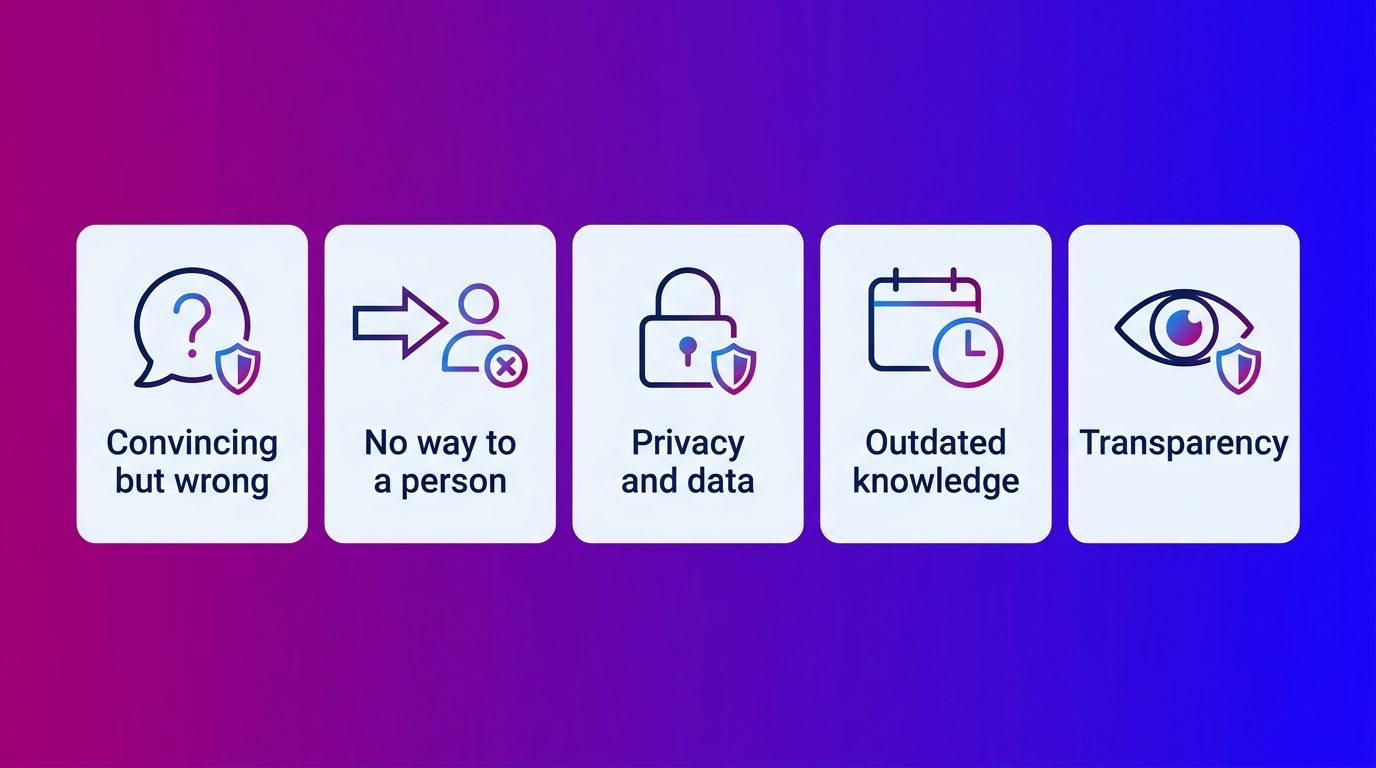
The biggest AI agent risks are answers that sound convincing but are wrong, customers who get stuck with no way through to a person, careless handling of personal data, outdated knowledge and a lack of transparency. Almost all of those risks can be managed with three things: a clearly defined task, an up-to-date knowledge base and a person who can take over.
In this article you learn for each risk what can go wrong, with real examples, and which measure helps. If you first want to know exactly what an AI agent does, read what an AI agent is.
What are the risks of AI agents?
An AI agent acts on its own: it answers questions, records data and books appointments. That makes it useful, but it also means a mistake reaches the customer directly. These are the five AI agent risks that come up most often in customer contact:
Risk 1: convincing but wrong
An AI agent can give an answer that sounds fluent and confident but is factually wrong. That is called a hallucination: the language model fills a gap in its knowledge with something that seems plausible. In customer contact, that might be a wrong price indication, a delivery time that cannot be met or a condition that does not exist.
A case in Canada showed that this has real consequences. Air Canada’s chatbot promised a customer a retroactive discount that did not exist under the airline’s policy. The company argued that the chatbot itself was responsible, but the tribunal rejected that: according to the summary by the American Bar Association, Air Canada was held liable for the incorrect information and had to compensate the customer.
The lesson is simple: what your AI agent says, your business says. That is why you only let the agent answer based on your own, checked knowledge base. And when in doubt, it should not guess but hand over.
That risk weighs more heavily as soon as a system not only produces text but also acts. Where that difference lies is explained under agentic AI vs generative AI.
Risk 2: no way through to a person
The most recognisable risk for customers is getting stuck. The agent does not understand the question, repeats the same answer or keeps pointing to a form. Many people know that frustration from chatbots that leave them going round in circles.
For businesses, this is doubly damaging. A customer with a complaint gets angrier, and a visitor with buying intent clicks away. The answer is a fixed handover: for complaints, emotion, bespoke requests or doubt, a person takes over, with the full conversation attached. And a customer who asks for a colleague gets one.
That is why many organisations choose an AI chatbot where a person can take over, rather than a solution that has to handle everything itself. What that handover looks like in service is covered under the AI service agent.
Risk 3: privacy and data
An AI agent processes personal data: names, phone numbers and sometimes information about someone’s home, car or situation. Without clear rules, an agent asks for more than necessary, keeps data too long or data ends up in systems where it does not belong.
Under the UK GDPR and the EU GDPR, the same rules apply to an AI agent as to any other channel. Only ask for what you need for the next step, record how long you keep data and decide which systems may have access. Also look at the supplier: where is the data processed and is it used to train models?
In sensitive sectors, an extra limit applies. At a clinic, an agent can give general information and book a consultation, but medical questions always go to a specialist.
Risk 4: outdated knowledge
An AI agent is only as good as the information it runs on. If your price list, opening hours or promotion changes and the knowledge base is not updated, the agent gives a wrong answer in every conversation from that moment on. The treacherous part is that nobody notices until a customer is affected.
The solution is organisational. Appoint one owner who keeps the knowledge base up to date and link updates to existing moments, such as a new promotion or a price change. Also read back conversations regularly to see where the agent gets stuck. How to set up that rhythm is covered in implementing AI agents.
Risk 5: a lack of transparency
Customers have the right to know they are talking to AI. In the EU, this has been a legal requirement since 2 August 2026: under Article 50 of the AI Act, a visitor who talks to an AI system on your website must know that this is the case, unless it is already obvious from the context. If you serve customers in the EU, that applies to you too.
In the UK, the ICO expects organisations to be open about how they use AI and personal data. A short notice at the start of the conversation is enough, as long as it is clearly visible and not hidden in the terms and conditions. And a person should always be within reach.
How we cover these risks
At Bconnect, the measures in this article are fixed agreements in every conversation. The AI does not make things up: if it does not know something, it announces that it is handing over to a colleague. The visitor can also ask for a person themselves and then gets one.
For each type of question, we decide together with the client how much the AI does on its own. Predictable questions, such as an appointment confirmation or a status question, can be handled entirely by AI. For questions with more nuance, and certainly when there is buying intent, one of our chat specialists or the client’s own team takes over, with the full context.
That keeps the biggest risk small: a customer who gets stuck or receives a promise nobody can keep. AI agents are not risk-free, but they are manageable, as long as you record in advance what they may and may not do. You will find more on the whole topic under AI agents, and the difference with an ordinary chatbot is covered in the difference between an AI agent and a chatbot.
Frequently asked questions about the risks of AI agents
Can an AI agent make mistakes?
Yes. An AI agent can give an answer that sounds convincing but is wrong, or misunderstand a question. You limit that by letting it answer only from your own knowledge base and having it hand over to a colleague when in doubt.
Are you liable for what an AI agent says?
In practice, yes. In the case against Air Canada, the company was held liable for an incorrect promise made by its chatbot. Assume that what your AI agent says counts as what your business says.
Do you have to tell customers they are talking to AI?
In the EU, yes: since 2 August 2026, Article 50 of the AI Act requires that people know they are talking to an AI system, unless that is already clear from the context. In the UK, being open about AI use is what the ICO expects. A short notice at the start of the conversation is enough.
Is an AI agent GDPR compliant?
That depends on the setup. Only ask for the data you need, record retention periods and check where your supplier processes the data. Then the same rules apply to an AI agent as to any other customer contact channel.
What is a hallucination?
A hallucination is an answer a language model makes up when it does not know something. It sounds credible but is incorrect. In customer contact, you prevent it by limiting the agent to checked information.
How do you stop an AI agent from making wrong promises?
Record what the agent may and may not promise, such as prices, discounts or delivery times. Always have important agreements confirmed by a colleague and keep the knowledge base up to date, so the agent does not use outdated information.
Are AI agents suitable for high-value leads?
Yes, if you define its role clearly. Let the AI handle first contact and the qualifying questions, and let a person take over as soon as there is buying intent or a complex question. The risk is not in AI itself, but in leaving AI to work alone for too long.