WhatsApp marketing means using WhatsApp in your campaigns: ads that start a conversation, marketing messages to people who have given you permission, and WhatsApp links and QR codes in your online and offline material. The big difference from a form is that every response is immediately a conversation. That is also the pitfall: a campaign to WhatsApp only produces leads if someone picks up those conversations straight away. Below you will read how each form works and how to turn the responses into leads.
If you first want to know everything WhatsApp can do for business, see our overview of WhatsApp Business.
What is WhatsApp marketing?
WhatsApp marketing consists of three forms, which you use separately or together:
- Ads that start a conversation. An ad on Facebook or Instagram, or in WhatsApp itself, opens a chat with your business when clicked.
- Marketing messages. You send an offer, invitation or reminder to people who gave you permission to contact them via WhatsApp.
- WhatsApp links and QR codes. A button in your email, a link in your ad or a QR code on a leaflet or in the showroom brings people straight into a conversation.
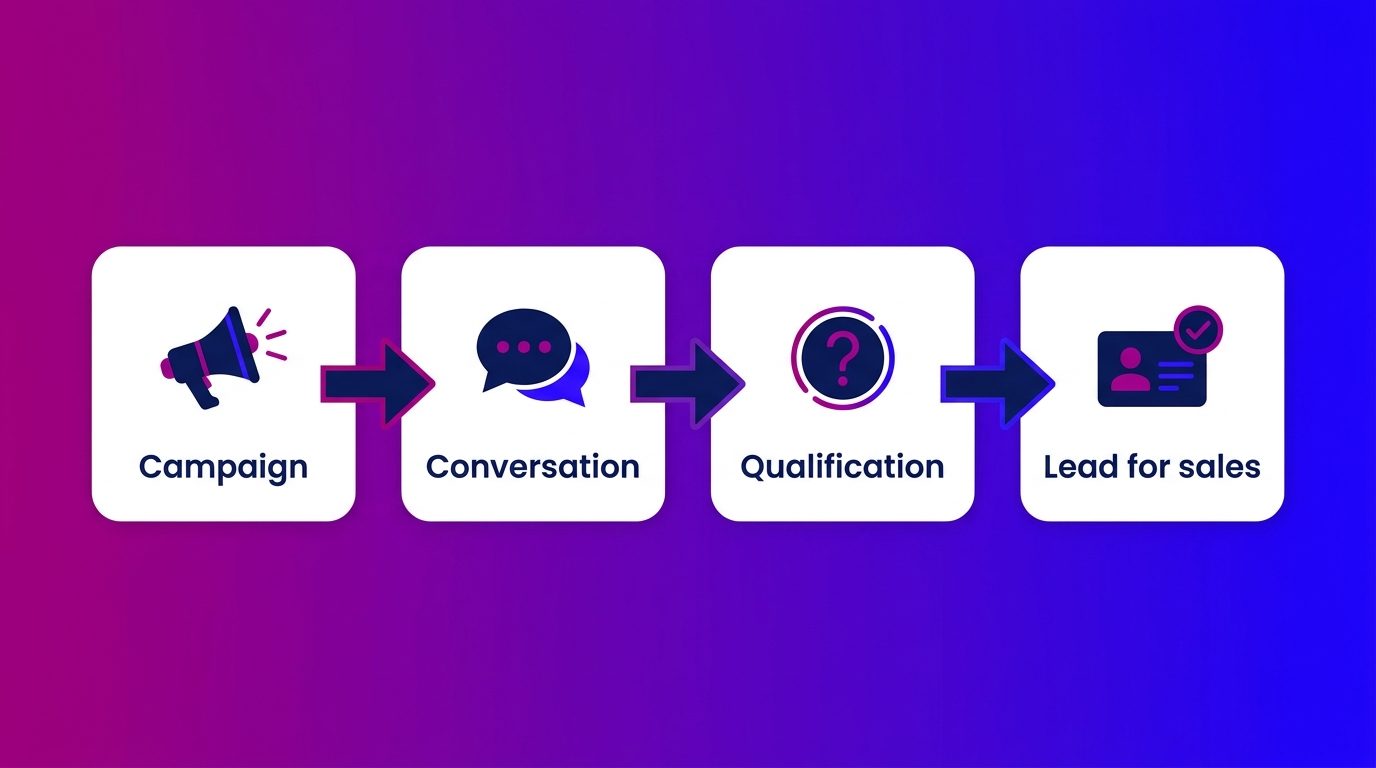
All three forms end at the same place: a WhatsApp conversation someone has to answer. That is where the difference lies between a campaign that produces conversations and a campaign that produces leads.
Advertising on WhatsApp: how ads that start a conversation work
Advertising on WhatsApp mainly runs through ads on Facebook and Instagram that open a WhatsApp chat with your business when clicked. Those ads run in the feed, Stories and Marketplace, among other places (WhatsApp Business).
Meta also shows ads in WhatsApp itself, in Status on the Updates tab. Those ads do not appear between personal chats (Meta).
An advantage of ads that lead to WhatsApp lies in the cost of your replies. If you reply via the WhatsApp Business API within the service window to someone who came in through such an ad, a free period of up to seven days opens. During that period you do not pay for your messages to that person (Meta for Developers).
Two tips for the ad itself:
- Put a pre-filled message in the ad that matches the promotion, such as “I would like to book a test drive”. Then your team knows immediately what the conversation is about.
- Only send people to WhatsApp if someone will actually reply. An ad that produces conversations in the evening without anyone responding costs budget without results.
Sending marketing messages via WhatsApp
You may only send a marketing message via WhatsApp to people who gave you permission in advance. At that opt-in it must be clear that someone will receive messages from your business, and under which name (Meta for Developers). You can ask for that permission on your website, in a form or in the shop, for example. In the UK, marketing messages to consumers also fall under the ICO’s rules on electronic marketing, so keep a record of the consent you collect.
Outside the 24-hour window you send marketing messages as an approved template in the marketing category. You pay for those per delivered message, and the rate depends on the recipient’s country. Marketing messages are not covered by the free service messages. How templates work and what the different messages cost is covered in the WhatsApp Business API.
Keep marketing messages personal and relevant. An invitation to an open day or a reminder about a quote works better than a general newsletter, and customers can stop marketing messages from a business themselves.
A WhatsApp QR code and link in your campaigns
A WhatsApp QR code is a QR code containing a WhatsApp link to your number. Anyone who scans it lands directly in a chat with your business. This is how you make one:
- Create a wa.me link with your number, or use the short link from the WhatsApp Business app.
- Add a pre-filled message that matches the campaign.
- Turn that link into a QR code with a QR generator and test it with a few phones.
QR codes work best where people have a moment: a price card next to a car in the showroom, a leaflet with a kitchen quote, a board at a project or a poster at a trade show. Online you use the link itself, for example as a button in an email or as the destination of an ad.
Give every campaign, branch or location its own pre-filled message. That way you see in the conversations which material works, without extra tools. More about the button on your own site is in WhatsApp on your website.
From conversation to lead: how to follow up WhatsApp responses
A WhatsApp response only becomes a lead if someone picks it up quickly, asks a few targeted questions and records the outcome. This is how you do that:
- Reply within the window. Within 24 hours after the customer’s last message you reply freely. The sooner, the greater the chance the customer is still engaged with your offer.
- Ask two or three qualifying questions. For a car: part-exchange, preferred specification and when. For a kitchen or windows: which room, what timing and whether there is already a quote.
- Record the lead with the conversation attached. Put the details and the whole conversation in your CRM or send them to the salesperson, so they do not have to ask again what the customer already said.
- Agree a next step. A test drive, a showroom visit or a measuring appointment turns a conversation into a concrete opportunity.
If you get more conversations than your team can follow up, or mainly outside office hours, you can outsource lead generation with WhatsApp and chat. If your campaigns also bring in questions from existing customers, read how to separate WhatsApp customer service from that.
What we see when campaigns lead to WhatsApp
Campaigns to WhatsApp often also produce conversations outside office hours, exactly when nobody is in the showroom. At Bconnect we do not set up ads ourselves, but we catch the conversations from campaigns with chat specialists and AI, from 08:00 to 23:30. We see the same patterns again and again.
- In automotive, a test drive campaign to WhatsApp often leads to questions about part-exchange and specification, with photos of the current car. Anyone who asks follow-up questions straight away and books a test drive has a complete lead for the salesperson.
- In home and living, a QR code on a leaflet or in the showroom works well for larger purchases. Customers scan at home, with the measurements to hand, and then want an appointment for measuring or advice.
- Without follow-up the effect evaporates. A campaign that produces many conversations on Friday evening that are only answered on Monday mainly produces disappointed customers.
What works is planning the campaign and the follow-up together. We take over the first conversation and the qualification, and the lead goes with the whole conversation to the sales team, in the CRM or by email. The salesperson follows up and closes the deal.
WhatsApp marketing only works when the follow-up is ready
WhatsApp marketing is more than sending messages. Ads that start a conversation, marketing messages with opt-in and QR codes in your campaigns all bring customers to the same point: a WhatsApp conversation. So first plan who answers those conversations, which questions you ask and where the lead ends up. Give every campaign its own pre-filled message, so you see what works. Then a click becomes a conversation, and a conversation an appointment.
Frequently asked questions about WhatsApp marketing
What is WhatsApp marketing?
WhatsApp marketing is using WhatsApp in your campaigns. That can be with ads that start a WhatsApp conversation, with marketing messages to people who gave permission, and with WhatsApp links and QR codes in your online and offline material.
Can you advertise on WhatsApp?
Yes. The most used form is ads on Facebook and Instagram that open a WhatsApp chat with your business when clicked. Meta also shows ads in Status on WhatsApp’s Updates tab, not between personal chats.
What does a WhatsApp marketing message cost?
You pay for marketing messages via the WhatsApp Business API per delivered message. The rate depends on the recipient’s country. If you reply to someone who came to WhatsApp via an ad, your messages to that person are free for up to seven days.
May you just send customers a WhatsApp message?
No. For marketing messages you need permission in advance, where it is clear that someone will receive messages from your business. If the customer starts the conversation themselves, you may reply freely within 24 hours.
How do you make a WhatsApp QR code?
Create a wa.me link with your phone number, or use the short link from the WhatsApp Business app. Add a pre-filled message if you like and turn the link into a QR code with a QR generator. Always test it before you print it.
How do you measure the results of WhatsApp marketing?
Give every campaign its own link or pre-filled message, so you see where conversations come from. Then measure not only the number of conversations, but above all how many of them became a lead, an appointment or a sale.
Does WhatsApp marketing work for B2B too?
Yes, especially with existing contacts and for follow-up after a first conversation or quote. For cold outreach WhatsApp is less suitable, because you need permission in advance for marketing messages.