An omnichannel strategy is a plan that sets out how all your customer channels work together, so a customer gets the same experience everywhere and can switch channels without repeating their story. The difference with simply opening more channels: a strategy also decides who answers, with what information and what happens at the handover.
Most step-by-step plans for omnichannel come from marketing or logistics: campaigns, stock, click and collect. This plan starts with the conversation with the customer. That is where the difference is made in practice, because a customer who has to repeat their question three times notices nothing of your carefully chosen channel mix.
Why a strategy, and not just more channels?
You need an omnichannel strategy because channels without agreements drift apart: each channel gets its own inbox, its own answers and its own gaps in availability.
Meanwhile, customers simply mix channels. In the UK, YouGov found that 74% of people use email and 65% use the phone to contact businesses, with chat, apps and social media alongside. A study of more than 46,000 shoppers in Harvard Business Review found that only 7% shopped exclusively online and 20% exclusively in store. If you want to help that customer equally well on every channel, you need more than an extra WhatsApp number.
A strategy answers three questions that otherwise nobody answers:
- Which channels do you offer, and which deliberately not?
- Who answers when: your own team, an external partner or an AI agent?
- How do you carry the context when the customer switches channels or a question is passed on?
Step-by-step: how to build an omnichannel strategy
You build a good omnichannel strategy in six steps, from understanding your customer to measuring what it delivers.
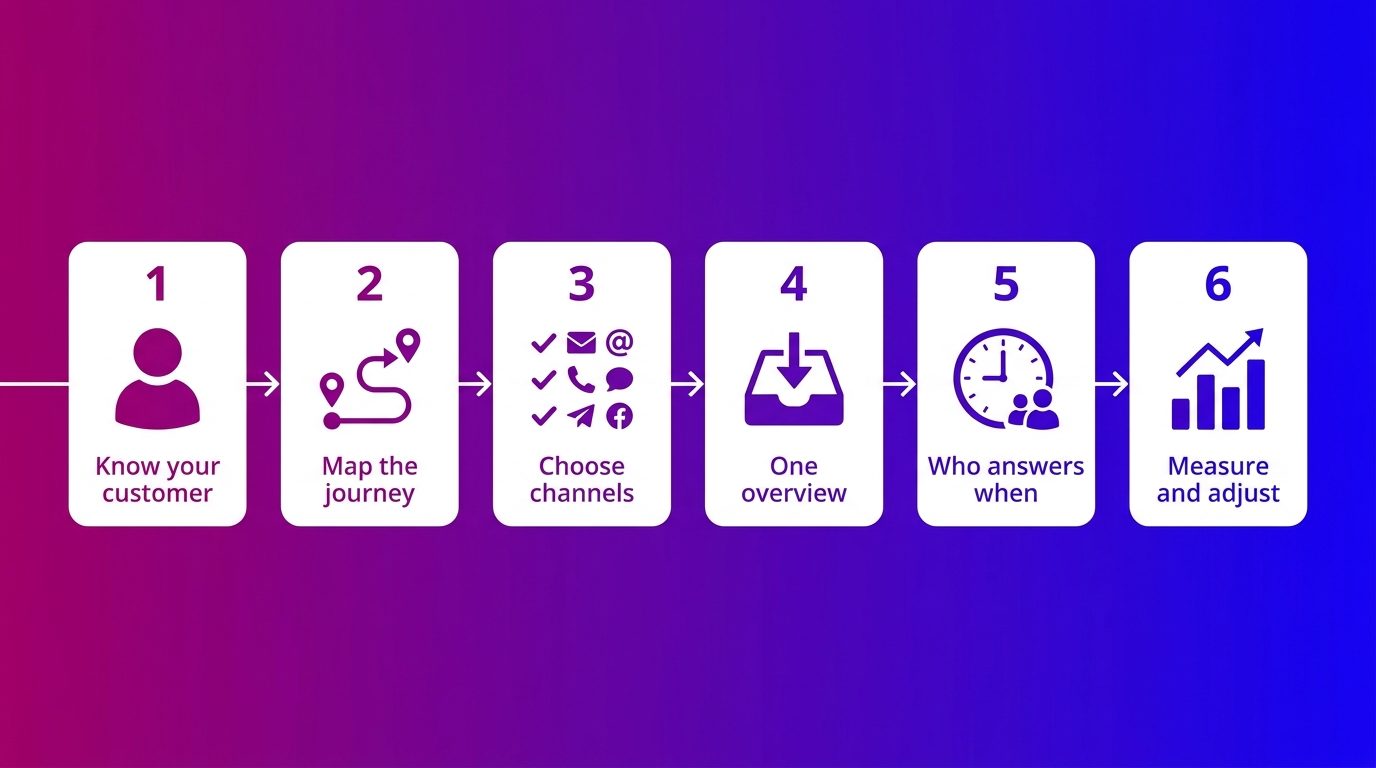
1. Know your customer and their questions
Start with what customers ask now, not with the channels you would like to have. Collect a few weeks of questions from chat, email, phone and social media and sort them: research, price, availability, appointment, service. You will quickly see which questions come up most and at what time of day.
2. Map the customer journey
The customer journey shows which touchpoints a customer passes from first question to purchase or appointment. Mark the switches in particular: where does someone start on the chat and continue on WhatsApp or the phone? Those are exactly the points where information gets lost.
3. Choose your channels deliberately
More channels is not automatically better. Every channel you offer also has to be staffed. Choose the channels your customers actually use and that you can answer well; two well-connected channels deliver more than five half-run ones.
4. Bring everything together in one overview
Make sure all conversations arrive in one inbox, with the history attached. This is the technical heart of omnichannel: without a shared overview it stays multichannel, however good the agreements are.
5. Decide who answers when
Record who answers which questions and at what times. What does an AI agent handle on its own, when does a person take over, and who picks up questions in the evening and at weekends? Also agree how a conversation is handed over to sales or service, with a short summary attached.
6. Measure and adjust
Measure per channel how quickly you respond, how many questions lead to an appointment or purchase and where customers drop out. Look closely at the switches between channels. Adjust your channel choice and staffing to what you see.
The customer journey: where omnichannel makes the difference
In the customer journey, omnichannel lives mainly in the moments between channels. A customer researches on your website, asks a question on the chat, receives a quote by email and sends a follow-up question on WhatsApp a week later. Each of those steps is a chance to recognise the customer, or to make them start again.
Three switches deserve extra attention:
- From website to personal contact: does the chat carry over what the visitor has already looked at?
- From first contact to follow-up: does the salesperson or service agent get the summary of the conversation?
- From office hours to evening: is a question at ten at night picked up, or does it wait until the next morning?
Get these three right and the foundation of an omnichannel customer journey is in place.
Common omnichannel strategy mistakes
Most omnichannel strategies don’t fail on technology, but on organisation. Researchers including Scott Neslin and Peter Verhoef named data integration, understanding customer behaviour and coordinating channels as the core of the challenge back in 2006. You still see that in practice today.
- Opening channels without staffing them. A WhatsApp button on the site that only gets a reply the next day does more harm than good.
- Each channel with its own owner. Marketing runs social, service runs email, sales runs the chat. Nobody sees the whole conversation.
- No agreements on handover. The conversation is passed on, but without a summary. The customer starts again.
- Forgetting channel rules. WhatsApp lets you reply freely for 24 hours after the customer’s last message; after that, only with an approved template. A strategy without follow-up inside that window runs into trouble.
How we approach this at Bconnect
At Bconnect we set up customer contact for businesses in automotive and home and living, and then handle the conversations ourselves, with more than 60 chat specialists and AI. A strategy never starts on paper for us, but with the question of where customer questions arrive now and who answers them.
With new clients we often see the same picture: the channels are already there, but they are split across departments and hours. The chat is staffed until five, WhatsApp is kept up by one employee, and weekend questions wait until Monday. The first step is almost never a new channel, but bringing what is already there into one overview, with clear agreements about who answers when. Clients then choose the mix of people and AI that suits them: a chat specialist supported by AI in real time, AI that hands over to a person when needed, or fully autonomous AI for predictable questions.
What makes the biggest difference in practice is the handover. Our chat specialists pass every qualified conversation to the client’s sales team, in their CRM, by email or via their support system, with the full transcript and a short summary: what the visitor is looking for, what has already been discussed and what the next step is. A car dealer or kitchen showroom that receives such a summary can call back with purpose instead of starting from scratch.
An example of an omnichannel strategy
Take a car dealership with a website, a chat, WhatsApp and a showroom. An omnichannel strategy then records:
- Channels: chat and WhatsApp on the website, phone for the workshop, the showroom for test drives.
- Staffing: chat specialists answer chat and WhatsApp from 08:00 to 23:30, an AI Sales Agent handles questions outside those hours and notes what the customer wants, and an AI Service Agent books workshop appointments and MOT reminders.
- Handover: a qualified question about a test drive or part-exchange goes to the salesperson with a summary.
- Measurement: how many conversations lead to an appointment, and how quickly the salesperson follows up.
You will find more worked examples in our omnichannel examples. Want to be clear first on what omnichannel involves? Read what is omnichannel. For dealerships specifically, see our page on chat and WhatsApp for automotive.
A strategy that starts with the conversation
An omnichannel strategy stands or falls on what happens between the channels. Choose deliberately which channels you offer, bring them into one overview and record who answers when and how a conversation is handed over. Then the customer won’t notice switching channels, and your team won’t notice serving more of them.
To run those channels you can choose your own tooling or outsourced omnichannel customer service, where a partner handles the conversations for you. How to organise it around management and roles is covered in our article on omnichannel management.
Frequently asked questions about omnichannel strategy
What is an omnichannel strategy?
An omnichannel strategy is a plan that sets out how all your customer channels work together. The aim is that a customer gets the same experience everywhere and can switch channels without starting again.
What is the difference between an omnichannel and a multichannel strategy?
A multichannel strategy puts several channels side by side, working separately. An omnichannel strategy connects those channels, so conversations and customer data are shared.
What is an example of an omnichannel strategy?
A car dealership that answers chat and WhatsApp in one overview, uses an AI agent outside office hours and hands every qualified question to the salesperson with a summary is running an omnichannel strategy.
Which step do you start with?
Start by understanding the questions customers ask now and on which channels. Only then choose your channels and set up the overview and staffing.
How many channels do you need for omnichannel?
There is no minimum. Two channels that are well connected are already omnichannel. Choose the channels your customers use and that you can staff well.
How do you measure whether your omnichannel strategy works?
Measure per channel the response time, the share of conversations that lead to an appointment or purchase and where customers drop out. Pay particular attention to what happens when customers switch channels.