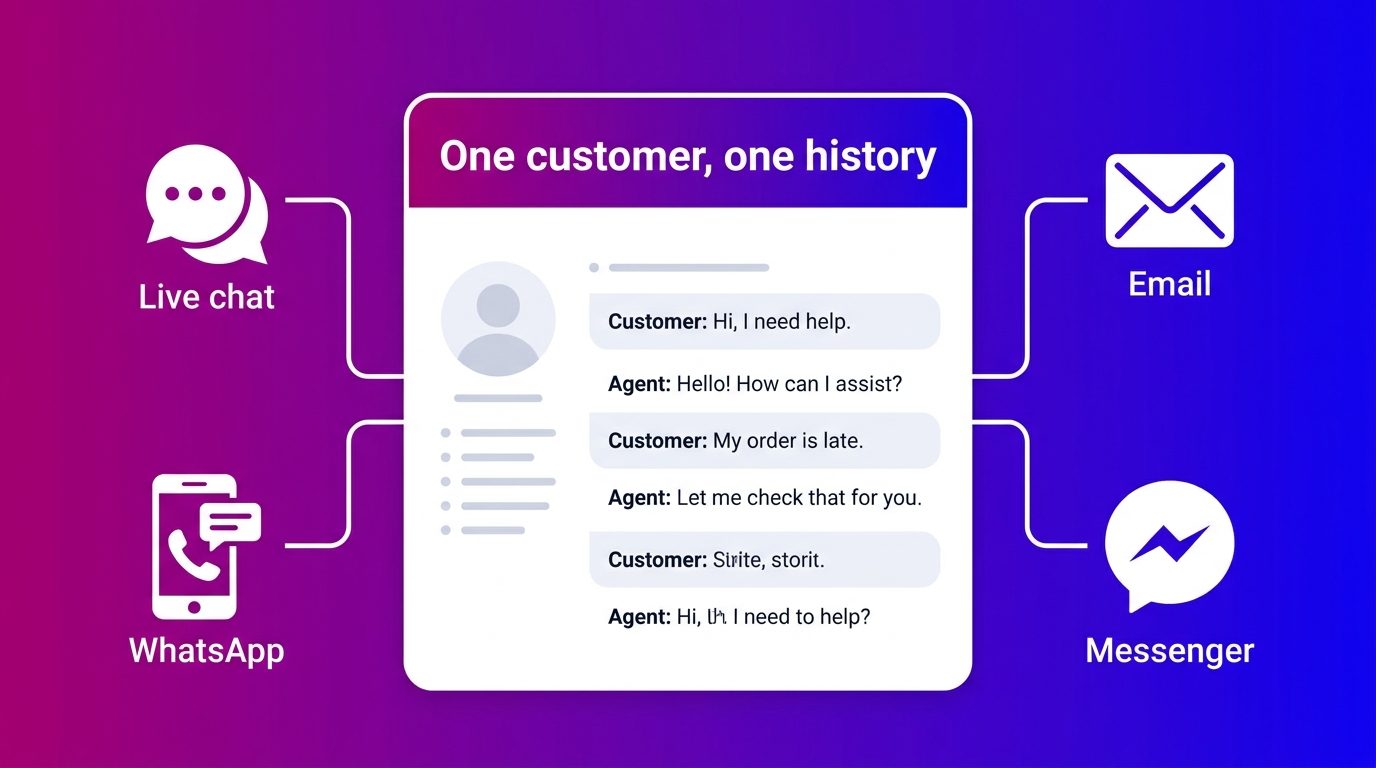
A simple example of omnichannel in customer contact is one central platform connected to several communication channels, such as live chat, WhatsApp, Facebook Messenger, SMS, email and Instagram. When someone starts a conversation, the visitor is registered. Later conversations, via any channel, can then be linked to the same visitor, and the information is always available in one place.
That sounds technical, but in practice it means something very recognisable: a customer who asks a question on WhatsApp and calls later does not have to tell their story again. Below you will find omnichannel examples, from a well-known brand to everyday practice at a car dealership, a kitchen showroom and an online shop.
What makes something an omnichannel example?
An example is only omnichannel if the customer can switch channels and the business recognises them as they do. Many lists of “omnichannel examples” mainly show that a brand is present on lots of channels. That is multichannel. The difference lies in three characteristics:
- One view of the customer: what the customer did on one channel is visible on the other.
- A continuous conversation: the customer can switch halfway without starting again.
- The same experience: the same information and the same tone, whatever the channel.
The examples below were chosen with that in mind.
A well-known example: ordering through every channel
An example that often comes up is Domino’s. In 2015 the pizza chain introduced the option, under the name AnyWare, to order through more and more channels, right down to tweeting a pizza emoji. You could also order by text message, smart TV, smartwatch and the in-car system.
What makes this an omnichannel example is not the number of channels, but what sat underneath. Every order ran through the same customer profile with a saved favourite order. Whether you tweeted or used your TV, the company knew who you were and what you wanted. That shared view of the customer is the core of omnichannel.
Examples from customer contact
In customer contact, omnichannel is less spectacular than a pizza emoji, but far more decisive for the customer experience. Three examples of what it looks like.
The car dealership: from used car to test drive
A visitor looks at a used car on a dealer’s website one evening and asks on the chat whether it is still available. They get an answer and are asked whether they want to part-exchange a car. The next day, they send photos of their current car on WhatsApp. Because both conversations are in one overview, whoever answers sees straight away which car it is about. The salesperson receives a summary with the car they want, the part-exchange and a preference for a test drive, and calls back with purpose. How this works for dealers and dealer groups is explained on our page about chat and WhatsApp for automotive.
The kitchen showroom: from inspiration to showroom appointment
Someone is planning a new kitchen and asks on the chat about worktops. Later, she sends a floor plan with measurements on WhatsApp. With an omnichannel approach, those two conversations are linked, so the designer already knows the style and the measurements at the showroom appointment. Without that link, the conversation in the showroom starts from scratch. You can read more on our page about customer contact for kitchen and home businesses.
The online shop: from product question to return
A customer asks on the chat about the size of a product, orders online and reports a return by email a week later. In an omnichannel set-up, the service agent sees the earlier chat and the order together, and doesn’t need to ask which product it was. That is omnichannel in e-commerce in its simplest form: the customer history travels with them across every channel.
What the examples have in common
All the examples rest on the same principle: the channel doesn’t matter to the customer, because the business recognises them everywhere. That takes three things:
- A shared view of the customer, like the profile at Domino’s or the central overview at the dealership.
- Agreements on handover, so a conversation goes to the right person with a summary.
- Staffing on every channel you offer, because a channel where nobody responds breaks the chain.
Research shows why it pays. In a study of more than 46,000 shoppers in Harvard Business Review, the large majority used several channels, and those customers spent more and came back more often than customers who used only one.
Where these examples come from
The dealership and kitchen showroom examples are not invented scenarios. At Bconnect, our chat specialists and AI have conversations like these every day for car dealers, kitchen showrooms and other businesses in automotive and home and living.
What we see again and again is that the switch from chat to WhatsApp often happens when the customer wants to show something: a photo, a floor plan, a registration number. That is exactly when it matters that the earlier conversation is right there.
What we also see: the biggest difference is not made in the conversation itself, but in the handover to the client. A summary of what the visitor is looking for and what has already been discussed means the salesperson or adviser can carry on immediately. All conversations arrive with us in an omnichannel contact centre where chat specialists and AI see the same history.
Examples as a starting point
Omnichannel examples show above all that it is not about the number of channels, but about how they hang together. Whether it is a pizza emoji or a WhatsApp photo of a part-exchange car: the customer is recognised and doesn’t have to repeat anything.
Want to get started yourself? Begin with the question of where your customers switch channels today. How to turn that into a plan is covered in our article on omnichannel strategy. What omnichannel means exactly is explained in what is omnichannel.
Frequently asked questions about omnichannel examples
What is an example of omnichannel?
A customer asks a question on WhatsApp and calls later. The employee sees the earlier WhatsApp conversation straight away and can carry on without the customer repeating their story. That is omnichannel in customer contact.
What is an omnichannel example in retail?
Ordering online and collecting or returning in store, where the shop sees the order and the customer details straight away. The customer switches channels without the process starting again.
What is an omnichannel example in e-commerce?
An online shop customer who asks a product question on the chat, orders online and later reports a return by email, while the service agent sees the chat and the order together.
Which companies use omnichannel?
Big brands such as Domino’s are well-known examples, but omnichannel works just as well for a car dealer, a kitchen showroom or an online shop. It is about how the channels connect, not the size of the business.
Is being on lots of channels the same as omnichannel?
No. Being on lots of channels is multichannel. Omnichannel means those channels are connected and the customer is recognised everywhere.
What do you need to work omnichannel?
A central overview where all conversations come together, agreements on who answers when, and a way to hand conversations over to sales or service with their context.