Multichannel means that a business uses several channels to reach and help customers, such as an online shop, a physical store, email, chat and WhatsApp, while those channels work separately. Each channel has its own process, its own data and often its own team.
For most businesses, multichannel is the step they have already taken. The question is what the next step is, and whether it is needed. Below you will read what multichannel means, how multichannel vs omnichannel compares, where cross-channel fits in and when multichannel is enough.
What is multichannel?
Multichannel is an approach in which you give customers a choice of several independent channels to contact you or buy from you. The emphasis is on reach and choice: the more channels, the more customers you can serve in their preferred way.
It has been studied for a long time. Researchers including Scott Neslin of Dartmouth and Peter Verhoef of the University of Groningen described multichannel customer management in 2006 as the design, deployment, coordination and evaluation of the channels through which a business and its customers interact. Their main warning: without linked data and coordination between channels, multichannel remains a collection of separate islands.
Typical multichannel channels:
- Sales channels: online shop, physical store or showroom, marketplace.
- Contact channels: phone, email, website chat, WhatsApp, Messenger.
- Marketing channels: newsletter, social media, advertising.
Multichannel vs omnichannel: the difference
The difference between multichannel and omnichannel lies in how the channels relate: with multichannel they are separate, with omnichannel they are connected and share data, so the customer can switch channels without starting again.
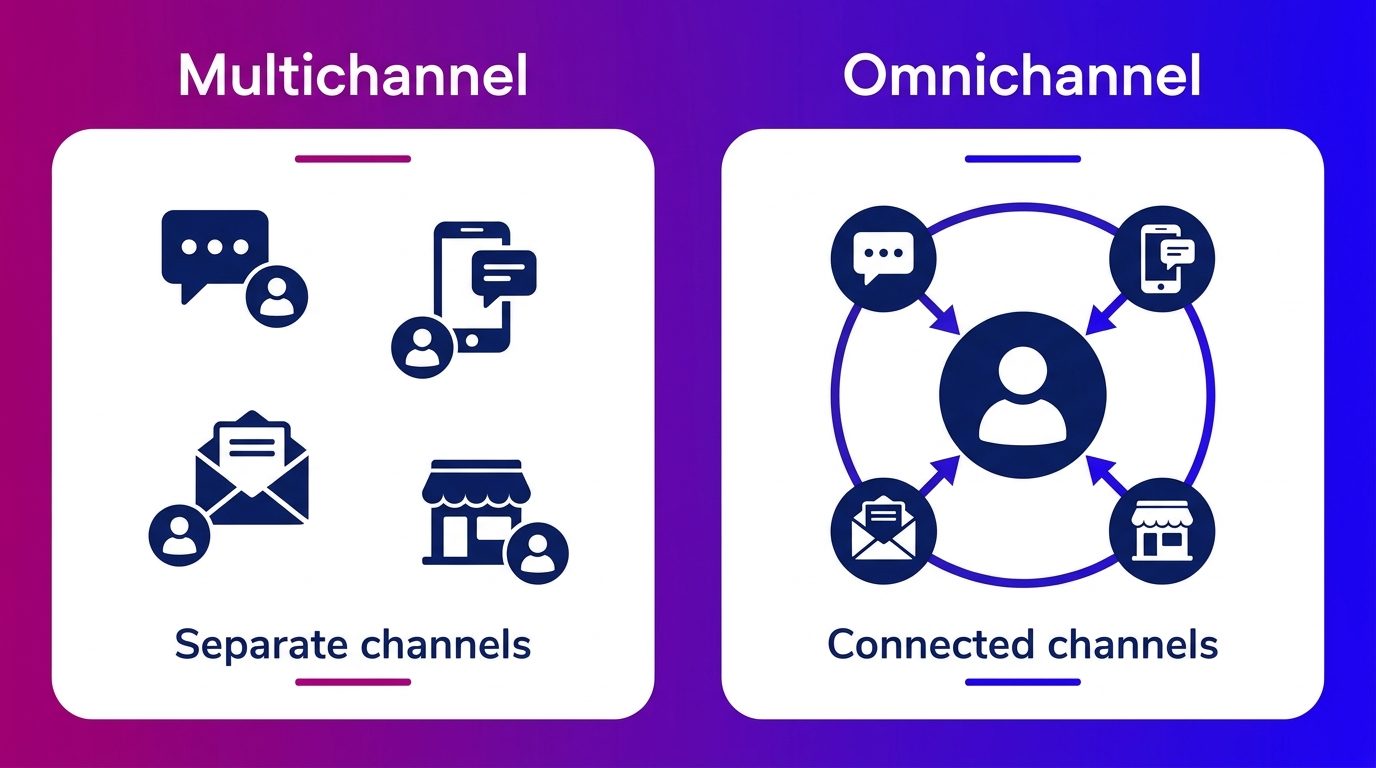
An example makes the difference tangible. A customer asks on your chat about the delivery time of a product. Two days later they send a WhatsApp message: “any news on my question?” With multichannel, the person on WhatsApp has no idea what it is about. With omnichannel, they see the chat conversation and can answer immediately.
And cross-channel?
Cross-channel sits between multichannel and omnichannel: the channels are linked at fixed points, but not yet fully integrated. Think of click and collect, or an email that automatically follows a visit to your online shop.
With cross-channel, the customer can switch at certain moments, but not everywhere. You can read more about this in-between form in our article on cross-channel marketing.
In one line: single channel is one channel, multichannel is several separate channels, cross-channel is several partly linked channels, and omnichannel is several fully connected channels.
When is multichannel enough?
Multichannel is enough as long as your customers use only one channel per question and rarely switch. An online shop where customers only report returns by email gains little from a fully integrated approach.
It becomes a problem as soon as customers start switching, and that happens more often than businesses think. In the UK, 28.3% of retail sales were made online in December 2025 while the rest still went through shops, so many customers combine both. In the study of more than 46,000 shoppers in Harvard Business Review, only 7% shopped exclusively online and 20% exclusively in store; the rest mixed channels.
Signals that your multichannel approach is reaching its limits:
- Customers have to repeat their question when they switch channels.
- Staff search several systems for the same customer.
- A WhatsApp message and a chat question from the same customer are answered separately by two people.
- You don’t know which channel leads to an appointment or a purchase.
A multichannel strategy that can grow
A multichannel strategy does not have to be the end point. You can set up your channels so the step to omnichannel is small later on:
- Choose channels you can staff. Better three channels that answer quickly than six that are left waiting.
- Use one customer record where you can, even if the channels are still managed separately.
- Agree how a question is passed on, with a short summary for whoever takes it over.
- Measure per channel how quickly you respond and what it delivers.
If you work like this, all that is left for omnichannel is bringing the channels into one overview. How to approach that step by step is covered in our article on omnichannel strategy.
From multichannel to omnichannel with our clients
At Bconnect we help businesses bring separate channels together, and then our chat specialists and AI handle the conversations that come in. We therefore see this transition up close with almost every new client.
Almost every new client starts out multichannel: a chat on the website, a WhatsApp number on the contact page and a general email address, each with its own route. The first improvement is rarely an extra channel. It is bringing those three into one overview, so our chat specialists can see that the visitor who asked about a used car on the chat this morning is the same person now sending a photo of their part-exchange on WhatsApp.
That platform, where website chat, WhatsApp, Messenger, SMS and email arrive in one inbox, is standard for us rather than an add-on. The real gain is in the agreements around it: who answers, how quickly, and what happens to the conversation when it goes to the salesperson. You can read more about how that works on our page about an omnichannel platform.
From separate channels to one conversation
Multichannel gives customers choice; omnichannel gives them continuity. The difference is not the number of channels, but whether those channels know about each other. As long as customers use one channel per question, multichannel will do. As soon as they switch, and most do, a connected approach pays for itself.
Want to see the terms side by side once more? Read what omnichannel means.
Frequently asked questions about multichannel and omnichannel
What does multichannel mean?
Multichannel means that a business uses several channels to reach and help customers, while those channels work separately. Each channel has its own process and its own data.
What is the difference between multichannel and omnichannel?
With multichannel the channels are separate. With omnichannel they are connected and share data, so the customer can switch channels without starting again.
What is the difference between multichannel and cross-channel?
With multichannel the channels work completely independently. With cross-channel they are linked at fixed points, for example click and collect.
What is an example of multichannel?
A business with an online shop, a physical store, customer service by email and a website chat, where each channel is managed separately and data is not shared.
Is multichannel worse than omnichannel?
Not necessarily. Multichannel is enough if customers only use one channel per question. As soon as customers switch channels, omnichannel delivers a better experience.
Is it multichannel or multi-channel?
Both spellings are used and mean the same thing. Multichannel as one word is the most common in marketing and customer service.