Cross-channel marketing is an approach in which you link your marketing channels at fixed points, so a customer who starts on one channel is guided logically to the next. Think of an ad that opens a WhatsApp conversation, or an email that follows a visit to your website.
Cross-channel therefore sits between multichannel and omnichannel. The channels are no longer separate, but not yet fully connected either. For many businesses it is a logical and achievable step, precisely because you don’t have to integrate everything at once.
What is cross-channel marketing?
Cross-channel marketing means deliberately designing the move between channels. You don’t judge each channel on its own results, but look at the route a customer takes: where they start, where they continue and where the decision is made.
That matches how customers behave. Researchers led by Peter Verhoef at the University of Groningen described the research-shopper phenomenon: customers often use one channel to search and another to buy. Cross-channel marketing responds to that by making the switch easy.
Typical cross-channel links:
- Ad to conversation: a Meta or Google ad with a WhatsApp button as its destination.
- Website to email: a visitor leaves their details and receives a tailored follow-up email.
- Offline to online: a QR code in the showroom or on a flyer that opens a chat or WhatsApp conversation.
- Online to store: research and order online, collect in store.
How cross-channel differs from multichannel and omnichannel
The difference lies in how strongly the channels are connected.
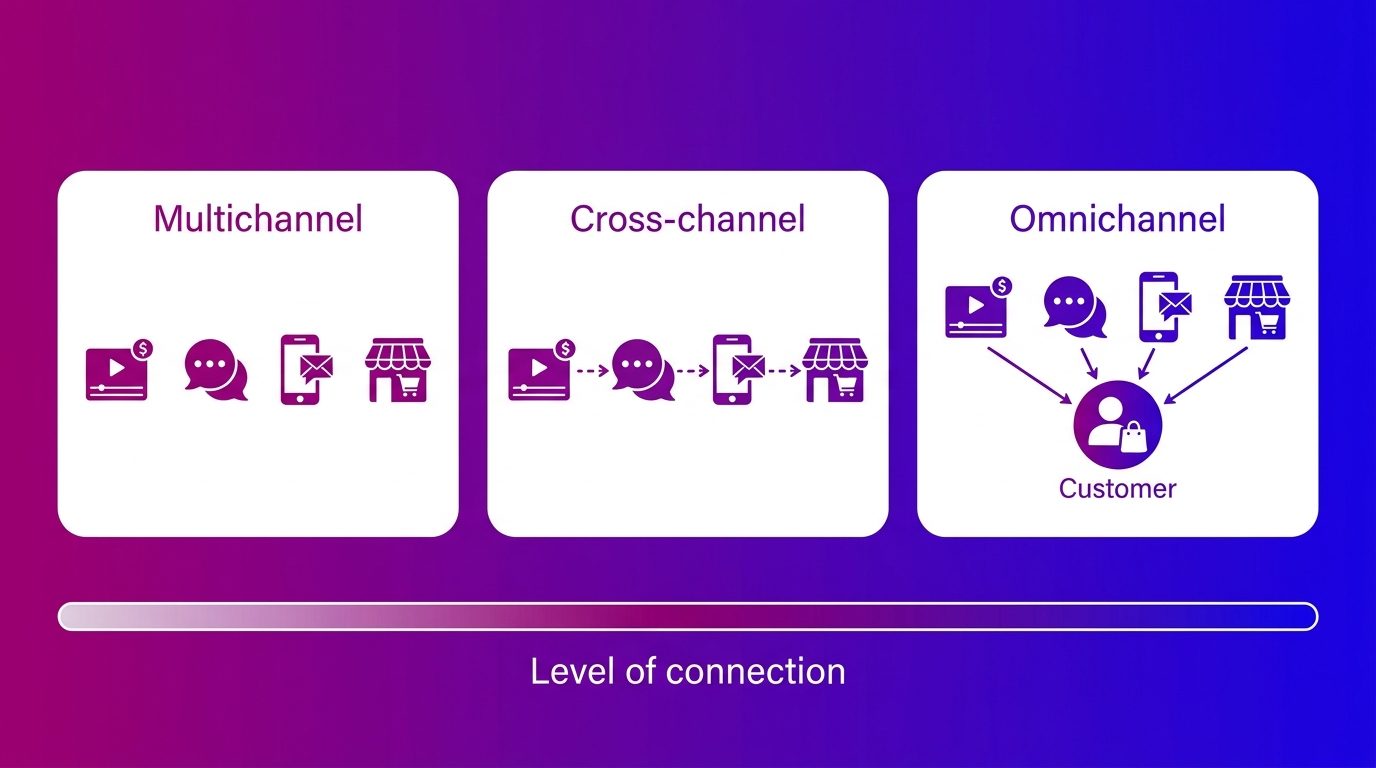
- Multichannel: you are present on several channels, but each one works separately. What the customer does on one channel is invisible on the others. Read more in our article on multichannel vs omnichannel.
- Cross-channel: channels are linked at fixed points. The move from ad to conversation or from website to email is designed, but not every channel knows the full history.
- Omnichannel: all channels are connected and share data. The customer can switch at any moment and is recognised everywhere. You can read exactly what that involves in what is omnichannel.
Think of it as three levels of connection. Cross-channel is the level at which many businesses make their first real gains.
When should you choose cross-channel marketing?
Cross-channel marketing suits you when your customers follow a recognisable route and you want to strengthen it, without connecting all your systems straight away. It works especially well when:
- you run campaigns and want clicks to lead straight to a conversation rather than to a form;
- customers research online and buy offline, as with a car, a kitchen or a home renovation;
- you want to automate the follow-up after a first contact, for example with an email or WhatsApp message.
Bear in mind that some links come with rules. In the UK, sending marketing emails or texts to individuals generally requires their consent under PECR, as the Information Commissioner’s Office explains. A follow-up that the customer asked for, such as an answer to their own question, is a different matter from an unsolicited promotion.
If you want to go further, with one view of the customer across all channels, omnichannel is the next step. How to approach it is covered in our article on omnichannel marketing.
How we use cross-channel in customer contact
At Bconnect we see cross-channel mainly at the moment marketing turns into a conversation. Our clients use a WhatsApp link as the destination in Google Ads, Meta ads or emails, and QR codes in the showroom or on printed material. Whoever clicks or scans goes straight into a conversation with our chat specialists or AI, instead of landing on a form and waiting for a reply.
What makes the difference in practice is what happens after that first click. A conversation that starts from an ad lands in the same inbox as website chat and email. A question that comes in via a campaign can therefore be followed up later on WhatsApp without the customer having to start again. That way, cross-channel moves quietly towards omnichannel. You can read more about this approach on our page about customer contact through one inbox.
Cross-channel marketing in short
Cross-channel marketing links channels at the moments customers switch: from ad to conversation, from website to email, from online to store. It is more concrete than multichannel and more achievable than full omnichannel, which makes it a logical step for many businesses.
Frequently asked questions about cross-channel marketing
What is cross-channel marketing?
Cross-channel marketing is an approach in which you link your marketing channels at fixed points, so a customer is guided logically from one channel to the next.
What is the difference between cross-channel and multichannel?
With multichannel, channels work separately. With cross-channel, they are linked at fixed points and the move between channels is deliberately designed.
What is the difference between cross-channel and omnichannel?
With cross-channel, channels are partly linked. With omnichannel, all channels are fully connected and share data, so the customer can switch at any moment.
What is an example of cross-channel marketing?
An ad with a WhatsApp button that opens a conversation straight away, or ordering online and collecting in store. In both cases, the move between channels has been designed.
When is cross-channel marketing a good choice?
When your customers follow a recognisable route, for example researching online and buying offline, and you want to strengthen that switch without connecting all your systems straight away.
Is it cross-channel or cross channel?
Both spellings are used and mean the same thing. Cross-channel with a hyphen is the most common in British English.