A customer who wants to know at ten in the evening whether their order is on its way has enough with a chatbot. A customer who is angry because the wrong kitchen was delivered wants to speak to a person. The difference between a chatbot that helps and a chatbot that frustrates lies in that boundary.
This article is about chatbots in customer service: which questions they handle well, where they get stuck and how to arrange the transition to a person.
What is a customer service chatbot?
A customer service chatbot is software that answers customer questions in a chat window automatically, based on your company’s information. It works via your website, WhatsApp or Messenger, and can answer day and night.
There are two kinds. A rule-based chatbot works with buttons and fixed paths: the customer chooses from options and gets the answer that belongs to that path. An AI chatbot understands free text, even with typos or three questions in one message, and looks up the answer in a knowledge base.
An AI chatbot is part of the broader concept of AI customer service, in which AI also sorts email, summarises conversations and passes questions on. This article is about the chatbot itself: the window in which the customer types their question.
Which customer questions a chatbot handles well
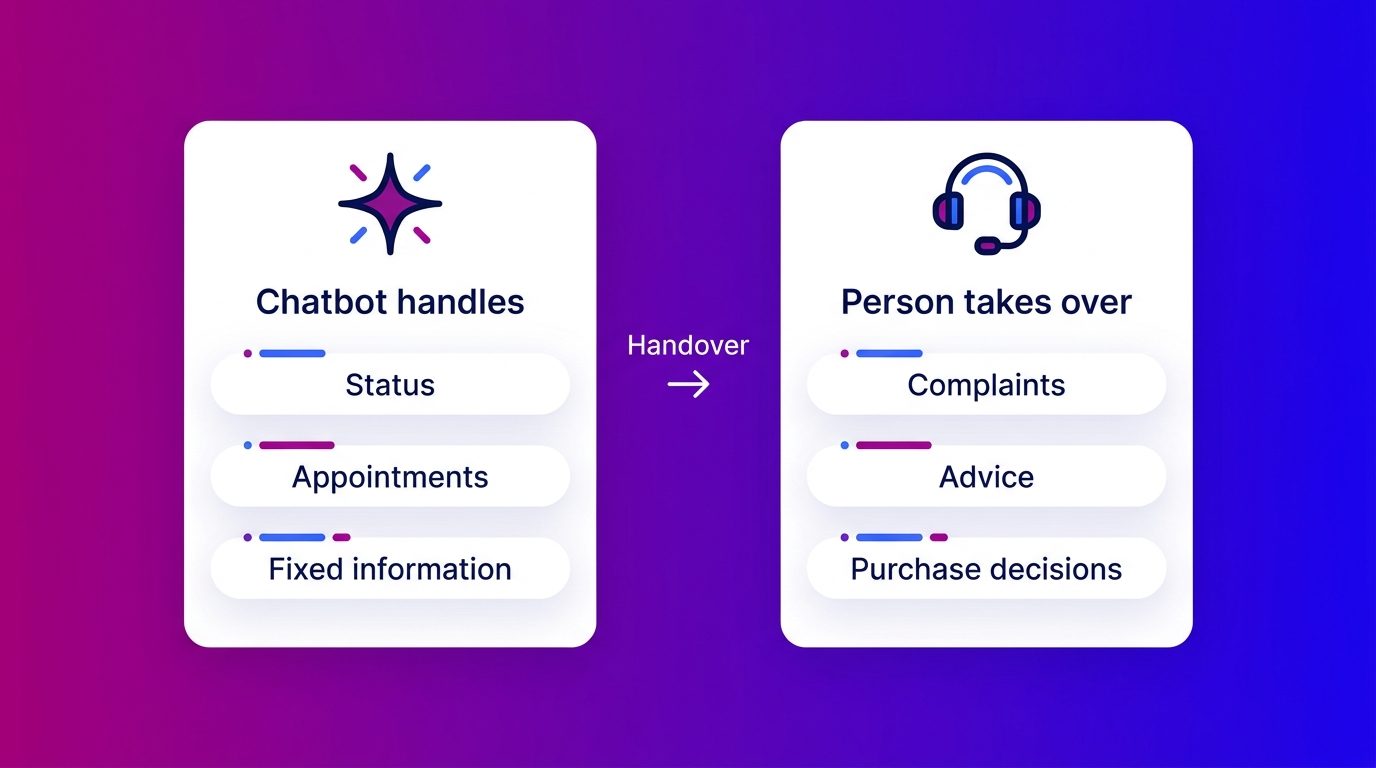
A chatbot works well with questions whose answer is fixed, is the same for every customer and does little harm if it is not quite right once.
- Status: where is my order, is my car ready yet, has the quote been sent.
- Appointments: booking or moving a workshop appointment, planning a showroom visit.
- Fixed information: opening hours, directions, warranty conditions, what to bring to an appointment.
In the motor trade it is often about MOTs, servicing and the status in the workshop. In home and living, delivery time, fitting date and the status of a quote are the regular questions. Such questions also come in during the evening and at the weekend, when your own team is not there.
A chatbot only does that well if it has access to reliable information. Without an integration with your planning or CRM, it can only answer a status question in general terms.
Where a chatbot gets stuck
A chatbot gets stuck as soon as a question requires judgement, bespoke work or empathy. Complaints, damage, deviating appointments and doubt about a purchase belong with people.
Most frustration does not arise because the chatbot does not know something, but because the customer then has nowhere to go. A chatbot that cannot help and offers no route to a person is the quickest way to lose a customer who was simply asking a question.
A chatbot also struggles with questions that are nowhere in the knowledge base. An AI chatbot that formulates an answer anyway can then say something convincingly wrong. More about the limitations is in the article on the disadvantages of chatbots.
Chatbot or live chat in your online customer service?
You make the choice between a chatbot and live chat per type of question, not for your whole customer service at once. Predictable questions go to the chatbot, questions that require judgement or advice to a person.
Use this decision rule:
- Is the answer fixed and the same for everyone? Then the chatbot can handle it.
- Does the answer depend on the customer’s situation? Then the chatbot starts and a person takes over as soon as it becomes specific.
- Is it a complaint, emotion or a purchase decision? Then the question belongs directly with a chat specialist.
In practice most organisations therefore do not choose between chatbot or live chat, but for a combination. The chatbot absorbs the volume, including outside office hours, and people keep the conversations that make the difference. If you would rather not set that up yourself, you can opt for digital customer service with AI and people, in which both are already aligned.
The broader comparison between chatbot vs live chat, beyond customer service, is in a separate article.
The handover: how to stop a chatbot being a wall
A chatbot only works in customer service if the customer can reach a person at any moment, without starting again. The handover is therefore not a side issue, but the most important part of the set-up.
Three rules for a good handover
- Announce it. The customer is told that an agent is coming, for example with “I am connecting you to a colleague”.
- Pass on the context. The agent sees the whole conversation, so the customer does not have to tell their story again.
- Let the customer choose. If the customer asks for a person, they get a person, even if the chatbot thinks it knows the answer.
What if nobody is there?
Outside the staffed hours the chatbot can record the question and say when a reply will come. The customer then does not have to wait in a window that does nothing any more. An AI chat that hands over to a specialist is set up so the question is with the right person the next morning with all the context.
What the rules require of a customer service chatbot
For anyone serving customers in the EU, a chatbot in your customer service has to make clear since 2 August 2026 that the customer is talking to AI. According to the European Commission, users must be told that they are not communicating with a real person but with an AI system. In the UK the ICO adds a data point: if a supplier runs the chatbot, a written contract between controller and processor is required under UK GDPR.
For the set-up that means three things:
- a name and introduction that make clear it is a chatbot
- a visible route to an agent
- a knowledge base you manage and update yourself
It also helps to let customers save or receive the conversation, so they can refer back to what was agreed.
How chatbot and chat specialist work together with us
At Bconnect, AI is never the end point of a conversation. If the AI cannot get any further, a chat specialist or the client’s own team takes over, announced and with the full context.
We usually work with the AI First + Human Handoff model. The AI holds the conversation and handles the predictable questions, day and night. Our chat specialists are available from 08:00 to 23:30, seven days a week, and take over where needed. The client decides at which moments the handover takes place.
What we often see in service conversations: the question a customer comes in with is not always the question that matters. Someone asking about the status of their service sometimes also wants to know what their car is worth in part-exchange. A chatbot that only answers the first question leaves the second lying there. That is why we always pass a buying signal to a person.
The AI invents nothing in the process. If it does not know the answer, it says so and connects the customer, instead of taking a guess.
A chatbot is only good if the person stays reachable
A customer service chatbot works best as the first line for predictable questions, not as a replacement for your team. Status, appointments and fixed information it handles quickly, even when your team is not there.
Complaints, advice and exceptions belong with people. Anyone who draws that line sharply, arranges the handover well and lets the customer know who they are talking to gets a customer service that is faster without becoming unreachable. All the topics are in our overview of customer service.
Frequently asked questions about the customer service chatbot
What is a customer service chatbot?
A customer service chatbot is software that answers customer questions in a chat window automatically, based on the company’s information. It works via the website, WhatsApp or Messenger and is available day and night.
Can a chatbot replace a customer service agent?
No. A chatbot handles predictable questions, such as status, appointments and opening hours. Complaints, advice and exceptions require a person, and customers should always be able to reach an agent.
What is the difference between a chatbot and live chat?
With a chatbot, software answers the question automatically. With live chat, a person types the answer. Many organisations combine both: the chatbot catches simple questions, a chat specialist takes over the rest.
Which questions can a chatbot not answer well?
Questions that require judgement, bespoke work or empathy, such as complaints, damage, deviating appointments and advice on a purchase. Questions that are not in the knowledge base are also a risk, because an AI chatbot can then give a wrong answer.
Do you have to tell customers they are talking to a chatbot?
For anyone serving customers in the EU, yes: since 2 August 2026 the AI Act requires organisations to make clear that a user is communicating with an AI system and not with a real person. It is good practice everywhere, because customers trust a chatbot more when they know what it is.
How do you prevent customers getting frustrated by a chatbot?
Make sure the customer can always reach a person, announce the handover and pass the conversation to the agent. Keep the knowledge base up to date, so the chatbot does not give outdated information.
Is an AI chatbot better than a chatbot with buttons?
An AI chatbot understands free text and can handle more kinds of questions. A chatbot with buttons is more predictable and easier to control. For customer service, an AI chatbot works best if it only answers from your own knowledge base and hands over when in doubt.