Improving customer service rarely works with a new tool or an extra member of staff alone. Most of the return is in a few concrete interventions: giving the first answer faster, being available when customers ask questions, automating routine questions and making sure nobody gets stuck between chatbot, WhatsApp and inbox. Which intervention delivers the most for you only becomes clear once you measure.
This piece is about digital customer service: questions that come in via website chat, WhatsApp and email. Telephony is left out.
What is good customer service?
Good customer service is service in which the customer gets a correct answer or a solution with as little effort as possible, via the channel they choose themselves. It is not about surprising people or extras. It is about the basics: being reachable, giving the right answer and finishing the question without the customer having to start again.
That definition has a solid foundation. In research published by Harvard Business Review in 2010, among more than 75,000 customers of contact centres and self-service channels, extra efforts to delight customers turned out to deliver little. Customers mainly want a fast, simple solution. The effort a customer had to make predicted loyalty better than customer satisfaction or the Net Promoter Score.
For digital customer service that means concretely: every extra action counts. A customer who first has to convince a chatbot, then fills in a form and then still sends an email experiences poor service, even if the final answer is correct.
Start by measuring
Improving customer service starts with knowing where it goes wrong now. Without measurement you choose the intervention that is most visible, not the one that delivers the most.
Measure at least these five points:
- Time to first answer per channel. Website chat, WhatsApp and email each have a different expectation. Measure them separately.
- Missed conversations. How many chats come in while nobody is available, especially in the evening and at the weekend?
- First-contact resolution. What share of questions is handled without a second contact or referral?
- Customer effort. Afterwards, ask how much effort it took to get help. That is the Customer Effort Score: one question, on a scale from easy to difficult.
- The top ten questions. Which questions come back every week? That is your list of candidates for automation and for better information on your website.
If you specifically want to improve customer satisfaction, also measure satisfaction directly after the conversation. But do not look only at that score: a customer who is happy with a friendly agent may still have had to make contact three times.
Record a baseline of one or two months. After every intervention you can then see whether it really makes a difference.
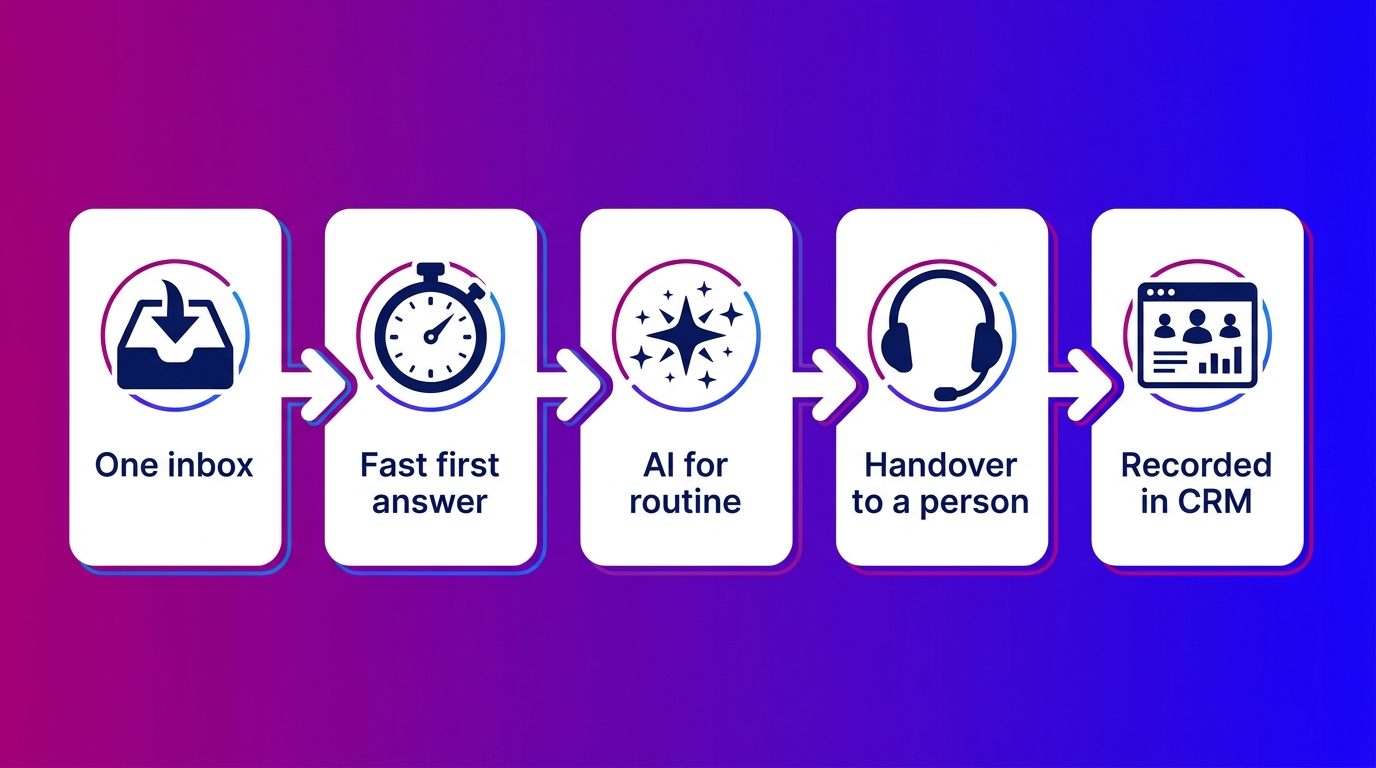
Six interventions that improve your customer service
The six interventions below are in the order in which they make the most difference for most businesses. Your measurement determines whether that order also holds for you.
1. Shorten the time to the first answer
In chat, the first minute counts. A visitor who asks a question in the chat is still on your website at that moment. If nothing comes, they click away or open a second tab at a competitor. With email the expectation is wider, with WhatsApp somewhere in between.
Speed alone is not enough, though. The same HBR research advises steering on solving the problem, not on speed. A fast but empty answer (“we will get back to you”) only shifts the work. So steer on two things at once: a quick first response, and a first response that answers the question outright as often as possible.
A good answer library makes that possible. Record the answers to the ten most asked questions, including links to the right pages, so everyone in your team gives the same, correct answer.
2. Be available outside office hours
Customers ask their questions when it suits them, and that is often not between nine and five. Anyone choosing a kitchen or windows does so in the evening on the sofa or at the weekend. Anyone who wants to move a workshop appointment thinks of it on Sunday evening.
There are three ways to cover those hours: extending shifts with your own team, using AI for the questions that lend themselves to it, or handing over the staffing. For many businesses a combination is the most realistic. You can, for example, outsource your customer service with AI and specialists, so routine questions are answered automatically and a person takes over the conversation where needed.
Whatever you choose: state clearly when a person is available. A chat that looks live but has nobody at night creates an expectation you do not meet.
3. Automate recurring questions
Questions about status, opening hours, delivery times and appointments are predictable. You can have those handled automatically, via an AI chatbot on your website, via WhatsApp or in your email inbox. That relieves your team and gives the customer an immediate answer.
Only automate what is really predictable. Questions that deviate from the standard are where chatbots get stuck, and a chatbot that does not make clear when it does not understand a question is the fastest way to lose a customer.
The decision rule is therefore simple. Let the AI handle what you can cover with a fixed list of answers, and have it hand over as soon as the question falls outside that. How to set that up is covered in our article on AI customer service.
4. Arrange a good handover to a person
A good handover is announced, happens in time and gives the agent the whole conversation. The customer hears that they are being connected to a colleague and does not have to type their question again.
This is no longer optional either. For anyone serving customers in the EU, the AI Act requires since August 2026 that people know they are talking to an AI system, as the European Commission explains, and customers everywhere expect a visible route to a human.
In practice it often goes wrong at findability. So put that option visibly in the chat, not only after three failed answers.
5. Bring your channels together in one inbox
Customers switch channels. They start in the website chat, later send a photo via WhatsApp and then reply to an email. If those conversations come in through three separate systems, nobody sees the whole story and the customer has to repeat themselves. The HBR research names limiting such channel switches as one of the ways to lower customer effort.
One inbox for all channels solves that. It also makes follow-up more reliable. On WhatsApp a hard limit applies: a customer’s message opens a service window in which you can reply freely, and after that only pre-approved message templates are allowed. A WhatsApp message left on a separate phone therefore costs you more than just time. How one inbox works across channels is on our omnichannel page.
6. Connect customer contact to your systems
An agent who first has to search three systems answers more slowly and less precisely. A conversation that is not recorded is untraceable next week. So connect your customer contact to the place where your customer data lives.
With an integration with your CRM or dealer management system you see in the conversation who the customer is and what happened earlier. Conversely, the chat transcript automatically lands with the right customer. In automotive that means, for example, that a question about a service lands directly with the right vehicle and the right branch.
An integration is not a condition for starting, though. Start by recording every conversation, by email if necessary, and connect once the volume justifies it.
Customer service tips that cost little
Not every improvement requires investment. You can apply these customer service tips this week:
- Make your contact details easy to find. Check that your email address and phone number are visible on your website.
- Put opening hours in the chat. Show when a person is available and what happens outside those hours.
- Send the conversation afterwards. Email the customer a copy of the chat. Then they can find agreements again and do not have to explain again what was going on with a follow-up question.
- Go through the top ten questions every week. Questions that keep coming back often point to unclear information on your website. Adjust that page and the question declines.
- Ask one question afterwards. Ask how easy it was to get help. An open comment often delivers more than the score.
- Read back ten conversations a week. You see immediately where answers are too long, too vague or incomplete.
Where it goes wrong in practice with chat and WhatsApp
At Bconnect our chat specialists and AI hold around 2.5 million conversations a year via website chat, WhatsApp, Messenger, SMS and email. What we see again and again: most customer service does not get stuck on knowledge, but on the moments between channels and between people and AI.
The first bottleneck is the evening. In home and living many questions come in after work, exactly when people discuss their renovation together. A question like “can this window be made to measure?” that is only answered the next morning has often already been answered by someone else. That is why our chat specialists are available seven days a week from 08:00 to 23:30 and AI covers the hours outside that.
The second bottleneck is the handover. An AI Service Agent can handle an MOT reminder or a status question in automotive perfectly well on its own. With a photo of a warning light, the AI should not give a diagnosis but pass the conversation to the workshop. We announce that handover, and the colleague who takes over sees the whole conversation.
The third bottleneck is what happens after the conversation. A good conversation without a record is half the job. We pass every conversation with transcript to the client’s CRM, inbox or support system, so their own team knows exactly what was discussed.
Where to start
You build better customer service step by step. Start with a few weeks of measuring, then choose the intervention that closes the biggest gap, and measure again. For most businesses that is availability in the evening or a handover that does not work. Only after that does it pay to automate or integrate further.
If you are unsure whether to keep doing it yourself or hand part of it over, first look at the customer service outsourcing cost and what it sets against your own hours.
Frequently asked questions about improving customer service
How can I improve my customer service without extra staff?
Start by automating recurring questions, such as status, opening hours and appointments. Also record fixed answers for the most asked questions and improve the information on your website. That leaves your team with time for the questions that really need a person.
What is the difference between customer satisfaction and customer effort?
Customer satisfaction measures how satisfied a customer is with the contact. Customer effort measures how much effort it took to get help. Customer effort often says more about whether a customer comes back, because a friendly conversation does not make up for a cumbersome process.
Which customer service metrics should I track?
Per channel, track the time to first answer, the number of missed conversations, the share of questions resolved in one go and the customer effort afterwards. Also note every week which questions come back most often.
How quickly should you respond to a chat message?
With website chat as quickly as possible, because the visitor is still on your website at that moment and otherwise clicks away. With WhatsApp and email the expectation is wider. More important than speed alone is that the first answer answers the question outright as often as possible.
Can a chatbot take over my customer service completely?
No. A chatbot works well for predictable questions, but gets stuck with questions that deviate from the standard. Customers also expect to be able to reach a person alongside a chatbot. So combine AI with a clear handover to a member of staff.
What is a good handover from chatbot to agent?
A good handover is announced, happens as soon as the chatbot cannot answer the question and gives the agent the full conversation. The customer then does not have to ask their question again.
Why is one inbox for all channels important?
Customers switch between website chat, WhatsApp and email. In one inbox you see the whole conversation, whatever the channel, and the customer does not have to repeat themselves. It also prevents a message being left lying around, which counts extra with WhatsApp because after the service window you can only reply with approved templates.