Using ChatGPT for business works well for internal work, such as writing texts, summarising documents and developing ideas. For customer contact it is less suitable: ChatGPT does not know your customers, stock or appointments, and cannot hand a conversation over to a colleague.
Below you will read what ChatGPT can do for businesses, which business version fits, how to introduce it safely and where you are better off choosing another solution.
What can you do with ChatGPT in business?
With ChatGPT, staff can write, read and think faster. It is a tool for tasks where a person checks the result before it goes out.
Businesses mainly use ChatGPT for:
- Writing. First drafts of emails, quotes, job adverts, product descriptions and social posts.
- Summarising. Reducing long reports, minutes and contracts to the essentials.
- Translating and rewriting. Converting a text into another language or tone, for example from internal jargon to customer language.
- Analysing and organising. Grouping customer feedback into themes or structuring a list of ideas.
- Brainstorming. Angles for a campaign, a presentation or a difficult conversation.
What these tasks have in common: a member of staff reads the result. That matters, because ChatGPT can give convincing answers that are wrong. Why that happens is covered in the limitations of conversational AI.
Which business version of ChatGPT fits?
There are separate versions of ChatGPT for business use, with different arrangements for your data than the free version. The most important difference: in the business versions, your data is not used to train OpenAI’s models by default.
- ChatGPT Business is for teams and smaller organisations. Until August 2025 this version was called ChatGPT Team, according to OpenAI. Only the name changed.
- ChatGPT Enterprise is for larger organisations, with extra admin controls, such as deciding how long conversations are kept and signing in through your company account.
- The free version and Plus are for personal use. Conversations in those versions can be used to improve models.
According to OpenAI’s enterprise privacy page, the company does not use business data from Business, Enterprise and the API for training by default, unless a customer opts in. OpenAI also offers business customers a data processing agreement, which you need under data protection law if you have personal data processed.
Note: “not used for training” does not mean data is not stored. Conversations are held on OpenAI’s servers, in the business versions too.
Using ChatGPT for business in five steps
Using ChatGPT for business does not start with the tool, but with agreements: who may use it, for what and with which data. These five steps help you set it up properly.
- Choose a business version. Make sure staff do not work in their own free accounts, because the personal-use terms then apply.
- Agree which data must not go in. No names, addresses or customer files, no medical or financial data and no confidential business information, unless you have a data processing agreement and a policy in place.
- Decide what it may be used for. For example first drafts of texts, summaries of public documents and internal brainstorms.
- Train your staff. Explain how ChatGPT works, what it cannot do and why every result must be checked.
- Review and adjust. After a few months, look at how it is being used and update the agreements.
What are the risks and rules?
The two biggest risks of using ChatGPT for business are data leaks and wrong answers. On top of that, data protection law and, for EU business, the AI Act apply.
Data leaks. Regulators have repeatedly warned about staff entering personal data into public AI chatbots. The advice is always the same: make clear agreements about which data may and may not go into a chatbot, and use a business version.
AI literacy. Since February 2025, organisations that use AI systems in the EU must take measures to support their staff’s AI knowledge. In its questions and answers, the European Commission explicitly mentions staff using ChatGPT for advertising copy or translations: they need to know the risks, such as invented answers.
Wrong answers. ChatGPT does not know what applies in your business. A price, delivery time or condition it mentions may be out of date or invented. For internal work you catch that by checking; in customer contact you cannot.
ChatGPT in customer contact: where does it get stuck?
ChatGPT is a general tool, not a customer contact system. It gets stuck on three points as soon as you use it for questions from customers or leads.
- No customer data of its own. ChatGPT does not know your customers, orders, stock or appointments. It cannot say whether a car is still available or when a kitchen will be delivered.
- No integrations. A lead from a conversation does not end up in your CRM by itself, and an appointment does not land in your sales team’s diary.
- No handover. If a customer wants to speak to a person or the question gets too complex, ChatGPT cannot pass the conversation to a colleague.
What happens when a chatbot goes live without boundaries is covered in the disadvantages of chatbots.
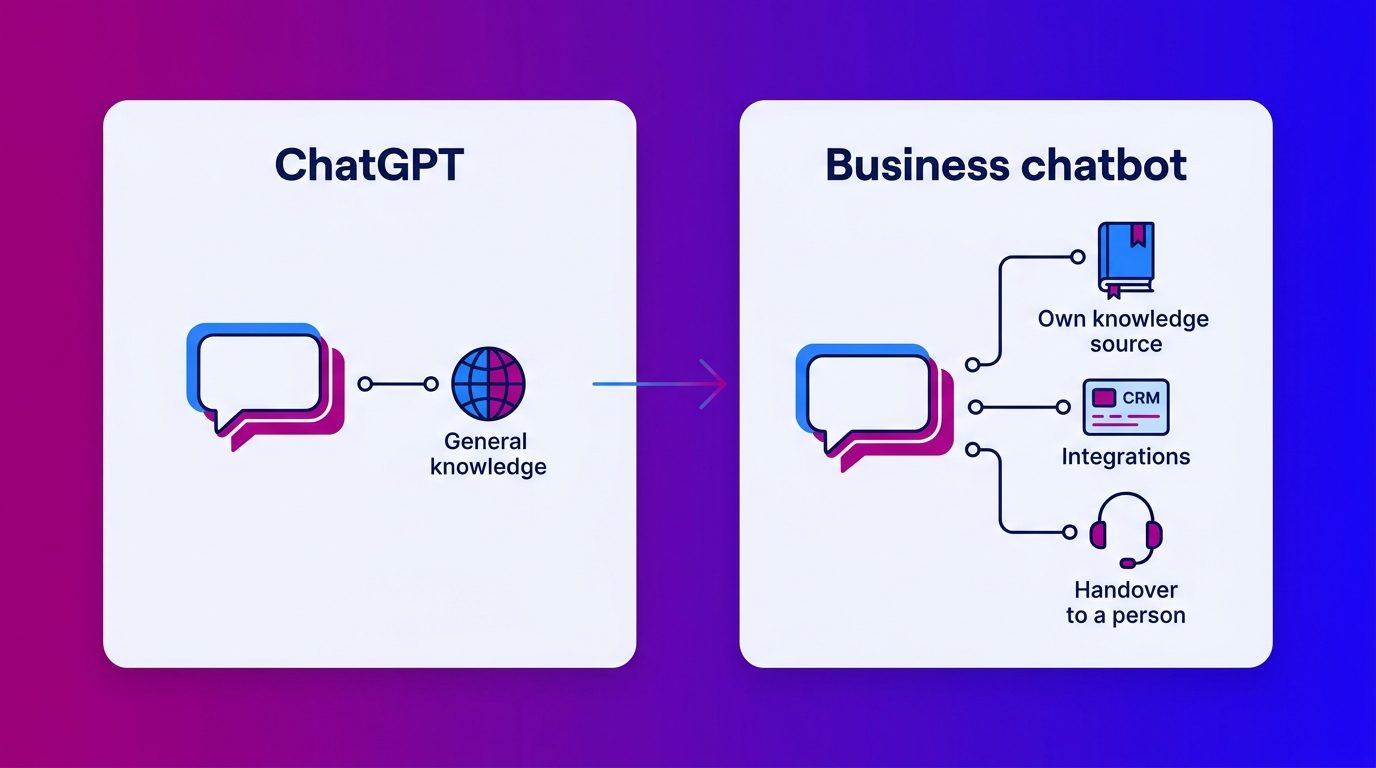
ChatGPT or a business chatbot?
Use ChatGPT for internal work with a member of staff checking, and a business chatbot for conversations with customers. A business chatbot often uses the same kind of language model, but is set up for one business.
The difference lies in three things:
- Its own knowledge source. A business chatbot answers from the company’s information: offering, terms, delivery times and frequently asked questions. Not from general knowledge on the internet.
- Integrations. A lead arrives in the CRM with name, question and conversation, and an appointment goes straight into the right diary.
- A person as a safety net. With doubt, a complaint or a buying question, a member of staff takes over with the full conversation.
What a chatbot is and which types exist is covered in what is a chatbot.
OpenAI and other language models
OpenAI is the US company behind ChatGPT. Alongside the ChatGPT subscriptions, OpenAI offers an API that lets developers build its language models into their own software.
OpenAI is not the only provider. Other companies also develop large language models, and many business chatbots can work with different models. For a business, the choice of model usually matters less than the set-up around it: the knowledge source, the boundaries and the handover.
How we use language models in customer contact
At Bconnect we do not use language models as a standalone chatbot, but as part of the customer contact of car dealers and home and living businesses. The AI answers from a knowledge base we build with the client from their own information, and does not make up answers that are not in it.
What ChatGPT cannot do, we arrange around it. A conversation with an interested visitor ends as a lead in the client’s CRM or dealer management system, with name, question and the full conversation. With doubt, a complaint or a concrete buying question, the AI announces a handover and one of our chat specialists takes over.
How much the AI does itself is agreed per client: from Operator Assisted AI, in which our chat specialists hold the conversation with AI support, to AI Only for predictable questions. If you want a set-up like this for your own website, you can choose a chatbot connected to your CRM.
ChatGPT for business: good for internal work, not for customer contact
Using ChatGPT for business pays off for internal work: texts, summaries, translations and analyses, with a member of staff checking the result. Choose a business version, agree on data and train your staff. For customer contact you need more than ChatGPT can offer: your own knowledge source, integrations with your systems and a person who takes over when it matters. All the articles on this topic are in the overview of chatbots.
Frequently asked questions about ChatGPT for business
Is ChatGPT free for businesses?
There is a free version of ChatGPT, but it is meant for personal use. For business use there are paid versions, such as ChatGPT Business and Enterprise, in which your data is not used to train the models by default.
Can I put customer data into ChatGPT?
Only if your organisation has made arrangements for it, with a business version, a data processing agreement and a clear policy. If staff do it on their own initiative in a free account, it can amount to a data breach.
Can ChatGPT handle my customer service?
Not well. ChatGPT does not know your customers, orders and terms, is not connected to your systems and cannot pass a conversation to a member of staff. For that you need a chatbot set up on your own business.
What is the difference between ChatGPT and a chatbot?
ChatGPT is a general AI chatbot that talks about many topics. A business chatbot often uses the same kind of language model, but answers from one company’s information, is connected to its systems and hands conversations over to a person.
What is OpenAI?
OpenAI is the US company that develops ChatGPT. Alongside ChatGPT, OpenAI offers an API that developers can use to build its language models into their own software.
What is the difference between ChatGPT Business and Enterprise?
ChatGPT Business, formerly ChatGPT Team, is for teams and smaller organisations. Enterprise is for larger organisations and offers extra admin controls, such as deciding how long conversations are kept. In both versions your data is not used for training by default.