Many dealerships have a WhatsApp button on the website. Messages come in, but there is no process behind them. One phone in the sales department, nobody watching it consistently, and on Monday morning a question about a used car from Friday evening.
That is a shame, because the reach is there. WhatsApp is one of the most widely used messaging apps in Europe, so your customer already has it open.
WhatsApp for car dealers is about what you do with that reach: who answers, within what time, and within which Meta rules. This article shows how WhatsApp works for car dealers in sales and in service.
What WhatsApp delivers for car dealers
WhatsApp for car dealers means customers and visitors ask questions, make appointments and receive updates via WhatsApp, and the dealership answers and follows up those conversations consistently.
The gain is not in one big advantage, but in a few moments where WhatsApp is shorter than the route your customer takes now.
One message instead of a form
A contact form takes patience: fill it in, send it, wait. WhatsApp takes one message. That means visitors who would otherwise drop out get in touch too. That way WhatsApp can help you to more test drives from your website, without a single extra visitor.
Photos and video do the showroom work in advance
A scratch on the bumper, the condition of the interior, the tyres: in text that takes three emails back and forth. Via WhatsApp you send a photo or short video and the question is answered. Anyone who still wants to come in afterwards comes with serious intent.
Follow-up with the whole history
After a showroom visit, a lead often disappears into a mailbox. A WhatsApp conversation stays put, with everything said earlier. At the next contact the salesperson still knows what it was about, and the customer does not have to repeat anything.
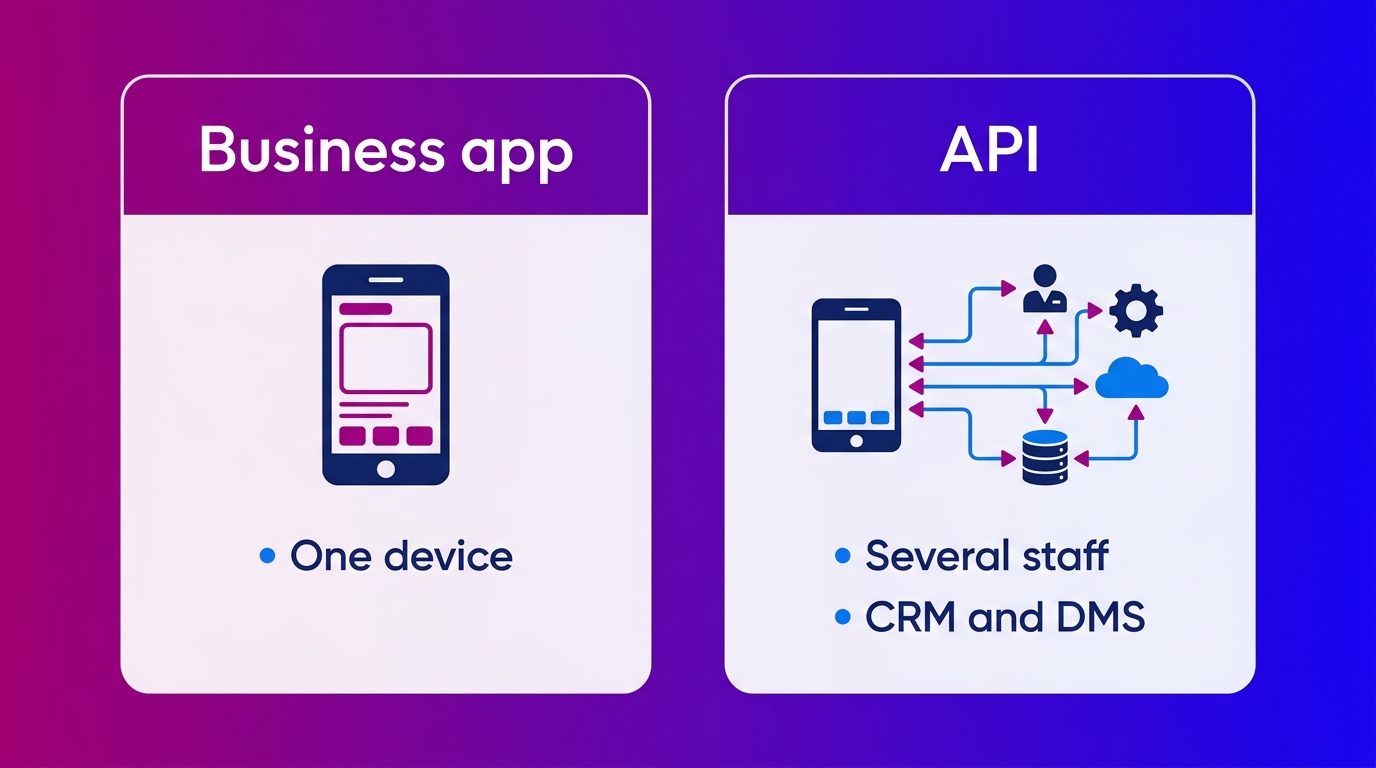
WhatsApp Business app or API: what fits your dealership?
The WhatsApp Business app is free and made for small organisations. You create a business profile with opening hours and location, set up a greeting and an away message, and organise conversations with labels.
The WhatsApp Business API is a different category. With it, several members of staff work on the same number, you route conversations to sales, the workshop or the right branch, and leads land in your CRM or DMS. Connecting is free; the costs are in usage, so in the messages that are sent.
The tipping point is sharper than many dealers think. As soon as more than one person needs to be able to answer, or a lead needs to land in a system automatically, the app gets stuck. To be fair: the API is not a switch you flip. It involves verification with Meta, and message templates must be approved in advance.
The 24-hour window: when you may send a message yourself
This is the rule most dealerships run into without knowing why. WhatsApp is not a channel you can simply broadcast on.
Within the window you reply freely
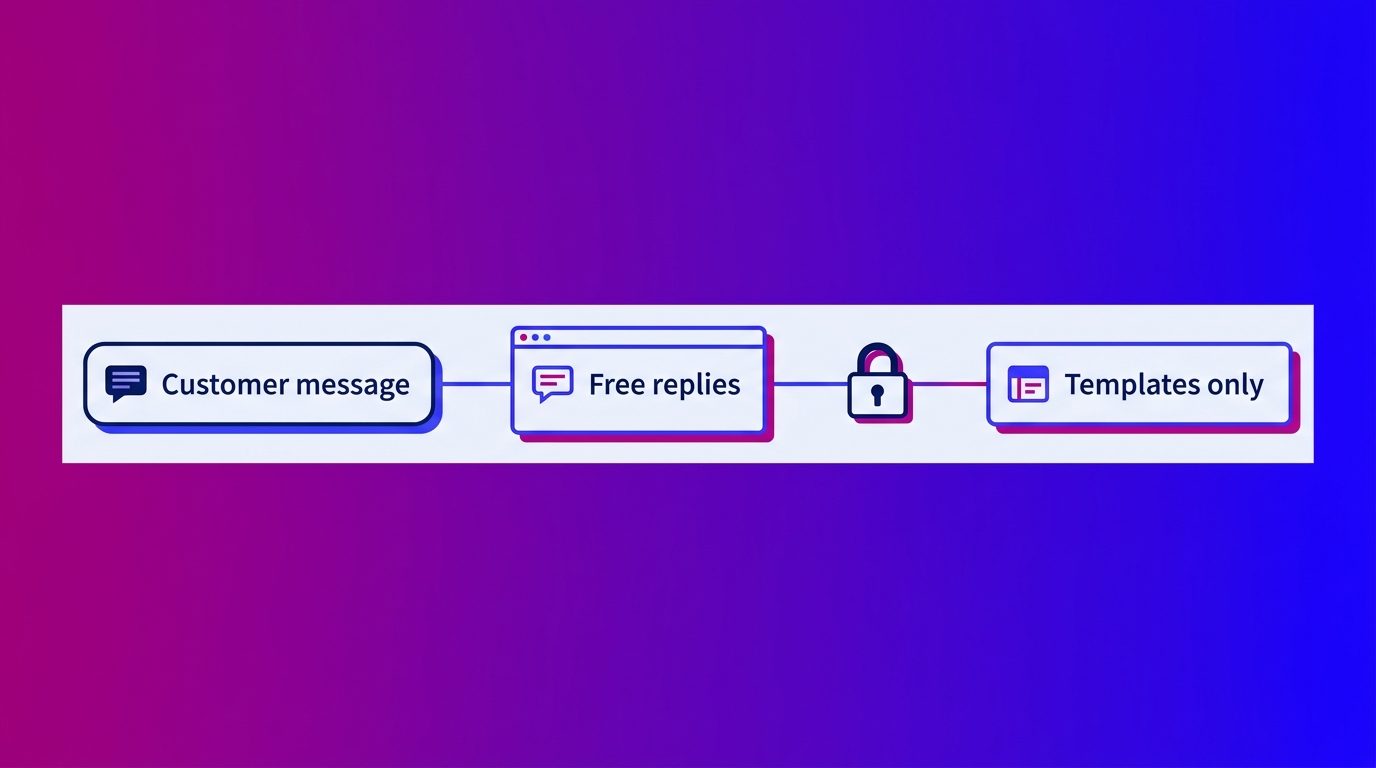
Under WhatsApp Business policy, you may reply freely as long as the customer’s last message is less than 24 hours old. In that window you can send text, photos or documents. If the customer messages again, the window starts again.
Outside the window you work with message templates
Once the window has closed, you may only send a pre-approved message template. Such a template works for an appointment confirmation or a reminder, not for a free sales conversation.
For automotive that makes the difference on a Friday evening. If a question about a used car comes in at 9pm and you pick it up on Monday at 9am, the window has closed. Speed here is not a service, but a technical condition.
Consent before you start yourself
If you want to start a conversation yourself, for example with an MOT reminder, you need consent. According to Meta’s documentation on opt-in, a business may only contact someone who has given their mobile number and agreed to receive messages from that business. A number in your DMS is therefore not a licence to message.
Three moments where WhatsApp makes a difference in automotive
Test drive confirmation
A test drive is in the diary, and usually nothing happens until the customer arrives. Or does not. A confirmation via WhatsApp is one message, and the customer can reschedule in the same conversation instead of calling. The barrier to rescheduling is lower than the barrier to cancelling.
Used car questions outside opening hours
This is where most revenue leaks away. A visitor looks at a used car at half past nine in the evening, asks a question and expects an answer. If he does not get one, he moves on to the dealer who does reply. And anyone who only answers the next working day is often already outside the 24-hour window.
MOT and service reminders
This is template work par excellence. A reminder is a message you start, so you need an approved template and the customer’s consent. The advantage is in the next step: if the customer replies, the window opens and you complete the booking in the same conversation. How to automate this further is covered in automating service bookings.
WhatsApp alongside live chat, SMS and QR codes
WhatsApp works best as part of a small, well-monitored set of channels. Better two channels you really monitor than six you switch on and forget.
- Live chat on the website catches visitors who have a question now, on this page. How to set that up is covered in live chat for car dealers.
- SMS works as a first contact with customers you do not yet have a WhatsApp conversation with, after which you continue on WhatsApp.
- QR codes on for-sale signs, leaflets and in the showroom lead offline interest straight into a WhatsApp conversation.
- Facebook Messenger catches responses to adverts on Facebook and Instagram.
What matters is that all those channels come in in one place, so nobody has to help a customer twice. With one inbox for WhatsApp and chat, your team sees every conversation, whichever channel it started on. For dealer groups with several branches there is also the question of which branch a lead goes to; that is covered in lead follow-up across dealer groups.
Who answers the WhatsApp conversations
Opening a channel is half a decision. The other half is who answers, and within how long. At Bconnect you choose the mix of people and AI that suits you:
- Operator Assisted AI: chat specialists hold the conversations, supported by AI. Suits sales conversations and valuable opportunities.
- AI First + Human Handoff: AI answers the first questions and a chat specialist or your own team takes over where needed, with the full context.
- AI Only: AI handles predictable questions on its own, such as opening hours and status questions.
If you automate on WhatsApp, WhatsApp Business policy requires a clear route to a member of staff. So the AI does not make anything up: what it does not know goes to a person with the context. What you do and do not leave to AI for car dealers is covered in a separate article.
What we see in WhatsApp conversations with car buyers
In the conversations we handle at Bconnect for car dealers, what stands out most is how often the moment of answering makes the difference.
WhatsApp is an evening channel. Customers send their message when it suits them, and that is often after working hours. Our chat specialists are available seven days a week from early morning to late evening and AI covers the hours outside that, so a question from Friday evening does not sit until Monday.
Offline campaigns work via QR codes. A QR code on a for-sale sign or in the showroom opens a WhatsApp conversation straight away. That turns offline interest into a conversation you can follow up.
Message templates need preparation. A reminder or confirmation must be approved in advance. Anyone who only arranges that at the moment they need it is behind. So we set up those templates together with the dealership at the start.
WhatsApp only becomes a sales channel with a process behind it
The channel does not make the difference; the set-up does. Who answers, within what time, with which integration and within which Meta rules. A dealership with one well-monitored number gets more out of WhatsApp than one with three channels nobody watches.
So do not start with the technology, but with the question of which moments in your customer journey are currently left lying. At dealerships that is almost always the evening hours, used car questions and follow-up after a showroom visit. More about live chat for car dealers is in the overview of this category.
Frequently asked questions about WhatsApp for car dealers
Is WhatsApp Business free for car dealers?
The WhatsApp Business app is free. With the WhatsApp Business API, connecting is free and the costs are in usage, so in the messages that are sent.
Can I send my customers a WhatsApp message myself?
Only under conditions. If the customer messages you, you may reply freely for 24 hours. After that you may only send a pre-approved message template, and only to customers who have agreed to receive messages from you.
Can I connect WhatsApp to my DMS or CRM?
Yes, via the WhatsApp Business API. Conversations and leads can land in your CRM or DMS via API, webhooks or Zapier. Without an integration, leads come in by email with the conversation transcript.
Can sales, service and the workshop share one WhatsApp number?
Yes, with the API. Several members of staff then work on the same number and conversations go to the right department or branch. The free app cannot do that, because it is tied to one device.
What happens to WhatsApp messages outside opening hours?
That depends on how you set it up. Bconnect’s chat specialists are available seven days a week from early morning to late evening, and AI can answer predictable questions 24 hours a day and hand over to a member of staff when needed.
Is Facebook Messenger still worth it alongside WhatsApp?
Messenger is mainly useful if you advertise on Facebook or Instagram, because responses to those adverts then come into the same overview. As a separate channel alongside WhatsApp it is less important.