Someone looks at three used cars side by side at half past ten in the evening. He wants to know whether leasing is possible, cannot find the answer quickly enough and clicks away. The next morning nobody at your dealership knows he was there.
Live chat for car dealers is about that moment. A car buyer asks his question while he is hesitating, and you answer before he clicks through to the next dealer. Set up well, that delivers test drives, part-exchange enquiries and service bookings, not just answered questions.
What live chat does for car dealers
Live chat for car dealers is a chat window on a dealership’s website in which visitors get an answer straight away from a person or from AI, at the moment they are looking at a car or have a service question.
The same channel has two roles. In sales, a good conversation ends with an appointment in a salesperson’s diary: a test drive, a quote request or a part-exchange valuation. In service, it ends with a solved question or a workshop booking.
The difference is not in the software but in what the conversation should deliver. A chat that only handles questions is a helpdesk. A chat that asks follow-up questions is a sales moment.
Why the visitor’s question is rarely the real question
Car buyers mainly ask simple, factual questions. How much horsepower does this car have, what is the range, can I lease or finance it? The answer is often already on the site, but not where the visitor is looking.
Research by the Dutch car trade association BOVAG found that 95 percent of buyers can find the information they need online. Yet they still get in touch with questions about features that are already in the advert: has it really never been smoked in, is the mileage correct, is it accident-free?
At that point the visitor is no longer looking for information. He is looking for someone to vouch for it.
What lies behind a price or finance question
“What does this car cost?” sits right next to the price in the advert. Yet the question keeps being asked. Behind it there is almost always something else: can I afford this, what is my current car worth, can I lease it?
A finance or lease question is therefore a buying signal, not an admin question. If you just refer to the finance page, you miss the chance to ask what the buyer wants to spend per month and what he drives now.
Answer first, then ask
The order decides whether the conversation continues. A visitor who does not have his answer yet and is immediately asked for his phone number is gone.
So answer the question honestly, even if the answer is unfavourable. If you do not know something, say you will find out. Only when the visitor feels he is being helped seriously is there room to ask what he is looking for.
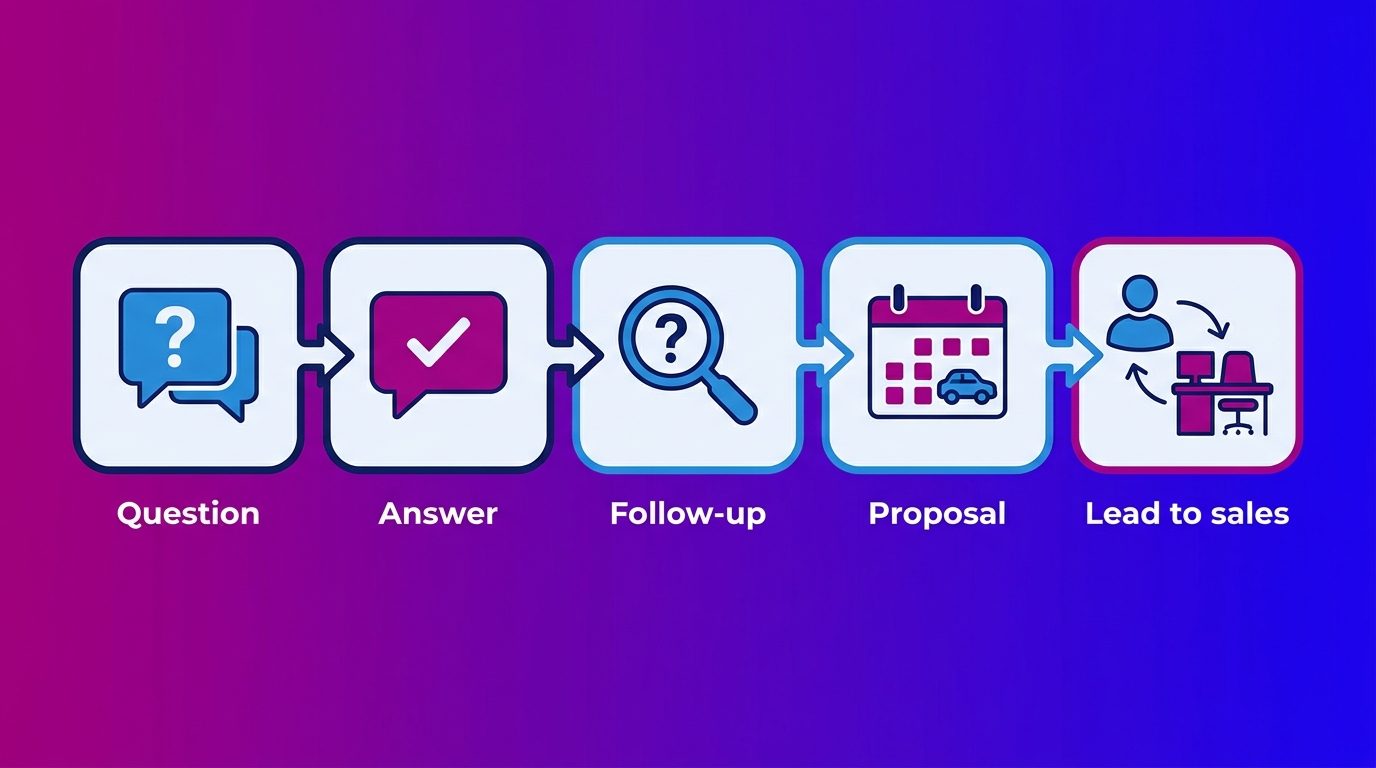
From chat to test drive: what you ask
A chat only becomes a lead if the salesperson can do something with it. So more needs to come out of it than a name and a phone number.
The details that count in car sales
In automotive, qualification revolves around a small number of points:
- part-exchange, and if so which car
- the preferred trim or engine
- finance, lease or cash purchase
- when the buyer needs another car
- which branch is closest to him
The last two are skipped most often. Yet they decide whether a salesperson should call today or in two months. With multiple branches, location is no detail.
Set lead criteria in advance
What counts as a lead is decided by the dealership itself. One dealer only wants name, email address and phone number. Another wants to know per lead whether there is a part-exchange and when someone is looking for another car.
That decides whether your sales team keeps following up the leads. If sales receives every conversation, the team starts filtering itself and follow-up drops. So set the criteria in advance and adjust them based on feedback per lead.
When to ask for contact details
The right moment is when you know the need. If you know someone wants to change within two months, is looking for an automatic and wants to part-exchange their current car, a proposal is logical rather than pushy.
“I’ll set up a test drive for you at the branch. Which number can the salesperson reach you on?” At that point it is a service, not a sales trick. That is how live chat becomes a form of lead generation for car dealers: leads from conversations rather than forms.
Live chat in service and after-sales
Live chat is not just a sales channel. After the purchase come questions about servicing, the status of a repair, the MOT or a light on the dashboard.
Those questions are predictable and can often be turned straight into a booking. A chat that answers them immediately takes pressure off the workshop phone and reception. With a technical question, such as a photo of a warning light, the chat should not diagnose but pass it to the workshop. You can also automate service bookings, so appointments, confirmations and reminders run by themselves.
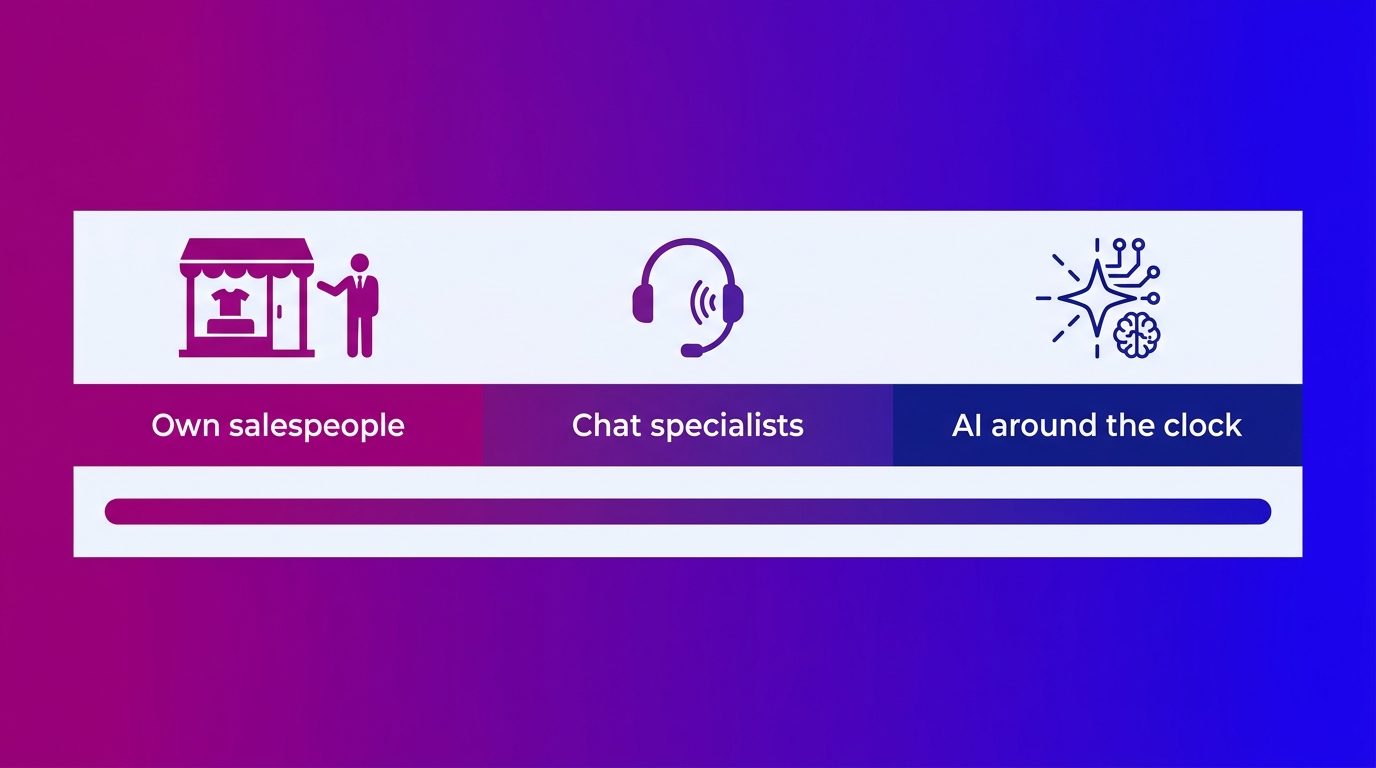
Who staffs the chat: your own salespeople, chat specialists or AI
Much of the research happens outside opening hours: in the evening on the sofa, at the weekend, in between things at work. At those times the chat is unstaffed at many dealerships.
There are three ways to solve that, and you can combine them:
- Your own salespeople chat during showroom hours. They know the stock, but also have customers in the showroom.
- Chat specialists take over the conversations when your team cannot.
- AI answers predictable questions straight away, even at night, and collects the details for a lead.
AI is a layer, not an end point. With a doubtful case, a part-exchange question that needs a tailored answer or a buyer who wants to speak to a person, there should be a handover: announced and with the full context. What role AI for car dealers can play is covered in a separate article.
Lead follow-up after the chat
A qualified lead is only warm for a short time. Research published in Harvard Business Review already showed that most companies respond far too slowly to online enquiries.
In automotive that weighs even more heavily, because buyers visit fewer dealerships and take fewer test drives than they used to. Call too late, and you are calling someone who has already made his choice.
Three things make the difference:
- The lead lands where sales works. With an integration in your CRM or DMS, without one by email, and always with the conversation transcript.
- The lead goes to the right branch. With dealer groups this goes wrong most often. How to set that up is covered in lead follow-up across dealer groups.
- The conversation can continue. A buyer who wants to discuss things with his partner or is waiting for a part-exchange valuation prefers to continue later. WhatsApp for car dealers is often a better channel for that than email.
Watch the time window with WhatsApp. Under WhatsApp Business policy, you can reply freely within 24 hours of the customer’s last message. After that you can only get in touch with an approved message template.
What we see in chats with car buyers
In the chat conversations we handle at Bconnect for car dealers, a few patterns keep coming back. Our chat specialists are available seven days a week from early morning to late evening, and AI covers the hours outside that.
Most questions are simple. How much horsepower, is lease or finance possible, is this car still at the branch? The answer is often on the site, but the visitor does not find it quickly enough and disappears. Answer straight away and you keep him. Our chat specialists pick up a conversation within twenty seconds on average.
Part-exchange is one of the best routes to a lead. A visitor who asks what his car is still worth is already doing the sums. We do not give a valuation in the chat, but ask: which car do you want to part-exchange, and what are you interested in? With those two answers the salesperson has a concrete reason to call.
Sector knowledge grows over time. At the start we build a knowledge base together with the dealership, covering models, stock and ways of working. What our specialists do not know, they do not make up: it goes to the client’s own team with the full context.
How that works out can be seen at Jaguar Land Rover, where up to 33.41 percent of chat conversations became a lead.
Four things that make chat fail at a dealership
1. The stock information is out of date
This is the most common mistake. The chat talks enthusiastically about a car that was sold last week, or mentions a trim that is wrong. The well-informed buyer sees through that immediately. A connection with your stock system keeps that information current.
2. The chat is set up as a service channel
Questions are answered neatly and that is where it ends. No follow-up question, no qualification, no lead. You have then built a well-working helpdesk in exactly the place where your traffic should convert.
3. Follow-up takes too long
A well-qualified lead that is called back after two days has often already taken a test drive at another dealer. The gain of a quick chat is then lost in the follow-up.
4. AI is the end point instead of a layer
AI handles basic questions and qualifies, 24 hours a day. With a price negotiation, a part-exchange proposal or a doubtful case, a person should step in. On WhatsApp this is even required: anyone automating within the 24-hour window must offer a direct route to a member of staff under WhatsApp Business policy.
Live chat is a sales moment, not an extra channel
The visitor comparing three used cars in the evening is not primarily choosing your dealership. He is choosing the car he wants, from the business that gives him certainty fastest.
Live chat is where you give that certainty at the moment the doubt is there. That does not require complicated technology, but a conversation that leads somewhere: from a question about horsepower or lease to a part-exchange proposal and a test drive. More about live chat for car dealers, from used car enquiry to service booking, is in the overview of this category.
Frequently asked questions about live chat for car dealers
What is live chat for car dealers?
Live chat for car dealers is a chat window on a dealership’s website in which visitors get an answer straight away from a person or from AI. It is used for sales questions, such as trim, lease and part-exchange, and for service questions, such as servicing and workshop bookings.
Does live chat replace the salesperson?
No. Chat answers questions, recognises buying intent and qualifies the visitor into a lead. Calling back, booking the test drive and closing the deal remain the salesperson’s job. Price negotiations, valuations and quotes do not belong in the chat.
When do you ask for contact details in a chat?
At the moment you know the need, so after the visitor’s question has been answered and you know what he is looking for. Then a concrete proposal for a test drive or a call-back is a logical next step rather than a barrier.
Does live chat work for used cars as well as new ones?
Used cars are particularly suitable. Every used car is unique in condition, history and specification, so there are more questions to answer and more doubt to remove. That makes the conversation more valuable than for a new car you configure yourself.
Do you need a connection with your stock system to start?
No, an integration is useful but not required. Without one, leads come in by email with the conversation transcript. A connection with your stock system mainly helps keep stock information in the conversation current.
What happens to chats outside showroom hours?
That depends on how you staff the chat. Your own salespeople can chat during the day, chat specialists can take over evenings and weekends, and AI can answer predictable questions 24 hours a day. The three can be combined per part of the day.