A customer sends you a WhatsApp message: can I book my MOT next week, and do you still have a bigger estate car in stock?
Those are two questions for two departments. Workshop planning handles the first, a salesperson the second. And if you have multiple branches, there is a third question: which branch picks this up? For the customer it is one message and one business.
That is where omnichannel customer contact for car dealers begins. Not with how many channels you offer, but with where a conversation ends up and how quickly someone follows it up.
Why omnichannel at car dealers is a routing question
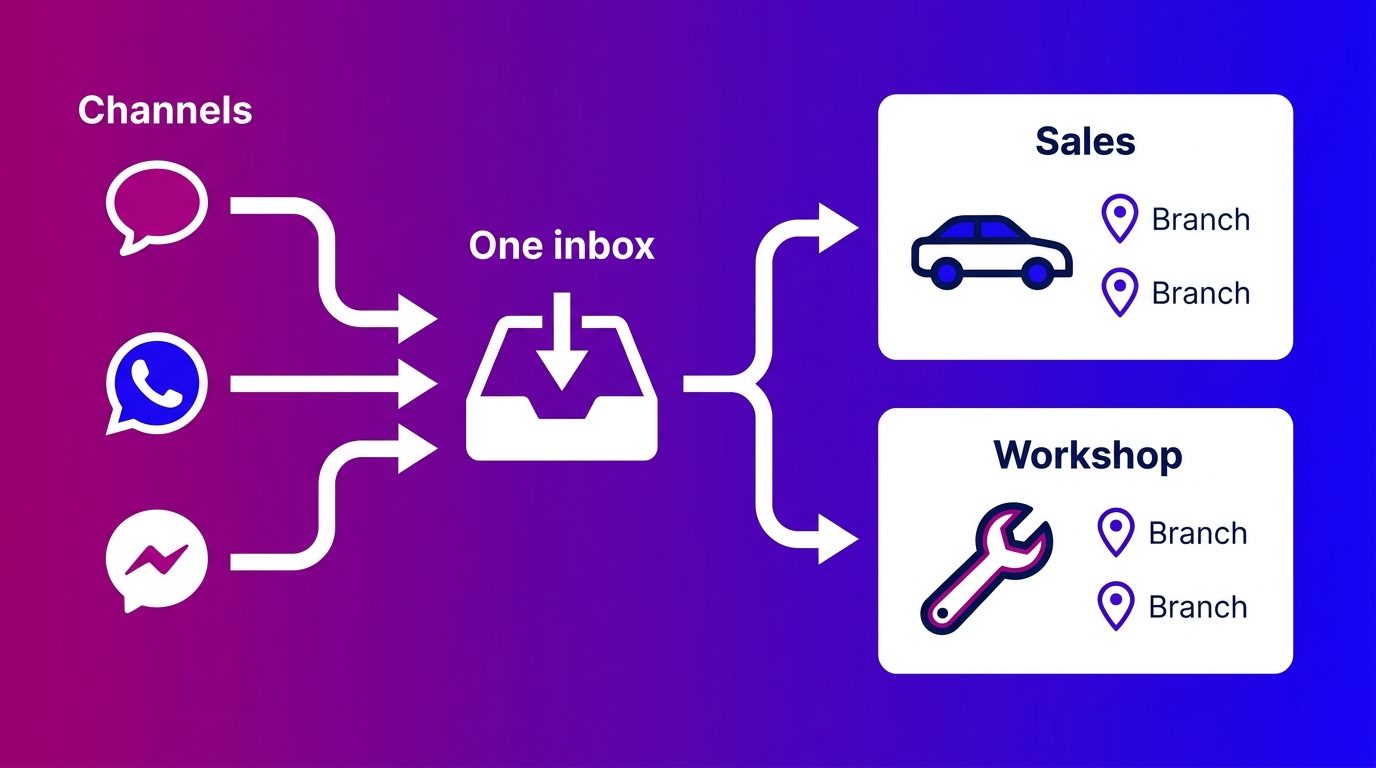
Omnichannel at car dealers means that all channels, from website chat to WhatsApp and Messenger, come together in one inbox and every conversation reaches the right department and branch, with the context attached.
Three things make a dealership different from an online shop. There are departments with different goals: sales wants an appointment, the workshop wants an efficient schedule. There are often multiple branches, sometimes with different brands. And there is a physical showroom, which is the end point of the customer journey rather than an extra channel.
That is why omnichannel here is mainly a routing question. The trick is not being reachable on five channels. The trick is that a conversation lands with the right person at the right location, without the customer having to start again.
The customer journey starts online and ends in the showroom
In automotive, researching online and finishing offline is the norm. Someone compares from a distance for weeks and sets foot in a showroom once.
Research by the Dutch car trade association BOVAG shows that the showroom visit has declined as a source of information, but remains crucial as the last step before the decision. According to the same research, 53 percent of car buyers visit only one dealership and buyers usually take only one test drive. So you have one chance at the move from online to the showroom floor.
Every online channel therefore has the same goal. Not a pleasant conversation, but a well-prepared appointment: the right car ready, at the right location. A conversation that ends with “feel free to pop in” does not achieve that. One that ends with a time, a branch and a registration does.
Which department and which branch does this conversation go to?
Switching on channels takes an afternoon. Deciding who picks up what is the real project.
Sales and after-sales mixed together
A visitor does not know your organisation consists of departments. He asks his questions in the order they occur to him. So one conversation sometimes has to be split: the MOT part to the workshop, the used car part to a salesperson. How each side works is covered in the articles on live chat for car dealers and automating service bookings.
With multiple branches there is an extra question
If you have more than one location, the department is only half the answer. Buyers are only willing to travel a limited distance, especially for a new car. If your branches are a good distance apart, a lead at the wrong branch is not an inconvenience but a missed appointment.
Lead follow-up at dealer groups: one process for all branches
At a dealer group, lead follow-up often differs per branch. One branch calls back within the hour, another the next afternoon. One salesperson notes everything, another nothing. For the customer it is one brand and one group, so every difference stands out.
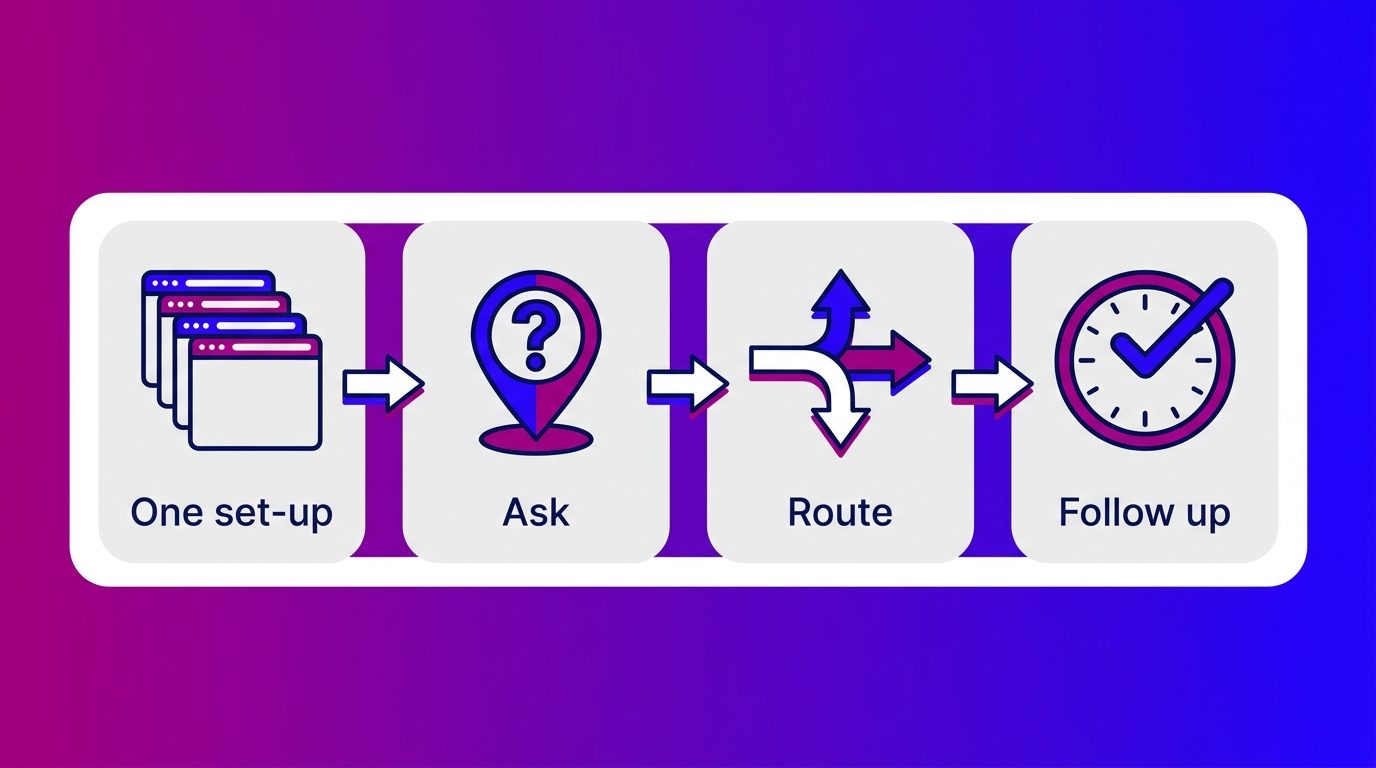
A shared approach solves this in four steps:
- One set-up for all websites. The same chat and the same way of working can run on several websites and domains at once, even if your group sells several brands.
- Ask where the lead should go. In the conversation, the postcode, preferred branch or branch where the car is located is asked for.
- Route automatically. The lead goes to the right team or branch, with the transcript and context attached.
- Fixed agreements on follow-up. For each branch it is clear who follows up and within what time.
That way lead follow-up is not a question of which branch happens to be sharp, but of one process. How Bconnect sets this up with chat and WhatsApp for dealer groups is on the automotive page.
A customer switches channel, the conversation should not
Customers behave predictably: someone starts on the website, continues via WhatsApp and calls afterwards. That is normal behaviour and not a problem, as long as the context travels with them.
What needs to travel is not the channel but the content. What was the question, what was promised, which registration or stock car was it about? Without that your colleague starts again, and so does the customer. With omnichannel customer contact in one inbox, chat, WhatsApp, Messenger, SMS and email come together, with a complete picture per customer.
Offline touchpoints count too
Omnichannel is almost always described as something purely digital. In automotive that is odd, because this sector is full of physical touchpoints.
A QR code on a for-sale sign, on the showroom window, on a leaflet or on the invoice opens a WhatsApp conversation straight away. Someone walking past your forecourt in the evening and seeing a car can ask what it costs immediately. That conversation lands in the same inbox as everything else. Which rules apply is covered in WhatsApp for car dealers.
What it takes to make it work
The set-up
Three things need to be in place: one platform where everything comes in, integrations so conversations and leads land in your existing systems, and agreements on who monitors which channel.
For the integrations: a connection with your CRM or DMS via API, webhooks or Zapier. Not required to start, but needed if conversations should land in the right place automatically. The third point is forgotten most often. Agree response time and ownership per channel and per branch.
Four ways it still goes wrong
- Switching on a channel without staffing it. A WhatsApp number nobody responds to is worse than no WhatsApp, because the expectation has been created.
- No owner per channel. Messenger then sits unmanaged for months, with unread messages from people who thought they were contacting a business.
- The customer has to repeat his story. Every switch where the context does not travel costs credibility.
- The WhatsApp number is on a personal phone. Popular with salespeople, risky for the business. If that salesperson leaves, the conversation history leaves too.
Channels disappear too
A channel choice is not a one-off. Google Business Messages was promoted for years as the messaging channel of the future, but according to Google’s announcement it stopped on 31 July 2024. Anyone who never removed the button from their website now has an entry point that leads nowhere. So check every year whether each channel still exists and is still staffed.
What we see at dealer groups with multiple branches
At the dealer groups we handle chat for at Bconnect, the same patterns keep coming back.
Routing is the first conversation, not the last. Before a channel goes live, we agree which questions go to which branch and department. That decides more of the result than the number of channels.
One set-up works for several websites. The same chat runs on the sites of different brands or branches, while the leads go separately to the right team.
Availability must be the same for the whole group. Our chat specialists are available seven days a week from early morning to late evening, and AI covers the hours outside that. That way the response time does not depend on which branch the customer happens to reach.
An example: Hedin Automotive. At Hedin Automotive we handle the live chat on the website for both branches, for service and lead generation. They expected a gradual build-up, but leads and sales from chat came in from the very first week.
The number of channels says nothing
Offering five channels is no achievement. Five channels where a customer gets an answer within a reasonable time from someone who has read his previous message, that is an achievement.
For a dealership or dealer group it comes down to two questions. Does this conversation reach the right department and branch? And does the customer not have to start again? If that is in place, every extra channel simply becomes an extra entry point to the same process. Which questions you can leave to AI for car dealers, and the other topics on live chat for car dealers, are in this category.
Frequently asked questions about omnichannel for car dealers
What does omnichannel mean for a car dealer?
Omnichannel means all customer contact channels come together in one inbox and every conversation reaches the right department and branch. It is not about more channels, but about bundling and routing conversations between sales, workshop and parts.
What is the difference between multichannel and omnichannel?
With multichannel, channels exist separately, each with its own inbox and history. With omnichannel they come together, so a customer can switch channel without repeating his story.
Which channels do car dealers usually use?
Usually live chat on the website, WhatsApp and Facebook Messenger, supplemented with SMS and email. Offline touchpoints that lead to a conversation count too, such as a QR code on a for-sale sign or in the showroom.
How does a lead reach the right branch?
By setting up the routing in advance based on what is asked in the conversation, such as the customer’s postcode or the branch where the car is. The lead then goes automatically to the right team or branch, with the transcript attached.
Does this work for a dealer group with several websites and brands?
Yes. The same set-up can run on several websites and domains at once, while leads go to the right team per brand or branch.
Do you need an integration with your CRM or DMS?
Not to start, but it saves a lot of manual work. Without an integration, leads come in by email with the transcript. With one, they land directly in the right place in your existing software.