Many dealerships have a chatbot on the website that knows the opening hours and the route to the showroom. Ask whether that estate car is also available with a tow bar, and the conversation goes quiet. Not because the bot does anything wrong, but because nobody ever decided which conversations it should actually hold.
AI for car dealers is about exactly that choice. Which questions can AI handle itself, where does a person take over, and what does the AI need to do that well? Decide that in advance, and you get more out of it than by putting a bot on everything and hoping.
What AI can do for a dealership
AI for car dealers is software that answers questions from visitors and customers via chat or WhatsApp, collects details and passes conversations to sales or the workshop, based on that dealership’s information.
In practice there are two roles. An AI Sales Agent works before the sale: it engages visitors, recognises buying intent, asks targeted questions and passes a promising conversation to a salesperson. An AI Service Agent works after the sale: booking appointments, status questions and reminders, for example for the MOT.
Both do the same kind of work, but at a different moment in the customer journey. A dealer who only thinks about sales leaves half the possibilities untouched.
Chatbot or AI agent: what is the difference?
The term chatbot covers two very different things, which explains why experiences vary so much.
A chatbot with a decision tree works with fixed keywords. If it recognises the pattern, the matching answer follows. If it does not, you get a standard sentence or nothing at all. For “what are your opening hours” that works fine.
An AI agent understands the question instead of matching it, using modern language models. That lets it ask follow-up questions about budget, specification and timing. Type “I’m looking for a family car under twenty thousand with a tow bar” and the decision tree gets stuck, while an AI agent starts filtering and asks what matters to you.
So the difference is not in the chat window, but in what sits behind it. A chatbot for car dealers is only useful if it can understand the questions car buyers really ask. How the two types work is covered in how do chatbots work.
What you do automate at a dealership
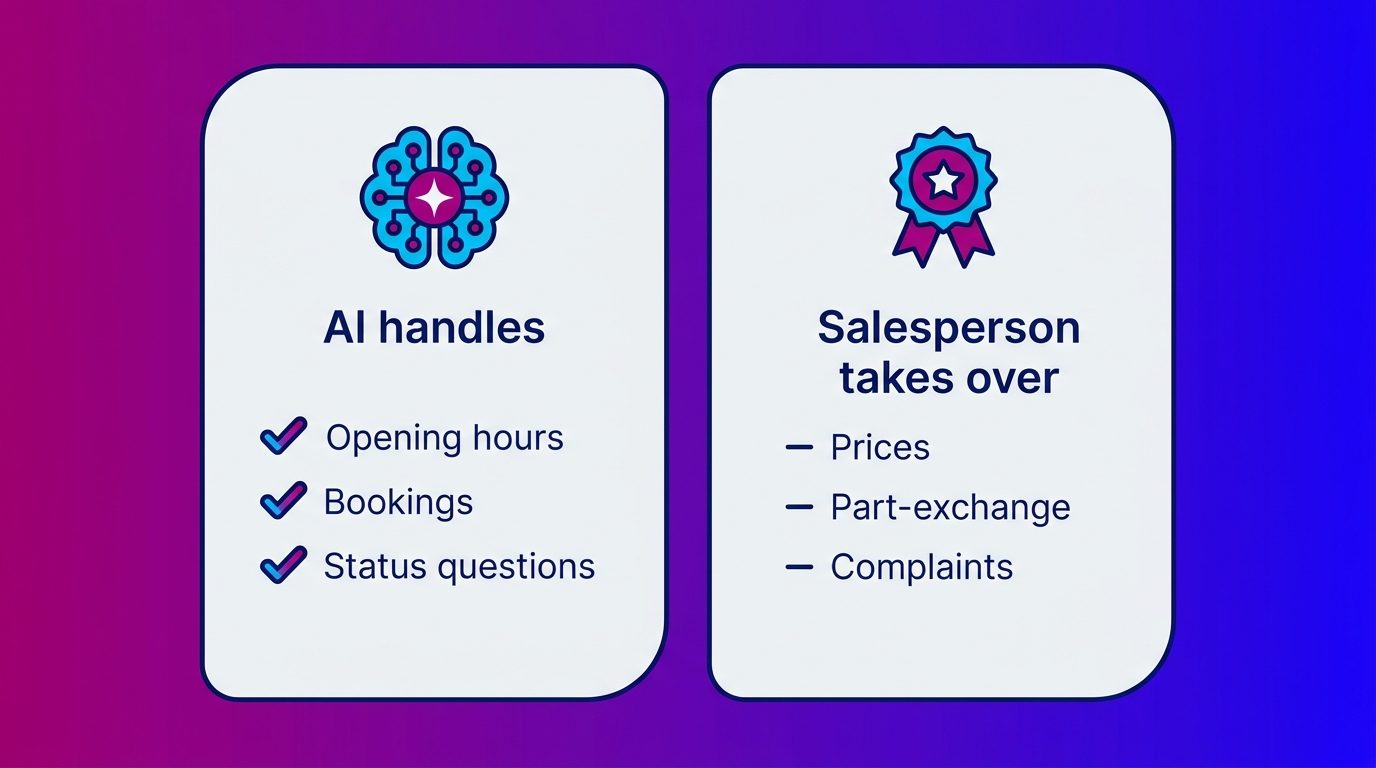
Conversations that are predictable and come back often lend themselves to AI. At a dealership there are four, each with one condition.
Service bookings
Workshop questions are short and concrete. Can my car go in on Thursday, when is the MOT due, has the part arrived? AI handles those questions on its own, including in the evening.
The condition: actually booking requires an integration with your diary or workshop planner. Without one, the conversation produces a complete request that someone still has to turn into an appointment. More on this in automating service bookings.
Test drive requests
Buyers take fewer test drives than they used to, often just one. That one request should not get stuck on a form with eight mandatory fields.
AI asks which car it concerns, which time suits and which details are needed, and passes the request to the right branch. What it does not do is push for an appointment straight away. Answer first, then the appointment.
Used car and stock questions
This is where most is lost. A visitor looks at three used cars in the evening and wants to know whether there is a service history.
AI can start the conversation based on behaviour, for example when someone views several model pages or stays on the specifications for a long time. That works better than a window that pops open on every page after three seconds.
Status and reminders
Is my car ready, when can I collect it, when is it due for a service again? These are questions where an AI Service Agent immediately takes pressure off your own team.
How a conversation with AI works in practice
A used car question on a Thursday evening, with an AI Sales Agent active on the stock page:
AI: You are chatting with our branch’s digital assistant. How can I help?
Visitor: Has this Golf always been accident-free?
AI: This Golf comes with a full service history and no damage is recorded. Would you like me to share the history, or do you have a question about the specification?
Visitor: What is my 2018 Polo worth as a part-exchange?
AI: I cannot give a part-exchange value, that needs a valuation. I can pass your question to a salesperson so he can come back to you tomorrow with a concrete proposal. May I have your name and phone number for that?
Three things happen here. The AI makes clear at the start that it is not a person. It handles the first question itself. And with the second question it stops in time, instead of naming an amount the salesperson then has to walk back.
What the salesperson receives the next morning is not a bare form, but a lead with the model, the question and the context of the conversation. If you would rather have a person hold the conversation, live chat for car dealers is the other route.
What you are better off leaving to a person
Be honest: if your online information does not match reality, you lose the buyer. That is why a few things belong with a person.
Quotes, negotiations and part-exchange values
AI that starts moving prices creates an expectation your salesperson then has to break. Price questions and concrete proposals belong with a salesperson.
Part-exchange value is the same story, but riskier. An indication feels like an offer to the customer. If the valuation comes out lower later, the problem is not the amount but the trust.
Complaints
A complaint is rarely just a request for information. There is irritation underneath, and that needs someone who can deviate from the script and make a commitment.
Leads that need follow-up questions
AI handles frequently asked questions well. But to really get more out of your website, you need people who ask follow-up questions, qualify and move the conversation to an appointment or quote. For predictable service questions, AI alone is often enough. For automotive leads a combination works better: AI for the first questions, a chat specialist for the sales conversation.
The handover and the AI Act
The line between AI and person is not a technical detail. The handover decides whether a visitor is helped or drops out.
When AI hands over
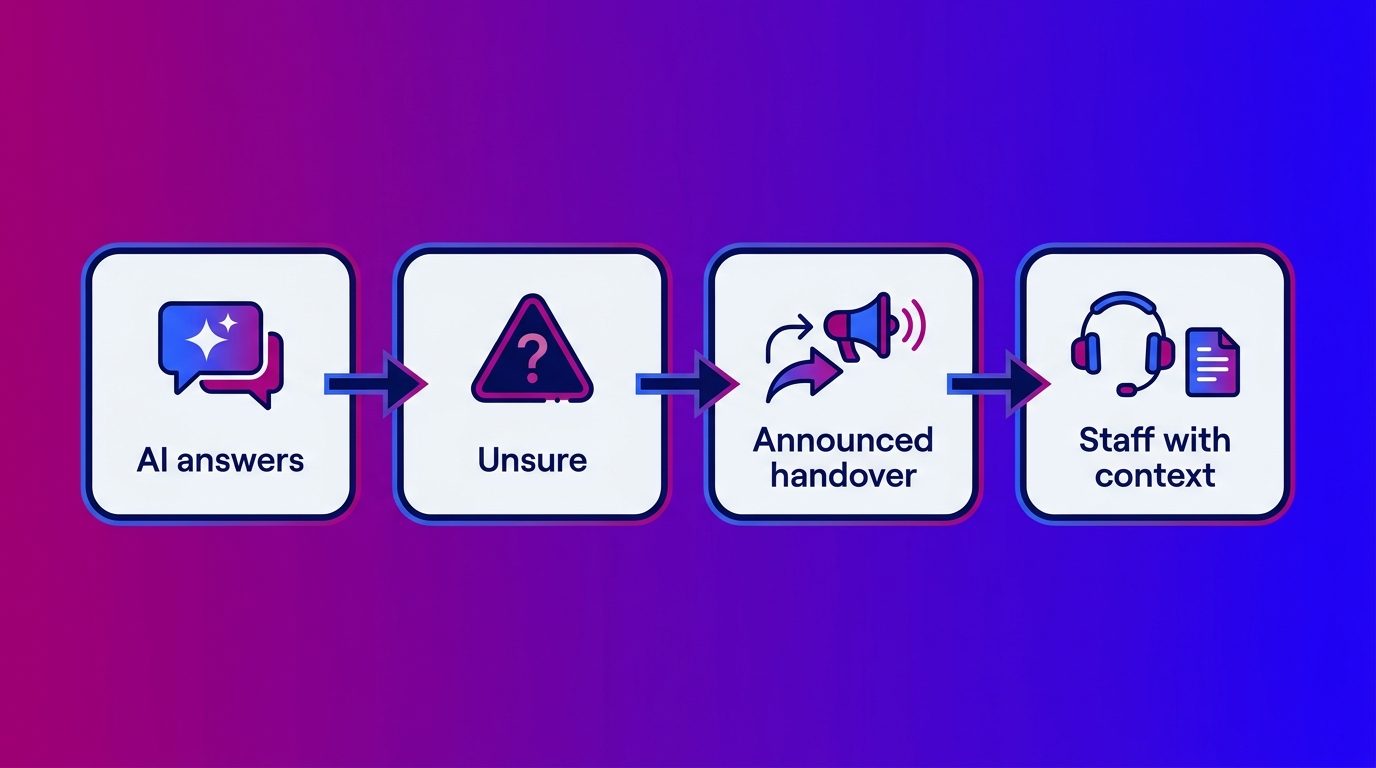
If the AI does not know the answer, it does not make anything up but hands the conversation over. The dealership decides at which moments that happens, for example with every price question or every part-exchange question. The visitor can also always ask for a member of staff.
A good handover is announced (“I’ll connect you with a colleague”) and comes with the full context, so the visitor does not have to tell his story again. On WhatsApp it works the same way; how to set up that channel is covered in WhatsApp for car dealers.
What Article 50 of the AI Act requires
For businesses serving customers in the EU, Article 50 of the AI Act has applied since 2 August 2026. According to the European Commission’s explanation, providers of chatbots and AI agents must make sure people know they are talking to AI. That notice should be there from the start of the first conversation, clearly recognisable.
There is an exception if it is obvious to an average user that he is talking to AI. The Commission adds that this exception should be interpreted narrowly. In a chat window on a dealer website, that is rarely obvious.
The obligation formally lies with the provider of the AI system, not with the dealership. But the AI on your website does have to comply. So ask whoever supplies your AI.
What happens to the data
Everything collected in a conversation falls under data protection law. At Bconnect all data stays within the EU and is never sold on. After each conversation the transcript goes to the email address you provide, so the salesperson can read what was said before calling.
What we see when AI and chat specialists work together
In the conversations we handle at Bconnect for car dealers, AI works best as a layer, not an end point.
AI keeps predictable questions away from the team. Opening hours, availability, the status of a repair: AI answers those directly, day and night. That leaves our chat specialists and the dealer’s own team time for the conversations that lead to sales.
The handover makes the difference. We announce every handover and pass on the full context. Our chat specialists are available seven days a week from early morning to late evening and pick up a conversation within twenty seconds on average. At night AI catches the questions and the lead is ready the next morning.
Honest advice on the mix. For predictable service questions we often recommend AI Only. For more leads we recommend a model with people in it: Operator Assisted AI, in which chat specialists hold the conversation with AI support, or AI First + Human Handoff, in which AI starts and a specialist takes over as soon as the conversation heads towards a test drive or quote.
What AI in automotive needs
A knowledge base with your information
AI is only as good as the information it works with. At Bconnect we build that knowledge base together with the dealership: we collect the information about models, stock and ways of working, organise it and set up the answers and qualifying questions. You do not have to supply everything yourself.
Integrations
Integrations decide how far automation reaches. We connect via API, webhooks or Zapier with your stock system, CRM, DMS or diary. An AI chatbot connected to your DMS can actually book appointments instead of just collecting requests.
Integrating is not required to start. Without one, leads come in by email with the transcript.
Time and volume
An AI Sales Agent is usually live within two to three weeks. The pace depends on the set-up and the integrations. At dealer groups with several brands or branches, one AI works on several websites at once and sends leads to the right team. How that works in a group is covered in lead follow-up across dealer groups.
And the honest lower limit: outsourcing works from around 5,000 website visitors a month. Below that, too few conversations come in to make it worthwhile.
Automation works if you know where it stops
The gain from AI is not in the technology, but in the boundaries. Which conversations does the AI handle, where is the handover, and which integration sits underneath? A dealership that gets that right for the workshop, test drives and stock questions gets more out of AI than one that puts a bot on everything.
So start with the question of which conversations are currently left lying, not with the software. At a dealership that is almost always the evening hours, the used car questions and the workshop planning. More about live chat for car dealers is in the overview of this category.
Frequently asked questions about AI for car dealers
What is the difference between a chatbot and an AI agent?
A chatbot with a decision tree works with fixed keywords and only answers what has been pre-programmed. An AI agent uses language models, understands the question behind the question and can ask follow-up questions about budget, specification and timing.
Can AI book service appointments?
Collecting the request is always possible. Actually booking requires an integration with your diary or workshop planner. Without that integration, the conversation produces a complete request that a member of staff turns into an appointment.
Does AI replace my salespeople?
No. AI does not prepare quotes, negotiate or give part-exchange values. With price questions or concrete appointments, it hands over to a salesperson. The aim is more qualified conversations, not fewer people.
Does the customer know he is talking to AI?
Yes, and that is intended. For businesses serving EU customers, Article 50 of the AI Act requires providers of chatbots and AI agents to tell people from the start of the conversation that they are talking to AI. The visitor can also always ask for a member of staff.
Does AI work with multiple branches?
Yes. One AI can be active on several websites at once and sends leads automatically to the right team or branch.
How quickly is AI live at a dealership?
An AI Sales Agent is usually live within two to three weeks. The pace depends on the set-up of the knowledge base and the integrations you want.