What live chat outsourcing costs depends on four things: how many conversations you expect, which hours you want to be available, which channels you chat on and how much of the work is done by people or by AI. There is therefore no fixed market price. Providers charge per conversation, per hour, a fixed monthly fee or a combination.
A rate only tells you something once you put it next to the cost of your own chat team. That is why, besides the pricing models, you will also find a calculation below that you can fill in yourself. If you first want to know what live chat outsourcing is, that is covered in a separate article.
How providers charge for outsourced live chat
There are four common pricing models: per conversation, per hour, a fixed monthly fee and a combination of a base rate with a variable part. Which model is cheapest for you depends mainly on how predictable your chat volume is.
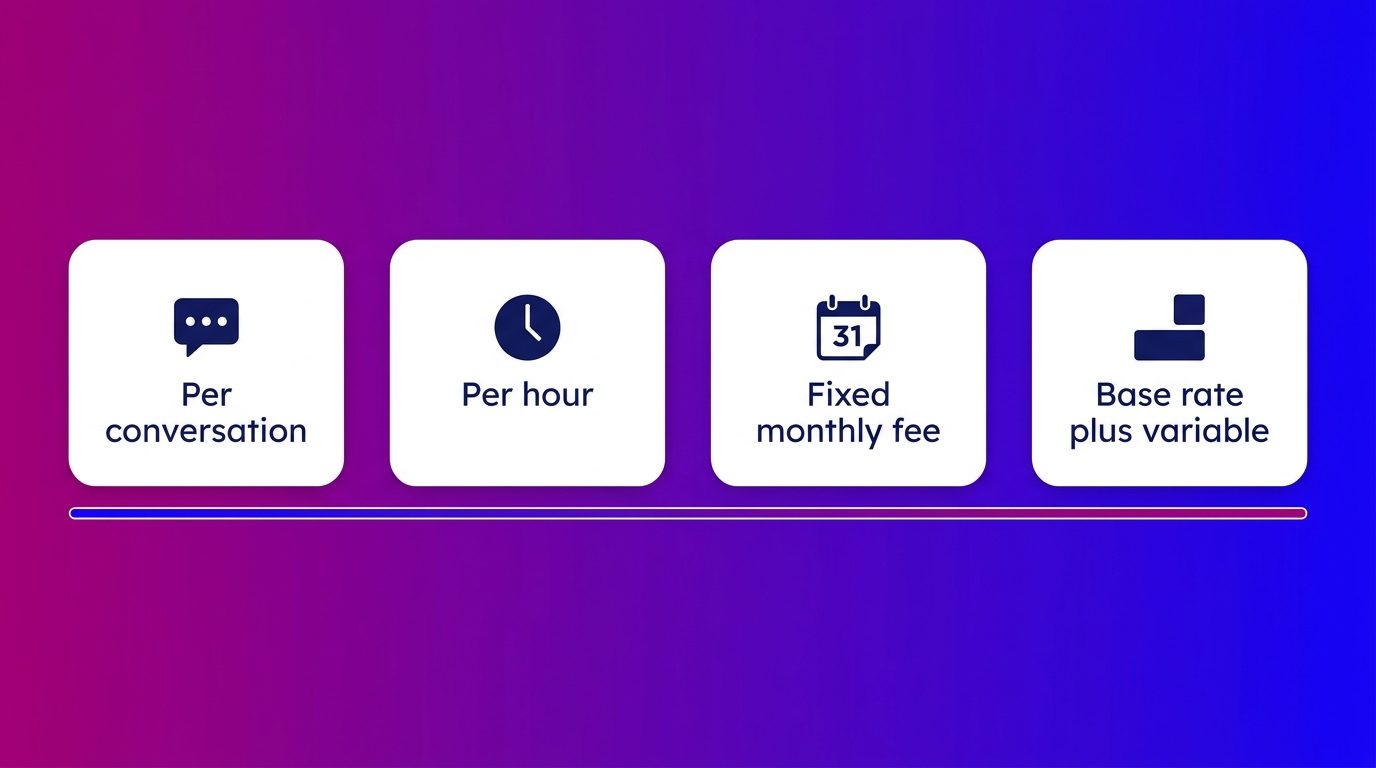
With every model, ask for the definition of the unit. “Per conversation” sounds clear, but a visitor who only types hello and clicks off is also a conversation. With a price per lead it matters a great deal whether a lead is just a name and phone number, or an enquiry with part-exchange, timing and budget.
If you outsource not only the chat but also WhatsApp and email, the same pricing models apply to your whole customer service.
What determines the price of outsourced live chat
Six factors determine the price, and the balance between people and AI usually weighs heaviest. A conversation held by a chat specialist costs more than one handled by AI. For advisory questions it also delivers more.
- People or AI. Fully by people, AI with a person taking over, or fully AI.
- Volume. More conversations means higher total cost, but often a lower price per conversation.
- Opening hours. Evenings and weekends require staffing outside office hours. In automotive and home and living, consumers often do their research after work.
- Channels. Website chat, WhatsApp, Messenger, SMS and email. Sometimes there is no fixed surcharge per channel, but there are usage costs per message.
- Complexity and language. Advice on a used car or made-to-measure windows requires more knowledge than a question about opening hours. Cover in more than one language also counts.
- Integrations. An integration with your CRM, diary or dealer system takes set-up time. Without an integration, leads can also come in by email.
What should be included in the price
A complete proposal does not just name a rate, but also what happens before and after go-live. If one of these elements is missing, ask whether it is charged separately.
- set-up: placing the chat script and connecting the channels
- a knowledge base with your products, prices and frequently asked questions
- training of the chat specialists on your offering and tone of voice
- agreements on lead criteria and on when a conversation goes to your own team
- reporting on conversations, leads and handovers
- ongoing optimisation and a dedicated contact
- agreements on data processing in line with UK GDPR
Also ask about one-off set-up costs, surcharges for extra channels or languages, the cost of integrations and the notice period. How you weigh those points against quality and sector knowledge is covered in the article on choosing a live chat outsourcing partner.
The calculation: your own chat team versus outsourcing
Your own chat team costs more than the salary of one employee. Wide opening hours quickly require three people, and every employee brings employer costs, holiday and sickness absence with them.
How many people do you need?
First work out your staffing hours. If you want to be available seven days a week from 08:00 to 23:30, that is 15.5 hours a day and 108.5 hours a week. With 37.5-hour contracts you then need almost three full-time employees for one person at a time on the chat.
That is before holiday, breaks and training. Besides, one person at a time is often too few at peak times, while in quiet hours you pay for someone who is waiting.
What an employee really costs you
On top of gross pay come employer’s National Insurance contributions, pension contributions and paid holiday. Even at the statutory minimum, the floor is clear: the National Living Wage for workers aged 21 and over is £12.71 an hour from April 2026, and a chat agent who has to qualify leads will usually earn more than that.
Then add sickness absence and the cover you need for it. Every day someone is off, the chat is either unstaffed or covered by a colleague who has other work to do.
What else comes on top
- recruitment and selection every time someone leaves
- onboarding and training on product and conversation technique
- rosters and management, including evenings and weekends
- licences for chat software and any integrations
- cover for holidays or sickness
The sum looks like this: gross annual salary plus employer costs, times the number of full-timers needed, plus recruitment, training, software and management. Put that outcome next to one proposal from a provider for the same hours and channels. Only then are you comparing like with like.
When outsourcing is cheaper, and when it is not
Outsourcing is usually cheaper as soon as you want to be available beyond office hours, or if your chat volume fluctuates strongly. You then pay for the cover you need, without employing three people.
It often works out well if:
- you want to be available in the evening and at the weekend as well
- your volume changes with campaigns, seasons or launches
- you have no time to recruit, train and roster a team
- you want to serve several branches or brands from one inbox
It makes less sense with little website traffic and therefore few conversations, or with questions so specialist that only your own experts can answer them. The full comparison, including control and quality, is in in-house or outsourced live chat. Where it can go wrong is covered in the disadvantages of outsourcing live chat.
How the price in our proposals comes about
At Bconnect we work without a fixed price list, because two businesses with the same number of visitors have very different conversations. After a 30-minute consultation you get one proposal with the approach, the expected costs and what is included. Set-up, training of our chat specialists, connecting channels, reporting and a dedicated contact are always part of it. An overview of how we price is on our pricing page.
The biggest lever in the price is the model. With Operator Assisted AI a chat specialist holds the conversation, supported by AI. With AI First + Human Handoff, AI does the first work and a specialist or your own team takes over where needed. AI Only handles predictable questions entirely on its own, and you can always switch later.
In consultations we often see businesses comparing the price per conversation, while the difference lies in the conversations nobody is having now. A question about a used car at nine in the evening only delivers something if someone asks about part-exchange and a test drive. What that looks like for your business is explained on the page about live chat outsourcing from Bconnect.
Compare on return, not just on price per chat
The lowest price per conversation is rarely the cheapest solution. An honest comparison counts the full cost of your own team and sets against it the enquiries you are currently missing outside office hours.
So first do the calculation for your own situation and then ask for one proposal for the same hours and channels. What outsourcing delivers beyond cost is covered in the article on the benefits of outsourcing live chat.
Frequently asked questions about live chat outsourcing cost
What does live chat outsourcing cost per month?
That depends on your volume, your opening hours, your channels and the balance between people and AI. A provider can only name an honest monthly price once it knows how many conversations you expect and at which hours. So ask for one proposal in which the rate and everything included are set out together.
Is paying per conversation or per hour cheaper?
With fluctuating or low volume, per conversation is usually cheaper, because you do not pay for quiet hours. With predictable activity at fixed times, an hourly rate or fixed monthly fee can work out better. With a price per conversation, check carefully what counts as a conversation.
Which costs come on top of the rate?
Ask about one-off set-up costs, surcharges for extra channels or languages, the cost of integrations with your CRM or diary and what happens if your volume exceeds the agreement. A complete proposal names those items up front, so you are not surprised afterwards.
Is outsourcing cheaper than your own employee?
With wide opening hours, usually yes. Being available seven days a week from 08:00 to 23:30 requires almost three full-timers for one person at a time, plus employer costs, holiday and sickness absence. With few conversations and office hours only, your own employee can be cheaper.
Does live chat get cheaper with AI?
AI lowers the cost per conversation for predictable questions, such as opening hours, delivery times or the status of an appointment. For advice and qualifying leads, a person who asks follow-up questions is often needed. Many businesses therefore choose a mix in which AI does the first work and a chat specialist takes over.
Does availability in the evening and at the weekend cost extra?
Cover outside office hours requires staffing at hours when an in-house team usually does not work, and that is reflected in the price. At the same time, those are often the hours when consumers do their research. So weigh the extra cost against the enquiries you are missing now.
From what level of website traffic does outsourcing pay off?
There is no fixed threshold. Outsourcing pays off when enough conversations come in every day to earn back the set-up and the staffing. With little traffic and a product that needs no advice, a good contact form is sometimes enough.