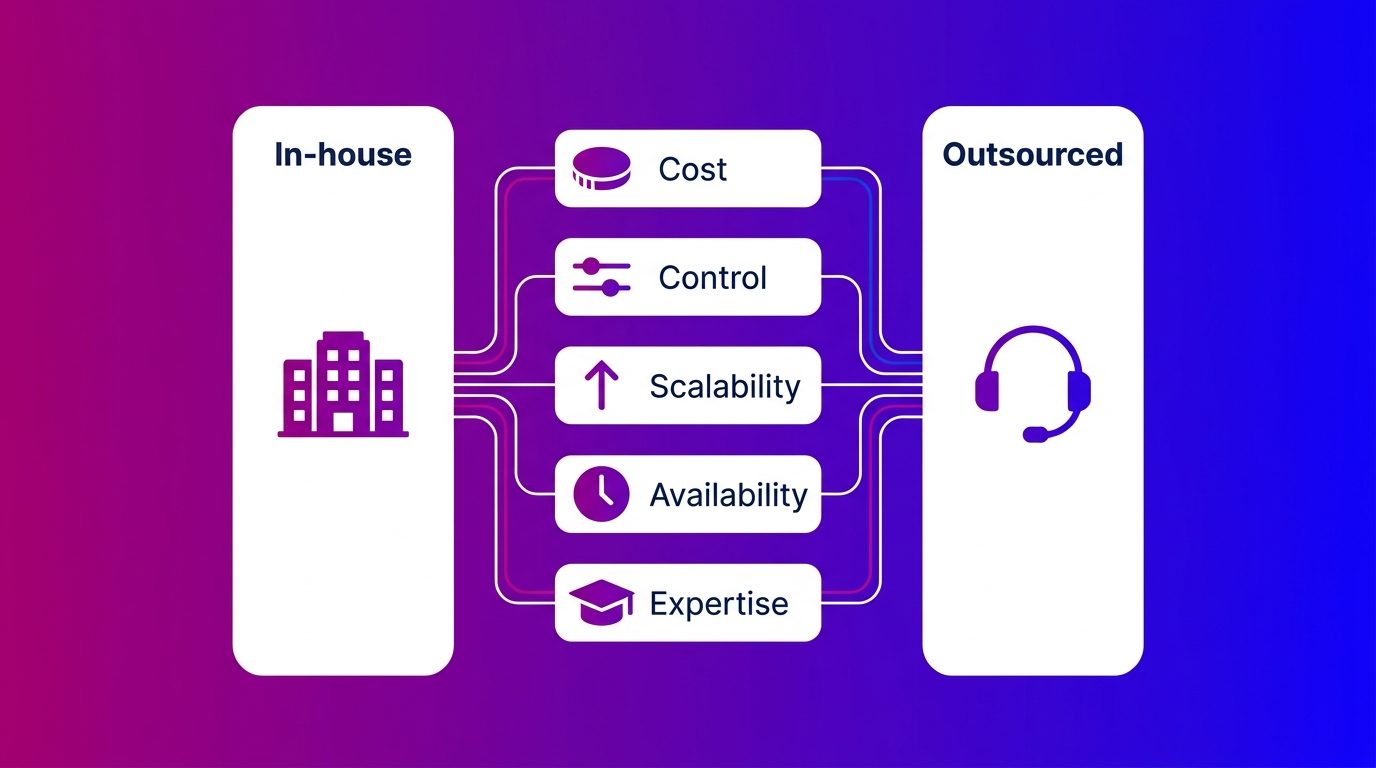
If you look seriously at live chat on your website, you soon run into the same question: do you build your own team or do you go for outsourced live chat? This article compares an external chat service with an in-house team on business criteria rather than gut feeling.
We walk through the main differences in cost, control, scalability, availability and expertise. Each section ends with a short decision aid, so you can make a business decision rather than a hopeful one.
Cost: own team or outsourced
Cost is usually the first difference between an in-house team and outsourced live chat. An in-house chat agent costs more than a gross salary: add employer’s National Insurance, pension contributions, holiday, sickness, recruitment, onboarding, training and time for rostering and management. On top of that come licences for chat software: anyone who only buys software still needs people for good conversations and follow-up.
With outsourced live chat you pay a rate in which staff, software, monitoring and quality control are usually bundled. You have less fixed overhead and the capacity scales: you pay for use instead of for empty hours in quiet periods. A full cost breakdown is in the article on live chat outsourcing cost.
Decision aid on cost. Choose in-house if you already have a well-staffed customer service team with room to add chat. Choose outsourcing if you have no chat capacity of your own, do not want to build it and want to keep fixed staff costs down.
Control and quality
With an in-house chat team you have maximum control over tone, processes and brand experience. You adjust daily, hear directly what is going on and can roll out new scripts or campaigns quickly. Quality is assessed through internal reviews, shadowing and one-to-one coaching.
When you outsource, you depend on your partner, but good providers work with clear reporting, conversation audits and periodic reviews. In practice a specialist partner is often more consistent in process and quality control than an in-house team that does chat on the side, because there is a clear owner.
Decision aid on control and quality. Choose in-house if brand consistency is the absolute priority and you have time for daily management and coaching. Choose outsourcing if you trust a partner with proven quality processes and mainly want to steer on outcomes rather than daily supervision.
Scalability and flexibility
Flexibility is in most cases the clearest advantage of outsourced live chat over an in-house team. A partner can scale up quickly for campaigns, seasonal peaks or promotions, without you having to recruit new staff or sign contracts. Rosters, cover and holiday planning sit outside your organisation.
With an in-house team, scaling up almost always means recruiting and onboarding. That takes weeks to months and carries the risk of overcapacity in quiet periods. Flexibility is especially valuable in sectors such as automotive and home and living, where peaks follow promotions, launches and seasons. The article on which businesses outsource live chat shows per sector how that works in practice.
Decision aid on scalability. Choose in-house if your chat volume is small, stable and predictable. Choose outsourcing if you work with peaks, run campaigns or want to scale up and down quickly without long-term commitments.
Availability and response times
In practice, in-house teams are often limited to office hours. Evening or weekend cover requires separate rosters, unsocial-hours pay and extra management. Chat quickly becomes a side task, which leads to longer waiting times when the phone rings or the showroom fills up.
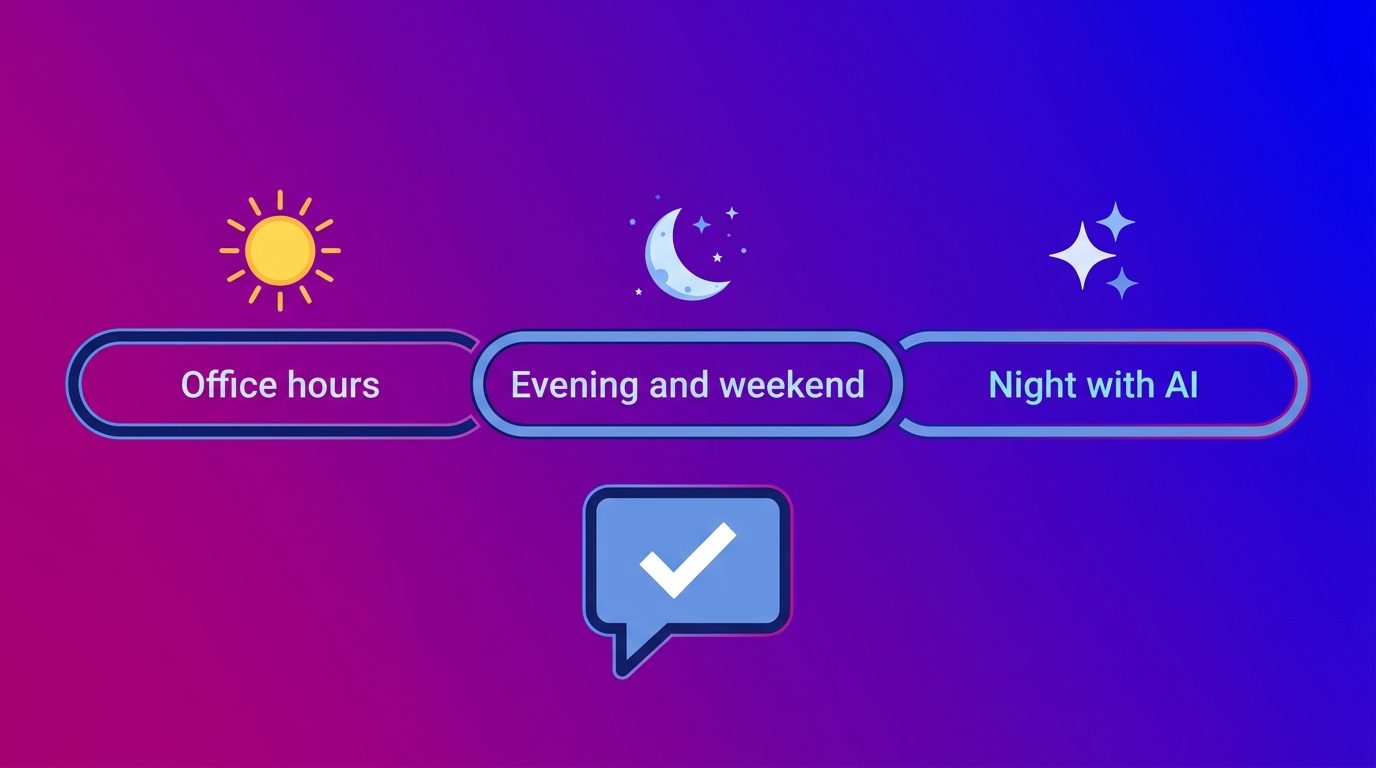
When you outsource, you can agree wider opening hours, including evenings and weekends. Response times are usually better too, because operators are dedicated to chat and do not have to handle other channels in between. If you want maximum cover, availability in the evening, at the weekend and with AI at night is the most far-reaching option: visitors always get an immediate answer, including outside office hours and during holiday periods.
Decision aid on availability. Choose in-house if you mainly need to be available during office hours and chat remains a supporting channel. Choose outsourcing if you want consistently fast response times and longer opening hours without reorganising your own rosters.
Expertise and sector knowledge
An in-house team often knows your products, processes and exceptions in detail. That is an advantage in complex markets with specialist knowledge. At the same time, that team has to build experience in chat: conversation structure, short response times, lead qualification and conversion-focused writing are separate skills.
When you outsource, you work with operators who hold dozens of conversations a day. Their experience lies in conversation technique, customer focus and recognising buying or contact intent. They start with less product knowledge, but that transfers well through clear scripts, a knowledge base and regular updates. The gains that follow, from faster conversion to happier customers, are covered in the article on the benefits of outsourcing live chat.
Decision aid on expertise. Choose in-house if product knowledge is the absolute priority and that knowledge is hard to standardise. Choose outsourcing if conversation skills, scalability and lead generation through chat matter more than answering every niche detail on the spot.
Chat software only, or software with chat specialists?
Chat software alone is enough if your own team can hold the conversations; software with chat specialists fits when that capacity is missing. The software handles the chat window, the inbox and the integrations, but it does not hold conversations.
Software only fits if:
- your own team is available during the hours you want to be reachable
- the number of conversations is manageable
- your staff can ask follow-up questions and qualify a lead
- you accept that chats outside office hours are left waiting
Software with chat specialists fits if:
- your own capacity is missing or fluctuates strongly
- you want to be available in the evening and at the weekend as well
- conversations need to lead to qualified leads in a structured way
- you want to serve several branches or websites from one inbox
What we often see go wrong with software only: chats left waiting because everyone is busy, and leads that come up in a chat but never reach the CRM. How a partnership with an external team runs is explained in what live chat outsourcing is and how it works.
A practical decision model: in-house or outsourced?
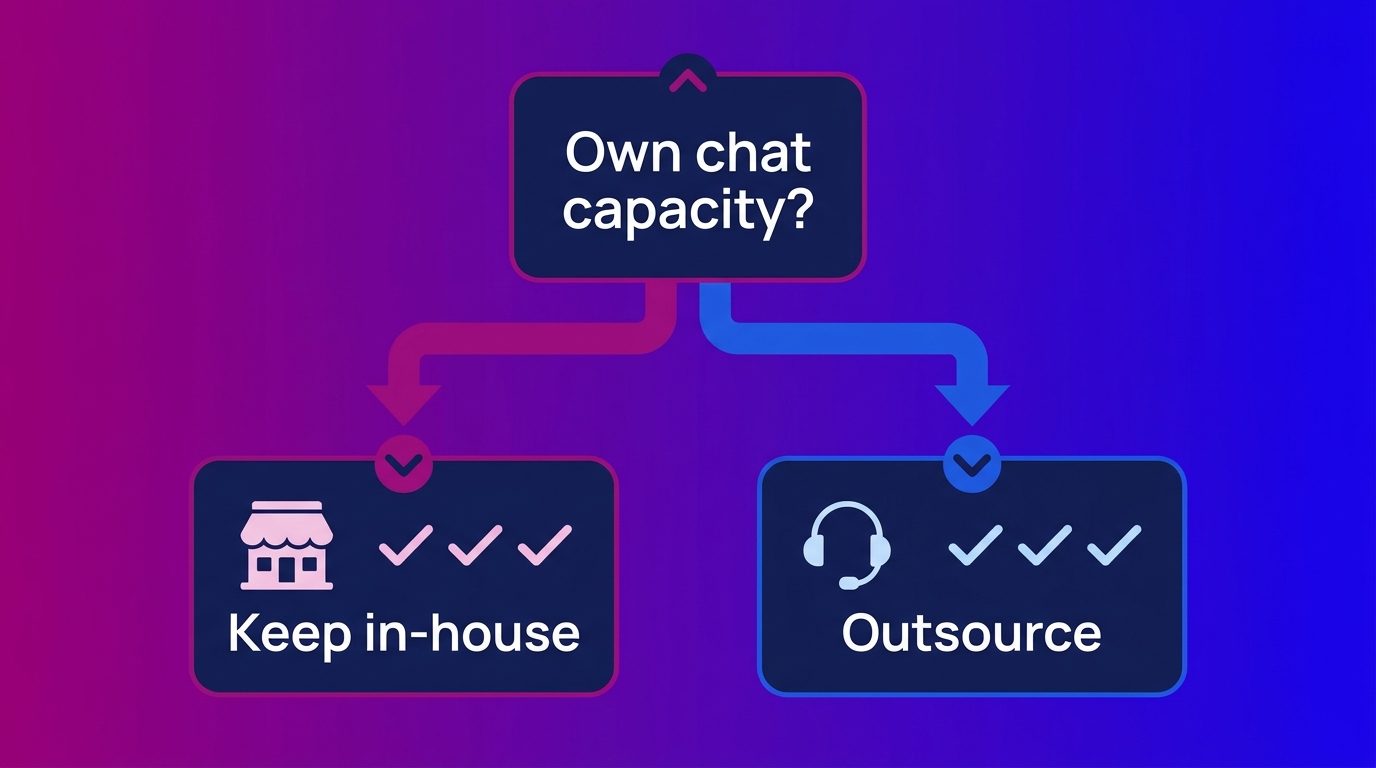
In short, you can decide between in-house and outsourced live chat on a few clear criteria. Use the checklist below as a compact decision model.
Choose in-house management if:
- you already have a customer service team with capacity that is structurally available
- the chat volume is small and stable
- product knowledge is extremely specialist and hard to transfer
Choose outsourced live chat if:
- you have no chat team of your own and do not want to build one
- you want to be available outside office hours, possibly 24/7
- your volume fluctuates or you want to start quickly without a long implementation
- your focus is on scalability and generating leads from existing website traffic
That is also the answer to when outsourcing becomes logical, and why for many small and medium-sized businesses it ends up being more efficient than setting up a team of their own.
How we weigh this up with clients
In our consultations we make that assessment together, and the answer is by no means always to outsource everything. If a business has a team that chats well during the day, we often advise outsourcing only the evening, the weekend and busy moments.
At Bconnect, platform and people work in one process: our chat specialists work in our own platform, supported by AI, and all channels come into one inbox. You choose the balance between people and AI yourself: Operator Assisted AI for advisory conversations, AI First + Human Handoff for high volumes, or AI Only for predictable questions. If you want to know how that would work for your business, read what it means to hand your live chat to an external team.
Frequently asked questions about in-house or outsourced live chat
Why do businesses choose outsourced live chat instead of doing it themselves?
Businesses often choose outsourced live chat for scalability, availability and lower overhead. You do not have to recruit, train and roster your own team, while you benefit from operators who specialise in chat and can start immediately. Time to go-live is short, opening hours are easy to extend and you pay for use rather than for fixed capacity that sometimes sits idle.
What does outsourced live chat cost compared with an in-house employee?
The cost of outsourced live chat usually consists of a rate per conversation, per lead or per period, which includes staff, software and quality control. With an in-house employee you pay the full employer package plus licences for chat software and time for internal management.
When is outsourcing live chat the best choice?
Outsourcing is usually the best choice if you have no chat team of your own, want to start quickly or expect fluctuating volumes. If you land on the outsourcing side on several points of the decision model above, you have a clear answer.
How do I measure whether outsourced live chat is effective?
With clear KPIs: response times, number of conversations, leads or appointments, conversion rates per page and customer satisfaction scores. A good partner provides reporting, conversation audits and insight into improvements. Compare those figures with your commercial goals every period.
What are the disadvantages of outsourcing live chat?
The main disadvantages are less direct control over daily conversations and an extra dependency on an external party. You need to transfer product and process knowledge properly and keep checking that chats match your brand. Outsourcing makes less sense if your service is extremely specialist.
Can you combine an in-house team with an outsourced one?
Yes. Many businesses let their own team chat during the day and bring in the partner for the evening, the weekend or busy moments. That way you keep control of the conversations where you want it.