Most comparisons between live chat providers get stuck on price and package names. Who charges a little more per day, who covers 24/7 and who stops at midnight. Those are real differences, but rarely the differences that decide whether you are still happy a year later. What ultimately makes the value of a live chat outsourcing partner lies underneath the packages: how conversations are really held, how lead criteria are built and adjusted, and what happens when a question becomes more complex than a standard scenario.
This article gives you a framework for assessing providers on the criteria that really matter, with a concrete checklist of questions for your selection meetings at the end. Not a sequential list of must-haves, but a distinction between what is hygiene and where the real difference lies.
What really sets a live chat outsourcing partner apart
Suppose three providers are on your shortlist. All three have English-speaking operators, all claim 24/7 cover, all integrate with your CRM, all are UK GDPR compliant. What still sets them apart?
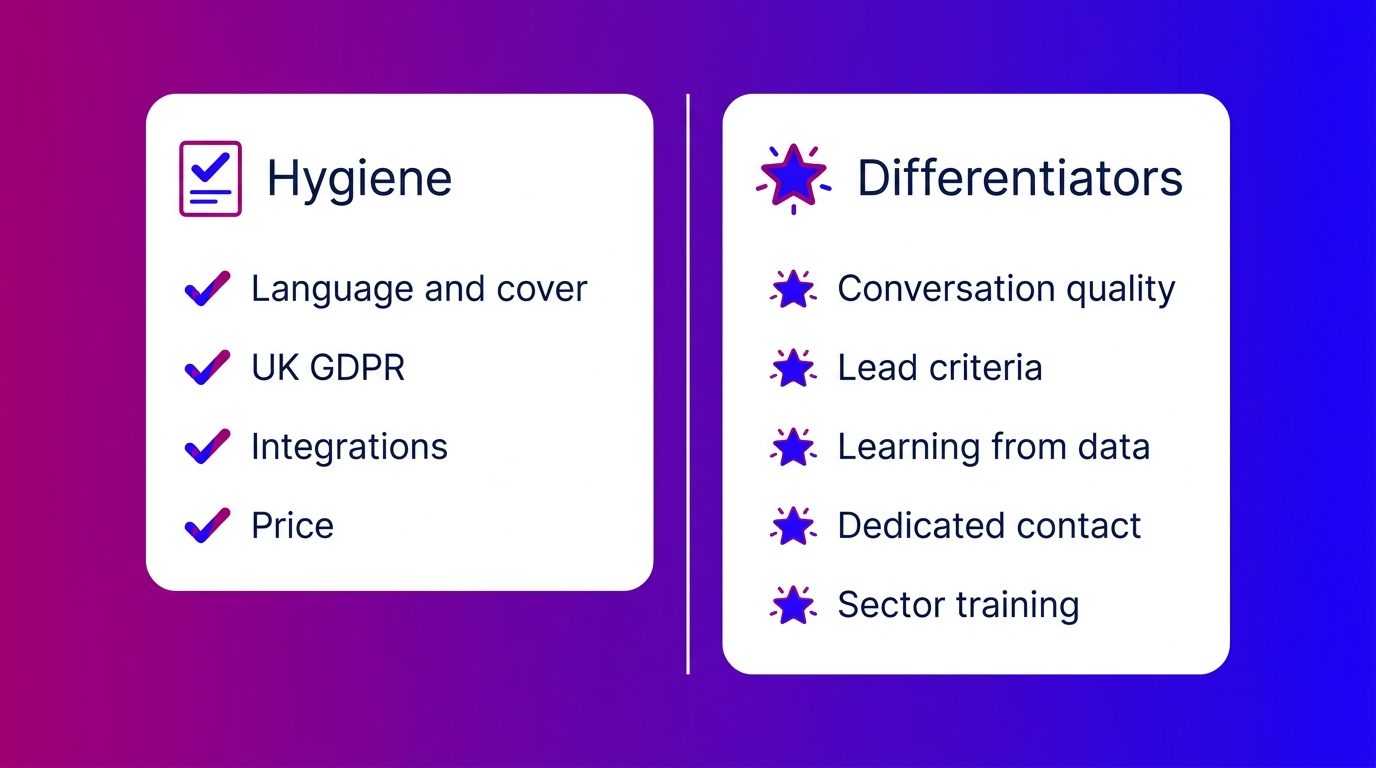
It helps to split criteria into two categories: hygiene and differentiators.
Hygiene is what every serious provider should have. Language, basic cover, UK GDPR compliance, reasonable integration options, a base rate in line with the market. If a provider scores on these, you know it is in the race. It says nothing about how good it is.
Differentiators are the criteria on which your choice actually stands or falls. The quality of the conversation itself. How lead criteria are developed and adjusted based on what turns out to work. How the provider learns from chat data. Who your dedicated contact is after go-live. How operators are trained for your sector.
The rest of this article is largely about the differentiators. You can run through the hygiene in a selection meeting in fifteen minutes. The differentiators take more time to explore, and that is almost always where the decision is made.
Sector experience: why this is the first filter
A chat in automotive plays out differently from a chat in home and living or in property. Someone who asks “what are the monthly payments?” on a used car page is deeper in the funnel than someone who asks “is this still available?”. An operator without a feel for the sector misses that signal and treats both as a general information request. An operator with automotive experience recognises the first question as a potential part-exchange conversation and asks about the current car, the preferred finance option and when they want to be driving.
The same applies to home and living. A question about kitchen dimensions is almost never just a question about dimensions. Behind it are timing (are they renovating), budget (which price range) and often a design conversation that has already started with a competitor. Anyone who has not had these conversations many times does not ask the follow-up questions at the right moments.
This is the first question you should ask every provider: in which sectors are you demonstrably active, which comparable clients do you work with, and how do you train operators on sector differences? Then ask for example chats from your sector, without the client’s name. That is where you see how a conversation really runs.
A practical point: providers that work with permanent operators who chat for several clients in the same sectors build pattern recognition faster than providers with changing or cross-sector staffing. At Bconnect, for example, operators work for several clients in the same sectors, which means they hold hundreds of conversations a day in comparable environments. Not just for one client.
Who actually holds the conversations?
There are three models you will encounter in the market: permanent operators employed by the provider, a pool of freelancers who work on demand, or a fully offshore team. Each model has consequences for consistency, language and sector knowledge.
Employment usually means fixed training, a longer attachment to the same clients and knowledge that stays in the team. Freelance usually means flexible capacity, but changing faces and knowledge that disappears with the operators. An offshore team can offer a cost advantage, but with written English and sector finesse it quickly runs into limits. The benefits of outsourcing live chat evaporate quickly if that quality base is missing.
The questions you want to ask here go deeper than “do you work with trained operators”:
- Are the operators employed by you, or do you work with freelancers?
- How long does an operator work for you on average?
- How much training do they get, and how often?
- How many clients does one operator serve at the same time?
- Which languages do they work in, and at what level?
Ask for example chats as well. Flawless written English, an appropriate tone, no typos in product names, no woolly phrasing. These are not extras, this is hygiene at conversation level. At Bconnect, for example, operators are employed by us, get weekly training and coaching, and serve several clients at the same time in the same sectors. That is one way of meeting the criteria above, not the only way.
Software and integrations: ask beyond “yes, we can do that”
Almost every provider claims broad integration options. “We integrate with all common CRM systems” is a standard line in sales conversations. The difference lies in what counts as a standard integration versus what becomes a custom project, and who bears the maintenance cost. Behind every provider there is also a software choice that determines what is technically possible.
Questions that help you see through this claim:
- Which platform of your own do you use to manage chats?
- What exactly is a standard integration, and what counts as custom work?
- How are leads passed on: via API, webhook, email or manually?
- What happens to the integration if we update our CRM?
- Which integrations are specifically important for our sector?
For automotive, dealer management system integrations are often decisive. For retail it is about product feeds and order data. For estate agents it is property data from the listings system. A provider that cannot show these integrations as existing work will not deliver them from a drawer.
A nuance that is easily overlooked: integrations are useful, but not always required to start. Where integrations are missing, leads can also arrive by email or via the provider’s support system. That works as a starting point and gives you time to make the integration choices properly. At Bconnect, our platform connects via API, webhooks and Zapier, as set out on our integrations page. But even without an integration you can go live: leads then come in by email or through the support system.
Reporting: figures you can actually use
Every provider has a dashboard. Number of chats, number of leads, average conversation time. For some providers it stops there. That is not reporting, that is reporting cosmetics.
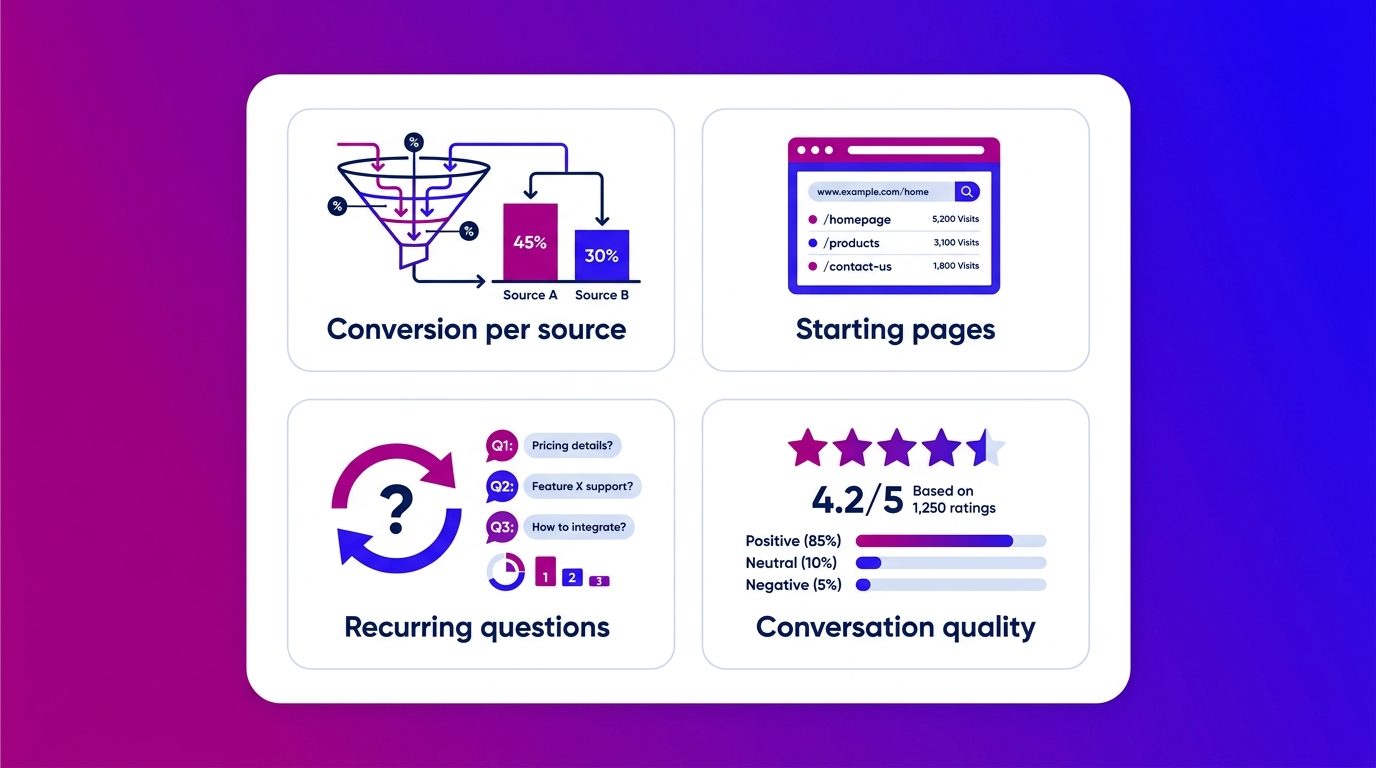
Useful reporting gives you insight into four things you cannot get from your own analytics:
- Conversion rate per source or campaign (which ad led to which leads via chat).
- On which pages most conversations start and which of those convert.
- Which questions keep coming back, as input for your website FAQ and product pages.
- Indicators of conversation quality, not just quantity.
Ask concretely whether you can look at the dashboard live or whether you get a weekly report. Whether your marketing attribution model connects to the chat data. Whether you get insight into where conversations drop out before they lead to a lead. A provider that only answers “we send a monthly report” offers reporting as an obligation, not as an instrument.
An underrated part of reporting is topic analysis. Which subjects keep coming up in conversations, and what does that say about your website, your purchasing policy or the information needs of visitors? At Bconnect, Bconnect Analytics provides these topic analyses based on the chat data, which also gives input for website improvements and commercial decisions beyond chat.
Cover and flexibility: can you scale up without renegotiating?
Two dimensions to assess providers on: cover (when is someone there) and flexibility (what if the volume doubles).
On cover, it is about operator hours, weekend arrangements, pick-up time and how 24/7 cover is filled. Not every provider that says “24/7” means human cover. Often it is a combination of people during the day and AI at night, which can work well but has to be clear. Ask specifically: until what time are there human operators, how is the weekend staffed, what is your average pick-up time?
On flexibility, it is about what happens with volume fluctuations. Can you scale up temporarily during a campaign without a contract change? What happens if your chat volume doubles in six months? How do you handle unexpected peaks after a TV campaign or a product launch?
A red flag in these conversations is the provider that only works with fixed monthly capacity blocks without flexibility. That works until your marketing does something new. At Bconnect, human operators are available from 08:00 to 23:30 seven days a week (weekends included as standard), with AI Sales and Service Agents 24/7. Mixed set-ups are common as well: AI during office hours as a top layer, or human cover during the day with AI at night. Pick-up time for human chat averages under 20 seconds.
How is the knowledge base built? This is where providers part ways
This is perhaps the most important differentiator in this whole list, and at the same time the one that comes up least in selection meetings. Yet it largely determines whether you are satisfied six months from now.
There are two models in the market:
Model A: you fill in a knowledge base, scripts and lead criteria yourself, and the provider uses them. This seems attractive because you have control, but in practice it means months of your own marketing and operations time to get everything written out. And after go-live you are responsible for keeping it up to date. This is one of the disadvantages of outsourcing live chat that rarely comes up in selection meetings.
Model B: the provider collects information from you, structures it and builds the scripts, answers and qualification logic itself. You validate and adjust. This costs you less time in onboarding, and knowledge extensions after go-live happen in consultation rather than one-sidedly.
The questions that show the difference here: how long does onboarding take until go-live, who writes the scripts and qualification logic, how many hours does this cost on our side, how are FAQ questions collected that we had not yet thought of ourselves, how does adjustment after go-live work?
A good provider can show you in the first week after go-live which questions were asked that were not in the original knowledge base, and how they were handled. That is not an optional extra, that is how a chat service really learns. At Bconnect the client-specific knowledge base is built together with the client: collecting information, organising it, building scripts and qualification logic. AI Sales Agents are typically live within two to three weeks, chat specialists within a week to a month depending on complexity. After onboarding there is a dedicated account manager for ongoing optimisation of scripts and lead criteria.
Contract and notice periods: what does it say if it disappoints?
Four things to read through before you sign: contract length and any automatic renewal, notice period, pricing model, and what happens if volumes structurally deviate from what was agreed.
The pricing model itself is a directional choice with consequences:
- Fixed monthly fee: predictable, but you also pay when results are poor.
- Per chat: you pay by volume, but there is no incentive for lead quality.
- Per lead: results-driven, but it fluctuates strongly and can become expensive when chat quality is good.
- Hybrid: base rate plus a lead component, combining predictability with a link to results.
A specific point to tackle up front is what exactly a “lead” is. That is often where friction arises later. Ask for a written definition with clear criteria: which details as a minimum, which intention, which qualification steps. The more of this is fixed in advance, the fewer discussions afterwards.
Also ask what makes a trial or pilot possible. Some providers offer this from certain volumes. At Bconnect a free demo of 20 to 30 minutes is standard, and a free trial period is possible from around 20,000 visitors a month. Below 5,000 visitors a month a chat service is generally not profitable; a trial makes little sense there either.
References: look beyond the logos on the website
A logo overview on a provider’s website is not a reference. Ask for two or three clients in the same sector as you, and speak to them yourself.
Good questions for references:
- How long have you worked together, and how has that partnership changed?
- What was the onboarding experience, and what would you do differently now?
- How are feedback and changes handled?
- How well does the chat connect to the rest of your commercial process?
- Is there anything you run into that you had not foreseen?
Online reviews are of limited use in this sector. The volume is low and the variation large. Trends in reviews can signal where problems are structural, but individual reviews are usually too thin to build on.
A tip that often delivers more in practice than the standard reference: ask specifically for a client where the partnership started less smoothly. How a provider dealt with that says more about how your partnership will go when something goes wrong than a smooth case where everything was right from the start.
The ten questions for your selection meeting
Distilled from all the criteria above: the ten questions you should ask every provider before you sign.
- In which sectors are you demonstrably active, and can you show example chats in our sector?
- Are your operators employed by you, and how much training and coaching do they get?
- Which platform of your own do you use, and what is a standard integration versus custom work?
- How is the client-specific knowledge base built: do we do that ourselves or do you do it with us?
- How long does onboarding take from first conversation to go-live?
- What is your pick-up time, and how is 24/7 cover arranged (people, AI or a mix)?
- Can I look at the reporting dashboard live, and which metrics does it contain?
- How exactly is a “lead” defined in your agreements?
- What are your contract length, notice period and flexibility with volume changes?
- Can you give references from two clients in our sector, including one where the start was harder?
A choice you do not make on one criterion
You do not choose the right partner on who is cheapest, who has the nicest package names or who has the highest online profile. The combination of sector experience, operator quality, knowledge base construction and contractual flexibility determines whether you look back satisfied a year from now. If you are still choosing between providers, the overview page everything about live chat outsourcing has the in-depth articles per sub-topic.
Ask for a demo, ask for example chats from your sector, speak to two references yourself, and let a provider show you how it handles objections before you are a client. That is your best predictor of how it will handle problems once you are. If you are considering working with Bconnect’s chat specialists, it helps to have these criteria ready before you start talking to providers.
Frequently asked questions about choosing a live chat outsourcing partner
What is the difference between a live chat provider and a live chat outsourcing partner?
A provider primarily sells capacity: operators, hours, leads. A partner also thinks along about how the chat performs: scripts, lead criteria, ongoing optimisation. Not every provider is a partner. The question to ask yourself up front: am I looking for extra hands or for thinking power? For a simple cover need a provider is enough. For commercial results over the longer term you need a partner.
How long does it take before a live chat service is live on my website?
That depends on complexity and on who does the work. A simple set-up can be done within a week, more complex set-ups take a few weeks to a month. At Bconnect an AI Sales Agent is typically live within two to three weeks, chat specialists within a week to a month depending on complexity. Ask each provider specifically about the onboarding timeline, because they define “live” differently.
What does live chat outsourcing cost per month on average?
That depends heavily on volume, cover and pricing model. At Bconnect you get one proposal after a 30-minute consultation with the approach, the expected costs and what is included. Ask every provider for a worked-out business case based on your expected traffic and conversation volume.
Can I run a trial period before I sign?
A free demo is standard with most providers. At Bconnect it takes around twenty to thirty minutes and is completely without obligation. A free trial period is rarer and depends on volume and sector. At Bconnect a trial period is possible from around 20,000 visitors a month. Below 5,000 visitors a month a chat service is generally not profitable and a trial is not useful either.
What if I want to switch to another party later?
Notice periods and switching conditions vary widely per provider. Important to check up front: the contractual notice period, ownership of chat data, exportability of leads and transcripts, and how the client-specific knowledge base is transferred or destroyed. Not every provider is transparent about this, so put these questions explicitly on your selection list before you sign.
How do I assess the quality of a provider’s conversations before signing?
Ask for example chats from your sector without client names, and look at how follow-up questions are asked, how buying signals are handled and how the conversation ends. Then speak to two references yourself, including one where the start was harder.