A showroom website with plenty of visitors and few quote requests is the rule rather than the exception in home and living. The short answer to how you get more quote requests: answer the questions visitors have before they want a quote, at the moment they ask them. Someone looking for a kitchen, new windows or a bathroom first wants to know whether it will fit, when it can be done and roughly what it costs. Only then do they request a quote or plan a visit to your showroom.
Why your showroom website brings in few quote requests
The threshold to a quote is high in home and living, because the products are expensive, made to measure and hard to compare. A visitor who is about to spend a significant sum does not simply fill in a form. They want certainty about a few things first.
Most websites in the sector leak in three places:
- The form is the only route. Anyone who is still unsure has nowhere to put a small question. A quote form feels like a commitment.
- Answers are missing. Lead times, colours and bespoke options are nowhere to be found, or buried deep in a PDF.
- Nobody responds outside opening hours. It is precisely in the evening and at the weekend that people research a renovation, while the showroom is closed.
The result is that visitors with real interest leave without a trace. How to get more enquiries from your website in general is covered in the article on website lead generation. This article is about what is specific to showrooms.
What visitors want to know before they request a quote
Visitors almost always ask about the practical side first: is it possible, when can it be done and does it suit me. In the conversations our chat specialists at Bconnect handle for home and living businesses, the same questions come up again and again:
- Is this model also available in another colour?
- What is the lead time?
- Do you also do bespoke work?
- What is the difference between a pivot door and a hinged door?
- What insulates best?
- What kind of glazing do you use?
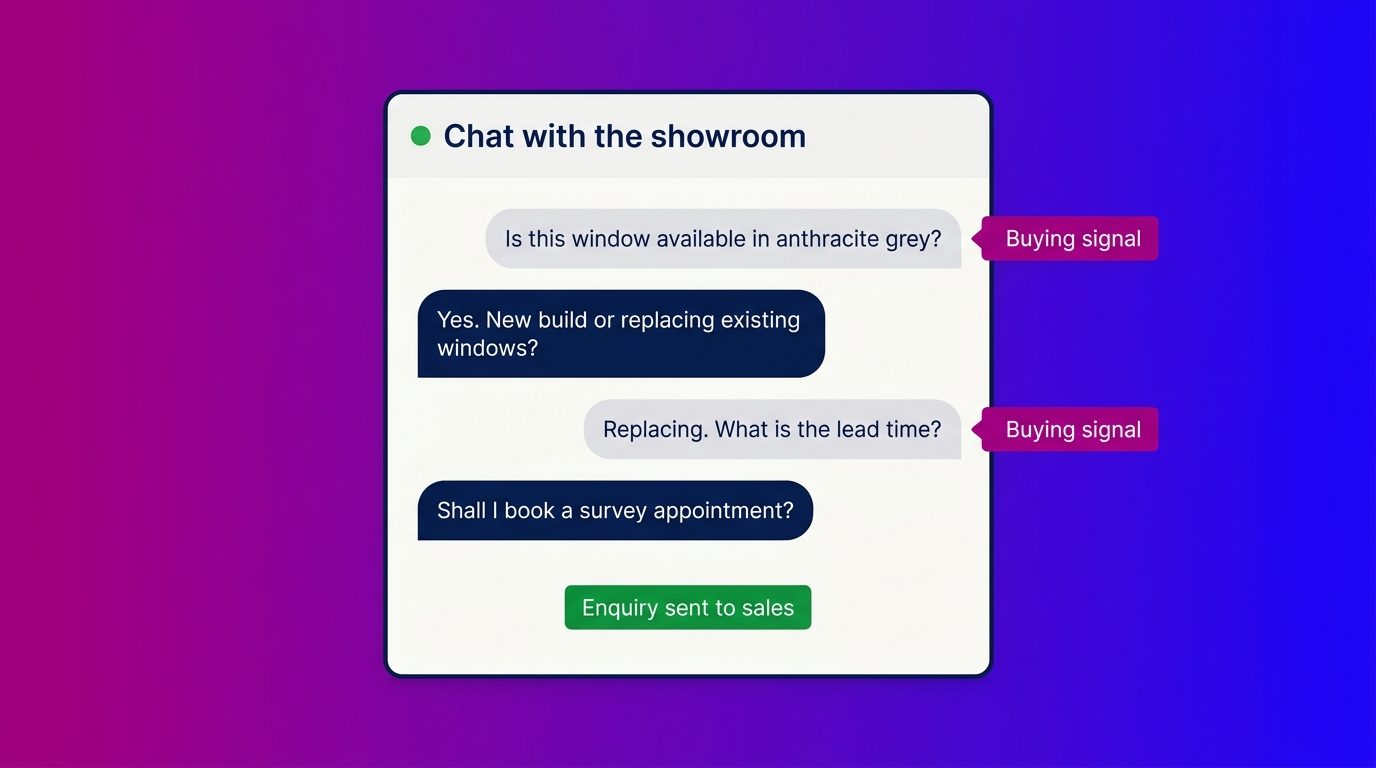
These are not isolated service questions. Someone who asks whether a window frame is available in anthracite grey already has a colour in mind and is actively comparing. Someone who asks about lead times has a schedule. Every question is a buying signal, and the answer decides whether the visitor takes the next step.
So put the five questions you are asked most often visibly on your product pages, with a short answer. And give visitors a way to ask the questions that are not there.
Do you sell windows and doors? Which questions window buyers ask and how to turn them into enquiries is covered in the article on leads for window companies.
Do you run a kitchen showroom? Which questions kitchen buyers ask and how to turn them into a design appointment is covered in the article on more kitchen leads.
How to make the step to a quote smaller
A smaller step brings in more quote requests than a better quote. You want a visitor to get in touch without much effort, even if they are not yet ready for a quote.
- Keep the quote form short. Only ask what you need for a first contact: name, contact details and what it is about. Measurements and details come later. Research from Google Research, among others, shows that forms improved according to fixed guidelines are completed faster and need to be resubmitted less often.
- Give a price indication. A from-price or a price range per type of product removes a lot of doubt. Visitors want to know whether they are in the right ballpark.
- Let visitors book an appointment themselves. A button to book a showroom visit straight away works for people who already know what they want.
- Put a conversation next to the form. Anyone who still has a question would rather send a chat or WhatsApp message than fill in a form. A chat on your showroom website catches that group.
That way you serve three kinds of visitor at once: those who are ready fill in the form, those who want to look book an appointment, and those who are unsure ask a question first.
Do you make staircases, window coverings or flooring to measure? There, a photo via chat or WhatsApp is often the first step. How to turn that into a consultation at home is covered in the article on more leads for bespoke businesses.
From a question in the chat to a showroom appointment
A question in the chat is the start of a quote request, provided you answer it well and then suggest the next step. In practice a conversation often goes like this:
- The visitor asks a product question. For example whether a kitchen is also available with a worktop in another colour.
- You answer the question straight away. Without asking for details first. That builds trust.
- You ask about their situation. Is it a new build or a renovation, and when does it need to be finished?
- You suggest a suitable next step. A showroom appointment, a survey appointment or a tailored quote.
- You pass on the enquiry with the full conversation. That way the salesperson does not have to ask again what the customer has already said.
The order matters. Ask for a phone number in the first sentence and you lose the people who are unsure. Help first, then ask for contact details.
With bathrooms there are usually two appointments: the design consultation in the showroom and the survey at home. How to work towards that from the chat is covered in the article on more bathroom leads.
More showroom visitors through your website
More visitors in your showroom starts with how easy you are to find and visit online. Someone looking for a kitchen showroom or window company nearby looks on Google first.
- Keep your Google Business Profile up to date. Opening hours, photos of the showroom and a link to book an appointment. Respond to reviews as well.
- Create a page for each showroom location. With the address, opening hours, parking and what there is to see.
- Make the difference between dropping in and booking clear. Do people need an appointment for advice, or can they just walk in? Visitors want to know that in advance.
- Be reachable when the showroom is closed. A visitor who asks a question on Sunday evening and gets an answer on Monday has often already been to a competitor.
Follow up quote requests quickly
A quote request is worth most in the first hours after it comes in. After that the customer carries on comparing and requests quotes from others too. So agree who picks up enquiries and within what time.
Pass on the enquiry with everything that is already known: which product, which measurements or colour, the timing and any questions. Then the salesperson can respond on substance straight away. A way of working for fast follow-up is in the article on lead follow-up. If you are considering buying enquiries instead of generating them yourself, first read the trade-offs of buying leads.
How a question about lead times ends in an appointment
A large share of quote requests in home and living starts with a small question. At Bconnect, a Dutch specialist in AI-driven customer contact, our chat specialists and AI handle these conversations for home and living businesses, including in the evening and at the weekend. A visitor asks about the lead time of a window, gets an answer, mentions that the renovation starts in spring and books a survey appointment at the end of the conversation.
What we see in those conversations: visitors who get a quick and concrete answer are far more willing to share their details. The sales team receives the enquiry with the full conversation attached, so it can carry on straight away. How that works for kitchen showrooms, window companies and bathroom showrooms is explained on the page about enquiries through chat for showrooms.
Start with the questions you already get
More quote requests rarely come from more traffic alone. They come from visitors who are now left with a question and leave. Look at which questions customers ask most often in the showroom and on the phone, put the answers on your website and offer a way to ask the rest. Keep the form short, let visitors book an appointment and follow up enquiries the same day.
Frequently asked questions about getting more quote requests
How do I get more quote requests through my website?
Answer the questions visitors have before they want a quote, such as lead times, colours and bespoke options. Keep the quote form short and offer a chat or WhatsApp next to the form for anyone who has a question first. Follow up enquiries the same day.
How do I get more customers into my showroom?
Make sure your showroom is easy to find online, with an up-to-date Google Business Profile and a page for each location. Let visitors book an appointment themselves and stay reachable when the showroom is closed.
What should a quote form ask for?
Only what you need for the first contact: name, phone number or email address and what the enquiry is about. Ask for measurements and details later, in the conversation or at the survey.
Should you put prices on your website?
A price indication almost always helps. A from-price or a price range per type of product shows visitors whether they are in the right ballpark, without committing you to a quote.
How quickly should you respond to a quote request?
Ideally the same day, and straight away for a question in the chat. The longer an enquiry is left, the greater the chance that the customer has already requested a quote from another company.
Does live chat work for a showroom?
Yes, especially for visitors who are still unsure. They would rather ask a short question in the chat than fill in a quote form. That conversation often leads to a showroom appointment or a quote request.