More kitchen leads come from the visitors who are already on your website: answer their questions about worktops, appliances, lead times and price at the moment they ask them, and turn that conversation into a design appointment in your showroom. A kitchen is a purchase people spend months on. They look at your kitchens online, often together in the evening, and the showroom that answers then gets the appointment. That applies to an independent kitchen showroom just as much as to a chain with several showrooms.
Why your kitchen website brings in few enquiries
A kitchen website brings in few enquiries if visitors can only choose between booking a showroom visit or leaving. Someone still unsure about a worktop or a budget does not book an appointment. That visitor wants an answer first.
The three leaks we see most often at kitchen showrooms:
- The appointment button is the only way in. A long design consultation is a big step for someone who has only just started looking.
- The price question goes unanswered. Kitchens rarely have a price on the site. The visitor does not know whether you are the right fit and carries on searching.
- Research happens outside opening hours. A kitchen is something you choose together, at the kitchen table, after dinner. Your showroom is closed by then.
What you can do in general to get visitors into your showroom is covered in the article on more quote requests for your showroom. Below is what is specific to kitchens.
What a kitchen lead is worth
A kitchen lead is worth a lot, because a kitchen is one of the biggest purchases in a home and the customer often buys appliances, fitting and sometimes flooring from you too. That is why it pays not to let any visitor with a serious question leave.
Work it out with the formula from the article on cost per lead: margin per kitchen sold multiplied by the share of leads that become customers. Suppose a kitchen sold earns you £3,000 in margin and one in four design appointments becomes an order; then every design appointment is worth £750. A visitor who leaves in the evening with an unanswered question about a worktop costs you money, even if you never see it.
Buy leads or generate your own?
In the kitchen sector too, leads are bought through comparison sites and quote platforms. That brings in enquiries quickly, but the same enquiry often goes to several kitchen companies at once, so you mainly compete on price. Enquiries through your own website belong to you alone and come from people who have already seen your kitchens. The trade-off between the two routes is covered in the article on buying leads.
What kitchen buyers want to know
Kitchen buyers first want to know whether a kitchen suits their home, the way they cook and their budget. More research than ever happens online, but people want to feel materials, colours and textures in the showroom. And they ask more about materials before they come in.
Our chat specialists at Bconnect see that in the conversations they handle for home and living businesses. The questions that keep coming back:
- Is this worktop available in another colour, and what is the difference between quartz and ceramic?
- Which integrated appliances are included, and can I choose another brand?
- What is the lead time, and do you do the fitting yourselves?
- Roughly what does a kitchen like this cost?
- Do you do bespoke work, for example for a sloping wall or a kitchen island?
- How energy-efficient is the dishwasher or the fridge?
Every question is a buying signal. Someone asking about the dishwasher is already thinking about the layout. That question can be answered too: fridges, freezers and dishwashers carry an energy label from A to G, where A is the most efficient. A visitor who hears that in the chat feels helped and stays.
Put the answers to the questions you get most often on your product pages, including an honest from-price per kitchen range. And make sure the rest can be asked in a conversation.
Answer first, then the design appointment
Give a kitchen buyer an answer first and only then suggest the design appointment. The kitchen trade has a reputation for sales pressure. Repeat that online, with a pop-up that immediately asks for an appointment, and you drive visitors away.
The order that works in our conversations is different. First answer the question, then ask about the situation (new build or renovation, when the kitchen needs to be in, how many people cook), and only then suggest the design appointment as the logical next step. The visitor experiences that as help, not as selling.
Form, chat or WhatsApp: which route works for kitchens?
Offer a separate contact route for each phase, because a kitchen buyer who has only just started looking needs something different from one who already has a drawing.
- An appointment form for people ready for the design consultation. Keep it short: name, contact details, preferred date and whether it is a new build or an existing kitchen.
- Chat on the website for people who are still comparing. This is where the questions about worktops, appliances and price come in.
- WhatsApp for people who want to send a photo or floor plan of their current kitchen. A photo of the room says more than a form, and the designer can start working with it at the appointment.
It must be possible to book a design appointment in the showroom from every route. With kitchens, that is the step where the sale really begins.
Chat, AI or outsourcing?
You can staff the chat yourself, use an AI chatbot or outsource the conversations. Staffing it yourself works as long as there is a salesperson in the showroom, but during the day they are with customers and in the evening the showroom is closed. An AI chatbot for kitchen showrooms then answers the standard questions about materials, appliances and lead times and records the first details. For a price question about a specific design, or when in doubt, a person needs to take over.
Want to hand over the conversation completely, including evenings and weekends? Then read how live chat for kitchen showrooms works. How the same approach works for windows and doors is covered in the article on leads for window companies.
Unsure whether to do it yourself, use an AI chatbot or outsource? The trade-offs per option are covered in the article on outsourcing customer contact in home and living.
Do you sell bathrooms as well as kitchens? Which questions bathroom buyers ask and which marketing works there is covered in the article on more bathroom leads.
How an evening question about a worktop becomes a design appointment
The difference lies in the hours in which someone gets an answer. At Bconnect, a Dutch specialist in AI-driven customer contact, our chat specialists and AI handle the conversations for home and living businesses, seven days a week from early morning until late in the evening, and the AI outside those hours too. The chat specialists are trained on the sector and search the kitchen showroom’s own website, so they can answer questions about a specific kitchen range or worktop.
In practice such a conversation often looks like this:
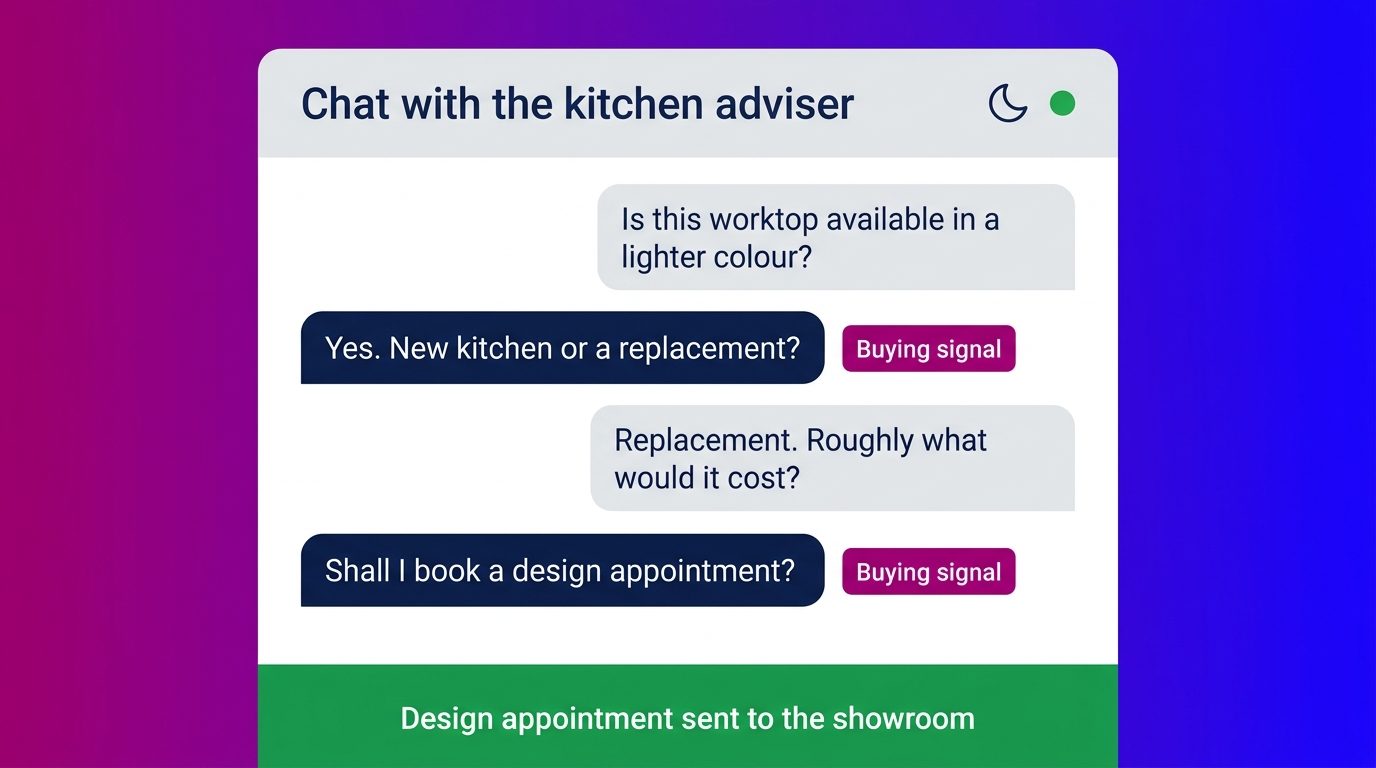
The showroom receives the enquiry with the full conversation attached, so the designer already knows which worktop, which appliances and which budget have been discussed when the customer arrives.
From design appointment to quote
A kitchen lead only becomes a customer if the design appointment is booked quickly and well prepared. Ideally book the appointment during the conversation itself, and send a confirmation with the date, time, the designer’s name and what the customer can bring, such as measurements or a floor plan.
Give the designer everything that has already been discussed: style, worktop, appliances, timing and budget. Then the customer does not have to repeat anything and the design can head in the right direction straight away. A way of working for fast follow-up is in the article on lead follow-up.
More kitchen leads are in the questions visitors already ask
As a kitchen showroom you get more leads from the visitors who already come to your website. Answer their questions about worktops, appliances, lead times and price, offer chat and WhatsApp next to the appointment button, and be reachable on the evenings when people choose their kitchen. Answer first, then suggest the design appointment and prepare it well.
Frequently asked questions about getting more kitchen leads
How do I get more kitchen leads?
Get more enquiries from the visitors who already come to your website. Answer their questions about worktops, appliances, lead times and price, offer a chat or WhatsApp next to the appointment button and be reachable in the evening too. Then suggest a design appointment in the showroom.
What is a kitchen lead worth?
Multiply the margin per kitchen sold by the share of leads that become customers. Because a kitchen is a big purchase and customers often buy appliances and fitting too, a good kitchen lead is usually worth a lot.
Should I buy leads for my kitchen showroom?
Bought leads bring in enquiries quickly, but they are often shared with other kitchen companies, so you mainly compete on price. Enquiries through your own website belong to you alone. Compare the cost per kitchen sold for both routes before you choose.
Which questions do kitchen buyers ask most often?
Questions about worktop materials and colours, about integrated appliances and energy labels, about lead times and fitting, about bespoke options and about roughly what a kitchen costs. Put the answers on your website and make sure the rest can be asked in a conversation.
Should I put kitchen prices on my website?
A from-price per kitchen range helps. Visitors want to know whether you are the right fit before they book an appointment. The exact price depends on the layout, worktop and appliances and belongs in the design consultation.
Does live chat work for a kitchen showroom?
Yes, especially for visitors who are still comparing. They would rather ask a short question in the chat than book a long design consultation straight away. That conversation often still leads to a design appointment.
How quickly should you follow up a kitchen enquiry?
Ideally the same day, and straight away for a chat question. Kitchen buyers usually visit several showrooms. Whoever suggests a design appointment first and prepares it well has a head start.